

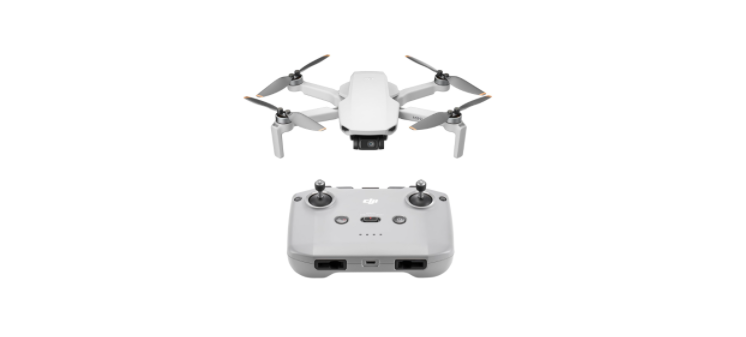
 DJI Mini 4K Fly More Combo 4K UHD Camera Drone
Introduction
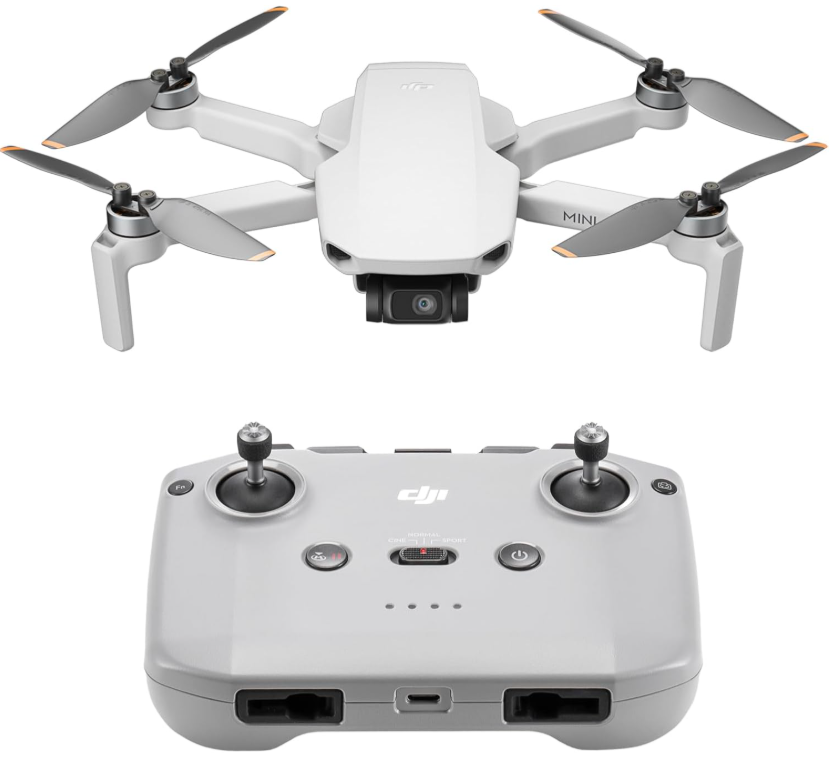
DJI Mini 4K boasts a foldable design and an ultralight weight of 246 g. Featuring a Downward Vision System and Infrared Sensing System, Dul Mini 4K can hover and fly indoors as well as outdoors and automatically initiate Return to Home (RTH). With a fully stabilized 3-axis gimbal and 1/2.3″ sensor camera, DUl Mini 4K shoots 4K video and 12MP photos. The aircraft has a maximum flight speed of 36 mph (57.6 kph) and a maximum flight time of 31 minutes.
Safety Instructions
- Small parts, such as cables and straps, are dangerous if swallowed.
- Keep all parts out of reach of children and animals.
- Never store in environments outside the temperature range of -10° to 45° C (14° to 113° F).
- DO NOT allow the camera to come into contact with or become immersed in water or other liquids.
- Turning on an aircraft that has fallen into water may cause permanent component damage.
- DO NOT store the camera in humid or dusty areas.
- DO NOT connect this product to any USB interface that is older than version 3.0.
- DO NOT connect this product to any “power USB” or similar devices.
- Check every part of the aircraft after any crash or violent impact.
- If you have any problems or questions, please contact a Dul authorized dealer.
- Regularly check the Battery Level Indicators to see the current battery level and overall battery life.
- Make sure to transport the aircraft with the arms folded when powered off.
- The battery will enter sleep mode after long-term storage. Charge the battery to exit sleep mode.
- Store the aircraft, remote controller, battery, and battery charging hub in dry environments.
- Do not use any cleanser that contains alcohol.
- Recommended storage temperature: between 22° and 28° C (71° and 82° F) for storage periods of more than three months.
Accessories
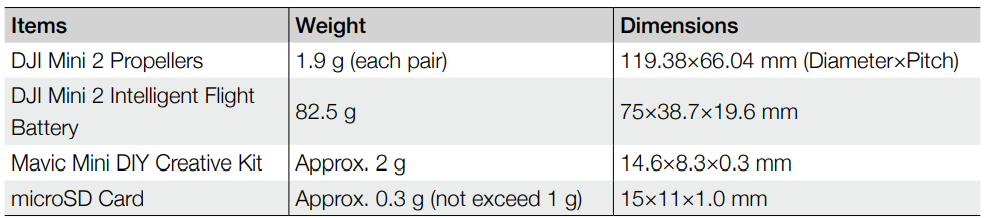
Replacement Parts
- DJi Mini 2 Propellers
- Dul Mini 2 Intelligent Flight Battery
MTOM Statement
DUl Mini 4K (Model MTSD) is a quartor aircraft. The Maximum Take-Off Mass (MTOM) is 246 g, including a microSD card. Please follow the instructions below to ensure flight safety.
- Do not add any payload to the aircraft not included in the original packaging or is not qualified for use on the aircraft.
- Do not use non-qualified replacement parts, such as propellers, intelligent flight batteries, etc.
- Do not retrofit the aircraft.
Preparing the Aircraft
All aircraft arms are folded before the aircraft is packaged. Follow the steps below to unfold the aircraft.
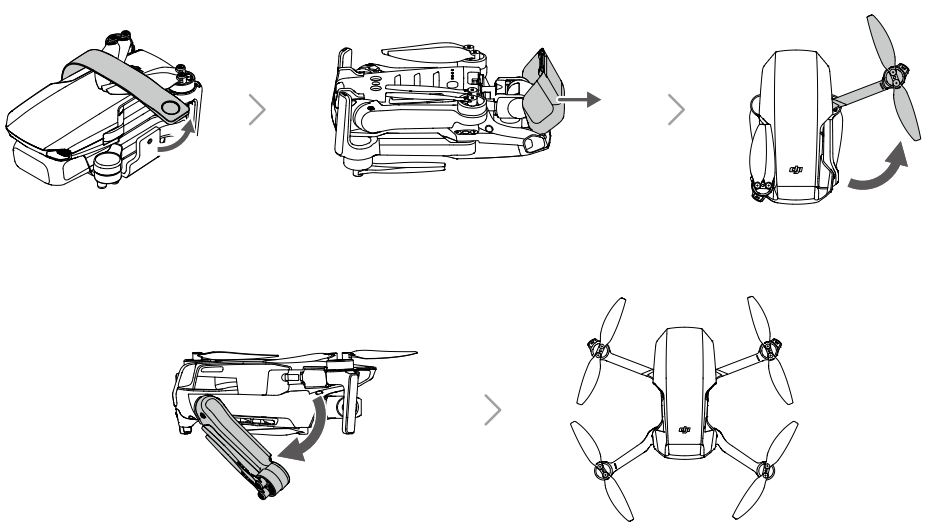
- Remove the propeller holder.
- Remove the gimbal protector from the camera.
- In the following order. unfold the front arms, rear arms. and all the propellers.
- All Intelligent Flight Batteries are in hibernation mode before shipment to ensure safety.
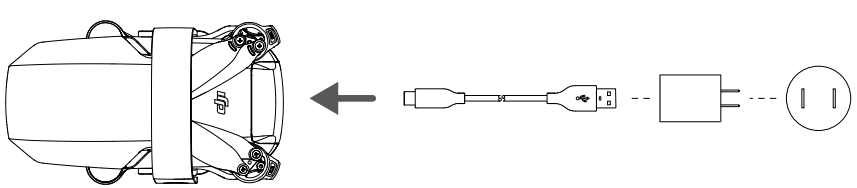
- Use the USB charger to charge and activate Intelligent Flight Batteries for the first time.
Preparing the Remote Controller
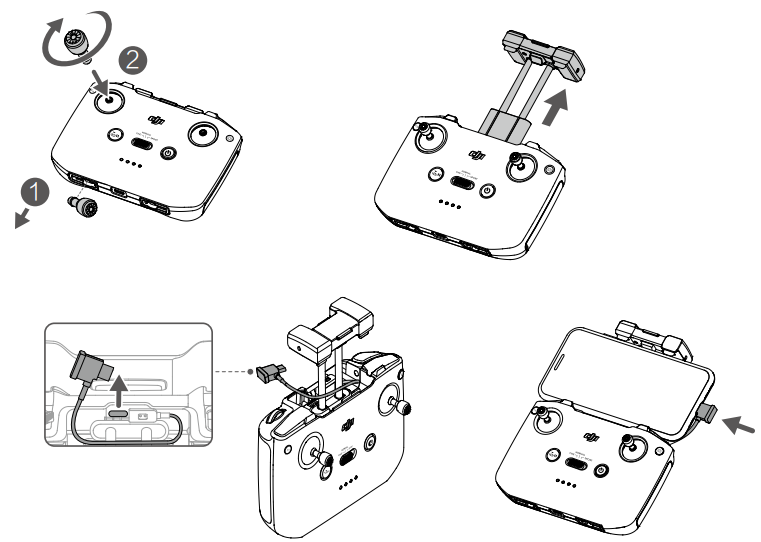
- Remove the control sticks from their storage slots on the remote controller and screw them into place.
- Choose an appropriate remote controller cable based on the type of mobile device.
- A Lightning connector cable, Micro USB cable, and USB-C cable are included in the packaging.
- Connect the end of the cable without the remote controller logo to the mobile device.
- Make sure the mobile device is secured.
Aircraft Description
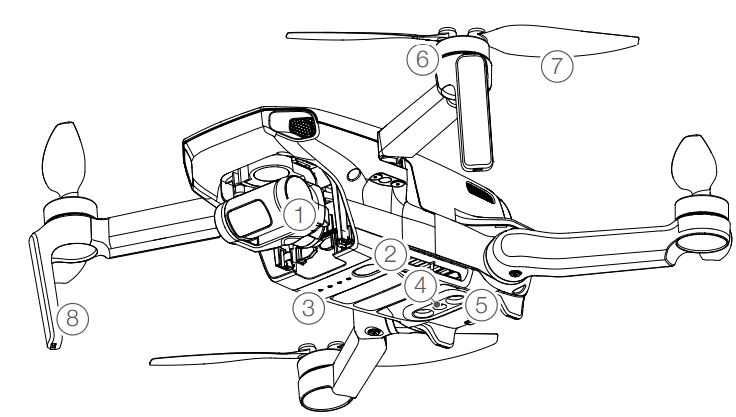
- Gimbal and Camera
- Power Button
- Battery Level LEDs
- Downward Vision System
- Infrared Sensing System
- Motors
- Propellers
- Antennas
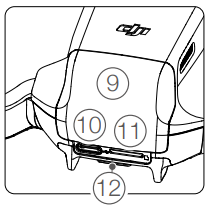
- Battery Compartment Cover
- USB-C Port
- MicroSD Card Slot
- Aircraft Status Indicator
Remote Controller Description
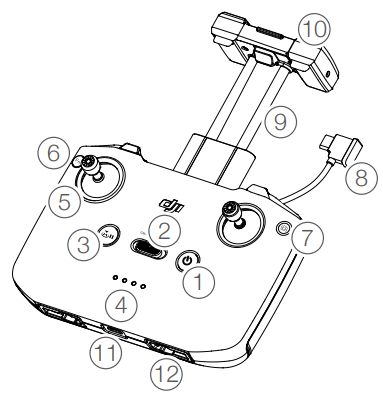
- Power Button
- Press once to check the current battery level.
- Press once, then again, and hold to power the remote controller on or off.
- Flight Mode Switch
- Switch between Sport, Normal, and Cine mode.
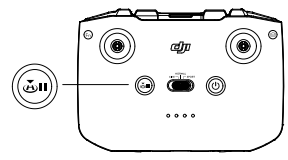
- Flight Pause/Return to Home (RTH) Button
- Press and hold the button to initiate RTH.
- The aircraft returns to the last recorded Home Point.
- Press again to cancel RTH.
- Battery Level Indicators
- Displays the current battery level of the remote controller.
- Control Stick
- Use the control sticks to control the aircraft’s movements.
- Set the control stick mode in DJI Fly.
- The control sticks are removable and easy to store.
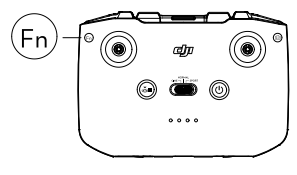
- Customizable Button
- Press once to recenter the gimbal or tilt the gimbal downward (default settings).
- The button can be set in DJI Fly.
- Photo/Video Toggle
- Press once to switch between photo and video mode.
- Remote Controller Cable
- Connect to a mobile device for video linking via the remote controller cable.
- Select the cable according to the mobile device.
- Mobile Device Holder
- Used to securely mount the mobile device to the remote controller.
- Antennas
- Relay aircraft control and video wireless signals.
- USB-C Port
- For charging and connecting the remote controller to the computer.
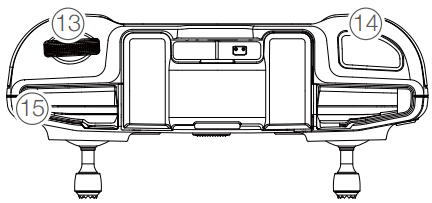
- Control Sticks Storage Slot
- For storing the control sticks.
- For storing the control sticks.
- Gimbal Dial
- Controls the tilt of the camera.
- Press and hold the customizable button to use the gimbal dial to adjust the zoom in video mode.
- Shutter/Record Button
- Press once to take photos or start or stop recording.
- Mobile Device Slot
- Used to secure the mobile device.
Activating DJI Mini 4K
DJI Mini 4K requires activation before using for the first time. After powering on the aircraft and remote controller, follow the on-screen instructions to activate the DJI Mini 4K using DJI Fly. An internet connection is required for activation.
Flight Modes
Dul Mini 4K has three flight modes, plus a fourth flight mode that the aircraft switches to in certain scenarios. Flight modes can be switched via the Flight Mode switch on the remote controller.
Normal Mode
The aircraft utilizes GPS and the Downward Vision System to locate itself and stabilize. Intelligent Flight Mode is enabled in this mode. When the GPS signal is strong, the aircraft uses GPS to locate itself and stabilize.
Sport Mode
In Sport mode, the aircraft uses GPS and the Downward Vision System for positioning. The responses are optimized for agility and speed, making it responsive to control stick movements. The maximum flight speed is 16 m/s, the maximum ascent speed is 5 m/s, and the maximum descent speed is 3.5 m/s.
Cine Mode
Cine mode is based on Normal mode, and the flight speed is limited, making the aircraft more stable during shooting. The maximum flight speed is 6 m/s, the maximum ascent speed is 2 m/s, and the maximum descent speed is 1.5 m/s.
Aircraft Status Indicator
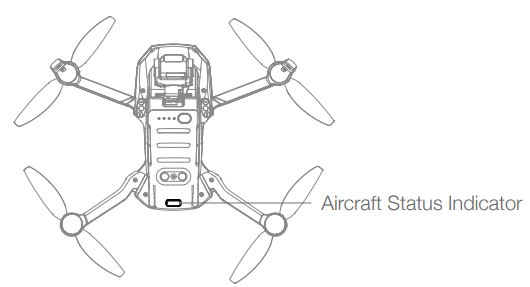
DJI Mini 4K has an aircraft status indicator, which shows the status of the flight control system of the aircraft. Refer to the table below for more information about the aircraft status indicator.
Aircraft Status Indicator States
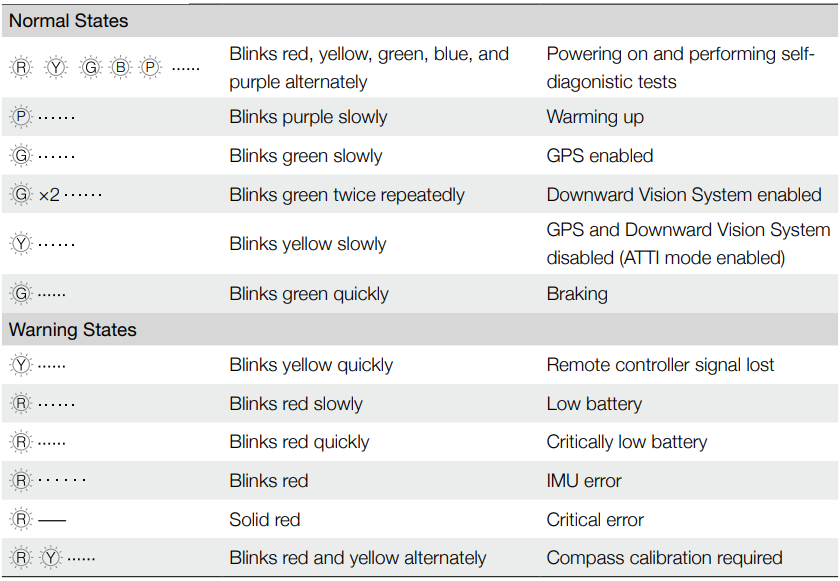
Return to Home
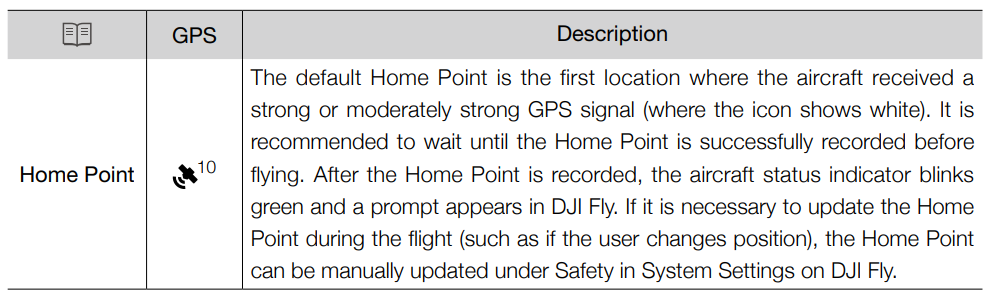
The Return to Home (RTH) function brings the aircraft back to the last recorded Home Point and lands when the GPS signal is strong. There are three types of RTH: Smart RTH, Low Battery RTH, and Failsafe RTH. RTH will also be triggered in other abnormal scenariossu ch as if there is a loss of video transmission.
Smart RTH
If the GPS signal is sufficient, Smart RTH can be used to bring the aircraft back to the Home Point. Smart RTH is initiated either by tapping c in DJI Fly or by pressing and holding the RTH button on the remote controller. Exit Smart RTH by tapping & in DJI Fly or by pressing the RTH button on the remote controller.
Low Battery RTHz
- To avoid unnecessary danger due to insufficient power, the JI Mini 4K will intelligently determine whether the current battery level is sufficient to return home based on the current location.
- The user can cancel RTH by pressing the RTH button on the remote controller.
- The aircraft will land automatically if the battery level is extremely low.
Failsafe RTH
In Dul Fly, users can set the action of the aircraft as Return to Home, Land, or Hover. The aircraft will fly backward for 50 m on its original flight route and ascend to the present RTH altitude to enter Straight Line RTH. When the aircraft flies backward along the original flight route and is less than 20 m from the Home Point, it will stop flying backward on the original flight route and enter Straight Line RTH at the current altitude.
Other RTH Scenarios
There will be a prompt to initiate RTH if the video link signal is lost during flight,t while the remote controller is still able to control the movements of the aircraft. RTH can be cancelled.
RTH Procedure (Straight Line)
The Home Point is recorded. RTH is triggered. After reaching the Home Point, the aircraft lands and the motors stop.
Landing Protection
Landing Protection will activate during Smart RTH and Auto Landing.
During Landing Protection, the aircraft will automatically detect and carefully land on suitable ground. If the ground is determined unsuitable for landing, the DJI Mini 4K will hover and wait for the pilot’s confirmation. If Landing Protection is not operational, DJI Fly will display a landing prompt when the aircraft descends below 0.5 m. Tap confirm or pull down on the throttle stick to land.
Vision System and Infrared Sensing System
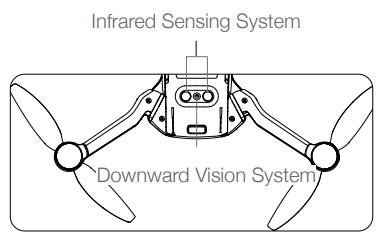
DJI Mini 4K is equipped with a Downward Vision System and an Infrared Sensing System. The Downward Vision System consists of one camera, and the Infrared Sensing System consists of two 3D infrared modules.
Detection Fields
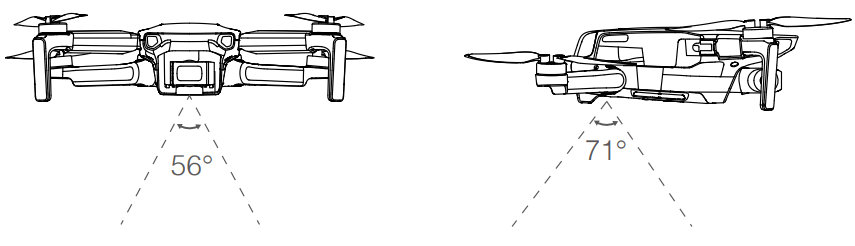
The Downward Vision System works best when the aircraft is at an altitude of 0.5 to 10 m and its operating range is 0.5 to 30 m.
Using the Vision Systems
When GPS is unavailable, the Downward Vision System is enabled if the surface has a clear texture and
there is sufficient light. The Downward Vision System works best when the aircraft is at an altitude of 0.5
to 10 m. If the altitude of the aircraft is above 10 m, the Vision System may be affected. Extra caution is
required.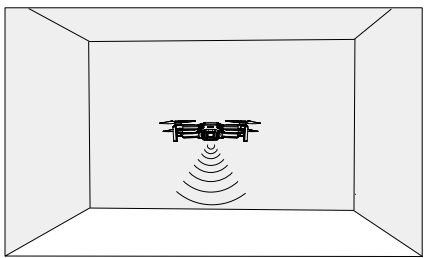
Follow the steps below to use the Downward Vision System.
- Make sure the aircraft is in Normal or Cine mode. Power on the aircraft.
- The aircraft hovers in place after takeoff. The aircraft status indicator blinks green twice, indicating the Downward Vision System is working.
Flight Environment
- Pay attention to the flight environment. The Downward Vision System and Infrared Sensing System
only work under limited conditions and cannot replace human control and judgment. During
flight, always pay attention to the surrounding environment and to the warnings on DJI Fly, and be
responsible for and maintain control of the aircraft. - The aircraft has a max hovering altitude of 5 m if GPS is unavailable.
- The Downward Vision System may not function properly when the aircraft is flying over water.
Therefore, the aircraft may not be able to actively avoid water below when landing. It is recommended
to maintain flight control at all times, make reasonable judgments based on the surrounding
environment, and avoid relying on the Downward Vision System. - Note that the Downward Vision System and Infrared Sensing System may not function properly when
the aircraft is flying too fast. The Infrared Sensing System only takes effect when the flight speed is no more than 12 m/s. - The Downward Vision System cannot work properly over surfaces that do not have clear pattern
variations, orwhere there is weak light. The Downward Vision System cannot work properly in any of the following situations. Operate the aircraft cautiously.- Flying over monochrome surfaces (e.g., pure black, pure white, pure green).
- Flying over highly reflective surfaces.
- Flying over water or transparent surfaces.
- Flying over moving surfaces or objects.
- Flying in an area where the lighting changes frequently or drastically.
- Flying over extremely dark (< 10 lux) or bright (> 40,000 lux) surfaces.
- Flying over surfaces that strongly reflect or absorb infrared waves (e.g., mirrors).
- Flying over surfaces without clear patterns or texture. (e.g., power pole).
- Flying over surfaces with repeating identical patterns or textures (e.g., tiles with the same design).
- Flying over obstacles with small surface areas (e.g., tree branches).
QuickShots
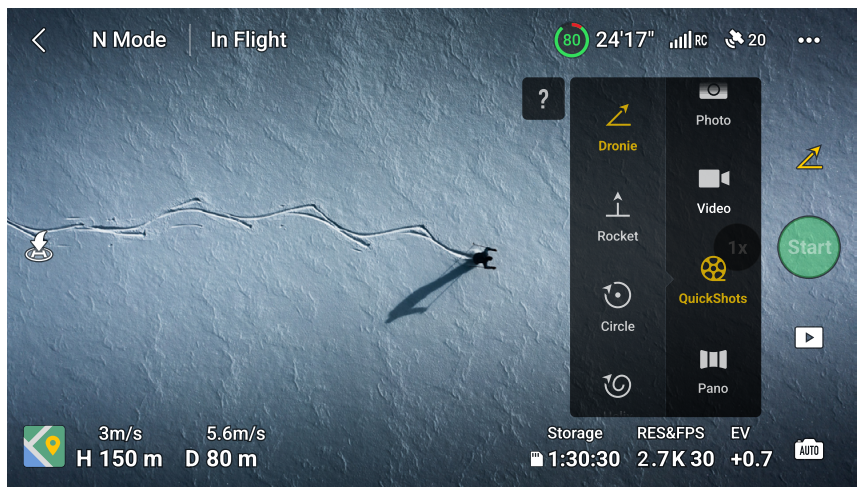
QuickShot shooting modes include Dronie, Rocket, Circle, Helix, and Boomerang. Dul Mini 4K records according to the selected shooting mode and automatically generates a short video. The video can be viewed, edited, or shared to social media from playback.

- Dronie
- The aircraft flies backward and ascends with the camera locked on the subject.
- Rocket
- The aircraft ascends with the camera pointing downward.
- Circle
- The aircraft circles the subject.
- Helix
- The aircraft ascends and spirals around the subject.
- Boomerang
- The aircraft flies around the subject in an oval path, ascending as it flies away from its starting point and descending as it flies back.
Using QuickShots
- Make sure that the Intelligent Flight Battery is sufficiently charged.
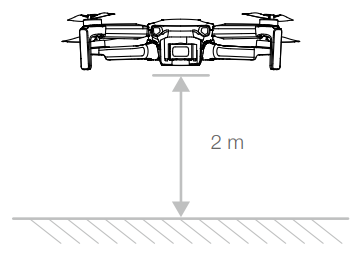
- Take off and hover at least 6.6 ft (2 m) above the ground.
- In DJl Fly, tap the shooting mode icon to select QuickShots and follow the prompts.
- Make sure that you understand how to use the shooting mode and that there are no obstacles in the surrounding area.
- The aircraft will fly back to its original position once shooting is finished.
- Tap to access the short video or the original video.
- You can edit the video or share to social media after downloading.
Exiting QuickShots
Press the Flight Pause/RTH button once or tap X in DJI Fly to exit QuickShots. The aircraft will hover in place.
- Use QuickShots at locations that are clear of buildings and other obstacles.
- Make sure that there are no humans, animals, or other obstacles on the flight path.
- DO NOT use QuickShots in any of the following situations:
- When the subject is blocked for an extended period or outside the line of sight.
- When the subject is more than 50 m away from the aircraft.
- When the subject is similar in color or pattern to the surroundings.
- When the subject is in the air.
- When the subject is moving fast.
- When the lighting is extremely low (<300 lux) or high (>10,000 lux).
Flight Recorder
Flight data, including flight telemetry, aircraft status information, and other parameters are automatically saved to the internal data recorder of the aircraft. The data can be accessed using DJI Assistant 2 (Consumer Drones Series).
Propellers
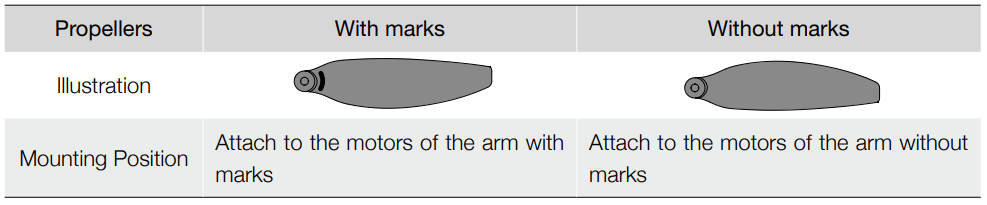
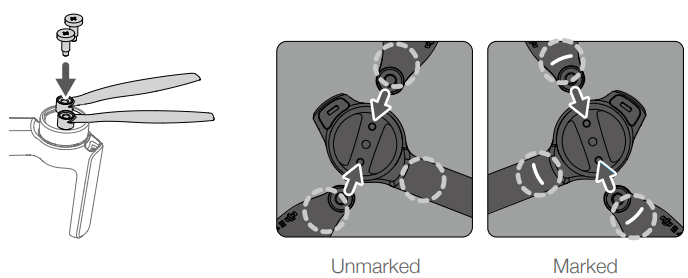
There are two types of DJI Mini 4K propellers, which are designed to spin in different directions. Marks are used to indicate which propellers should be attached to which motors. The two blades attached to one motor are the same.
Attaching the Propellers
Attach the marked propellers to the motors of the arm with marks and the unmarked propellers to the motors of the arm without marks. Use the screwdriver from the package to mount the propellers. Make sure the propellers are secure.
Detaching the Propellers
Use the screwdriver to detach the propellers from the motors.
- Propeller blades are sharp. Handle with care.
- The screwdriver is only used to mount the propellers.
- DO NOT use the screwdriver to disassemble the aircraft.
- DO NOT mix with propellers in other packages.
- Only use official DJI propellers. DO NOT mix propeller types.
- Purchase the propellers separately if necessary.
- Make sure that the propellers are installed securely before each flight.
- Check to make sure the screws on the propellers are tightened after every 30 hours of flight (approx. 60 flights).
Intelligent Flight Battery
The DJI Mini 4K Intelligent Flight Battery is a 7.7 V, 2250 mAh battery with smart charging and discharging functionality.
Battery Features
- During charging, the voltages of the battery cells are automatically balanced.
- It is normal to feel moderate heat being emitted from the battery during the discharging process.
- The battery stops charging automatically once fully charged.
- The battery stops charging if an excess current is detected.
- Discharging stops automatically to prevent excess discharge when the battery is not in flight use.
- Over-discharge protection is not enabled when the battery is in flight use.
- The power supply is automatically cut off if a short circuit is detected.
- DJI Fly displays a warning prompt when a damaged battery cell is detected.
- Charge the battery to wake it from hibernation.
- Information about the voltage, capacity, and current of the battery is transmitted to the aircraft.
Using the Battery
Checking Battery Level
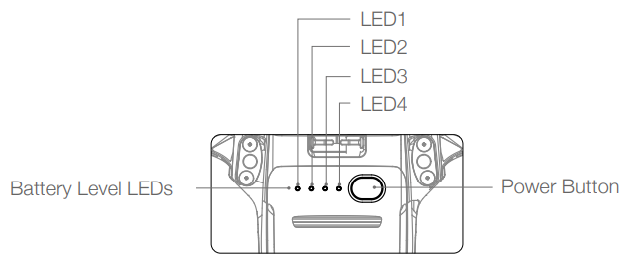
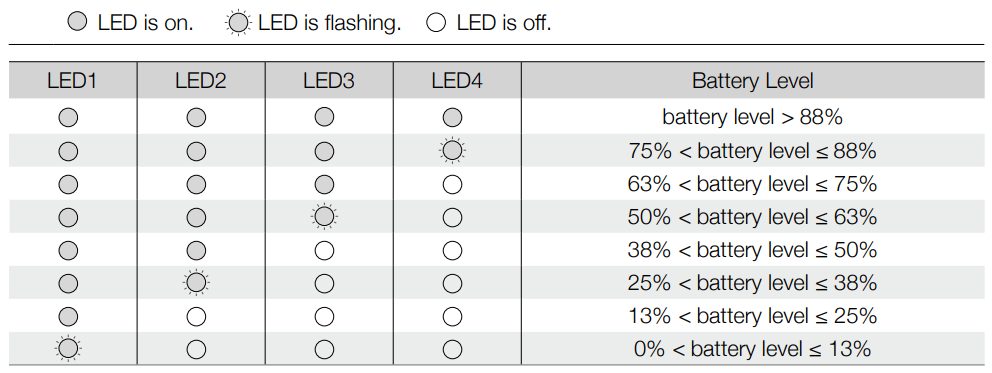
Press the power button once to check the battery level. The battery level indicators display the power level of the flight battery during charging and discharging. The statuses of the indicator are defined as follows:
Powering On/Off
- Press the power button once, then press again and hold for two seconds to power the battery on or off.
- The battery level LEDs display the battery level when the aircraft is powered on.
- Press the power button once, and the four battery level LEDs will blink for three seconds.
- If LEDs 3 and 4 blink simultaneously without pressing the power button, this indicates the battery is abnormal. Insert the Intelligent Flight Battery again and make sure that it is securely mounted.
Low Temperature
- Battery capacity is significantly reduced when flying in low-temperature environments of 0° to 5° C (32° to 41° F). It is recommended to hover the aircraft in place for a while to heat the battery.
- Make sure to fully charge the battery before takeoff. To ensure the optimal performance of the battery, keep the battery temperature above 20° C (68° F).
- The reduced battery capacity in low-temperature environments reduces the wind speed resistance performance of the aircraft. Fly with caution. Fly with extra caution at high sea levels.
Charging the Battery
Fully charge the Intelligent Flight Battery before each flight. It is recommended to use the charging devices provided by DJI, such as the DJI Mini 4K Two-way Charging Hub, DJI 30W USB-C Charger, or other USB Power Delivery chargers.
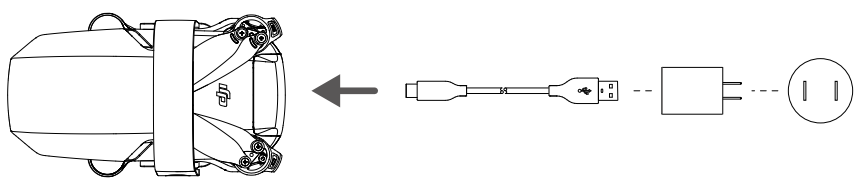
- Connect the USB charger to an AC power supply (100-240V, 50/60 Hz).
- Use a power adapter if necessary.
- Attach the aircraft to the USB charger.
- The battery level LEDs display the current battery level during charging.
- The Intelligent Flight Battery is fully charged when all the battery level LEDs are on.
- Detach the USB charger when the battery is fully charged.
The table below shows the battery level during charging.
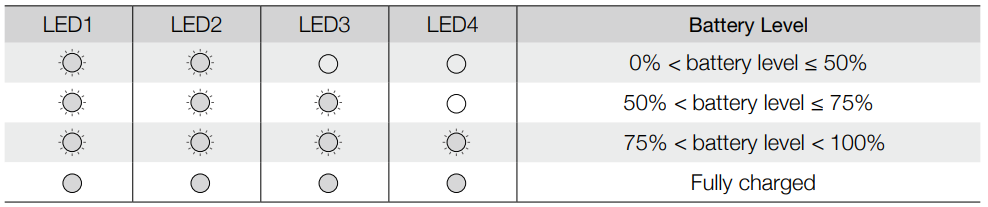
- The blinking frequency of the battery level LEDs will be different when using different USB chargers.
- If the charging speed is fast, the battery level LEDs will blink quickly.
- If the charging speed is extremely slow, the battery level LEDs will blink slowly.
- It is recommended to change the USB-C cable or USB charger.
- If the battery is not correctly inserted into the aircraft, LED 3 and 4 blink simultaneously.
- Insert the Intelligent Flight Battery again and make sure that it is securely mounted.
- The four LEDs blink simultaneously to indicate the battery is damaged.
Battery Protection Mechanisms
The battery LED indicators can display battery protection notifications triggered by abnormal charging conditions.
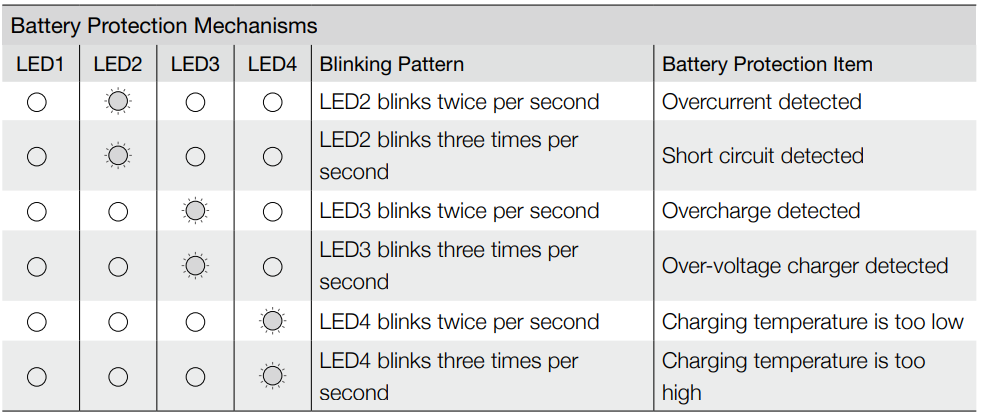
If one of the battery protection mechanisms activates, unplug the charger, and then plug it in again to
resume charging. If the charging temperature is abnormal, wait for the charging temperature to return
to normal, and the battery will automatically resume charging without the need to unplug and plug the charger again.
Installing/Removing the Battery
Install the Intelligent Flight Battery in the aircraft before use. Insert the battery in the battery compartment and secure the battery clamp. A clicking sound indicates the battery is fully engaged. Make sure that the battery is fully inserted and the battery cover is secure in place.
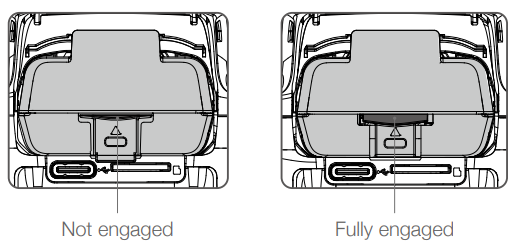
Press the battery clamp and detach the battery from the battery compartment to remove it.
Gimbal Profile
The 3-axis gimbal of DJi Mini 4K provides stabilization for the camera, allowing you to capture clear and stable images and video. The control tilt range i-90° to +20°. The default control tilt range is -90′ to 0″, and the tilt range can be extended to -90° to +20′ by enabling “Allow Upward Gimbal Rotation” in DJI Fly.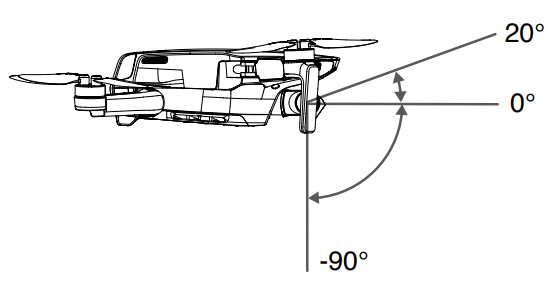
Use the gimbal dial on the remote controller to control the tilt of the camera. Alternatively, enter the
camera view in DJI Fly. Press the screen until a circle appears and drag the circle up and down to
control the tilt of the camera.
Gimbal Operation Modes
Two gimbal operation modes are available. Switch between the operation modes in DJI Fly.
- Follow Mode: The angle between the orientation of the gimbal and the aircraft’s front remains constant at all times.
- FPV Mode: The gimbal synchronizes with the movement of the aircraft to provide a first-person flying experience.
Camera Profile
- DJI Mini 4K uses a 1/2.3″ CMOS sensor camera.
- The aperture of the camera is F2.8 and can shoot at 1m to infinity.
- The DJI Mini 4K camera can shoot up to 4K video and 12MP photos, and supports shooting modes
such as Single, AEB, Timed Shot, and Panorama. It also supports up to 4x digital zoom.
Download Photos and Videos
Make sure that the aircraft is connected to the mobile device via the remote controller and that the motors have not started. Launch DJI Fly, enter playback, and tap in the upper left corner to access the files to download.
Remote Controller
Profile
DJI Mini 4K comes equipped with either the DJI RC-N1 or DJI RC-N1C remote controller, which both boast Dul’s long-range OcuSync 2.0 transmission technology, offering a maximum transmission range of 6 mi (10 km) and 720p when displaying video from the aircraft to Dul Fly on your mobile device. Easily control the aircraft and camera using the onboard buttons. The detachable control sticks make the remote controller easier to store.
DJI RC-N1 has a maximum operating time of 6 hours, and DJI RC-N1C has a maximum operating time of 4 hours. The remote controller charges the mobile device with a charging ability of 500mA@5V. The remote controller automatically charges Android devices. To charge iOS devices, make sure that the charging function is enabled in DJI Fly each time the remote controller is powered on (Charging for iOS devices is disabled by default).
Control Stick Mode
The control stick mode determines the function of each control stick movement. Three pre-programmed modes (Mode 1, Mode 2, and Mode 3) are available,e and custom modes can be configured in DJI Fly. The default mode is Mode 2.
Using the Remote Controller
Powering On/Off
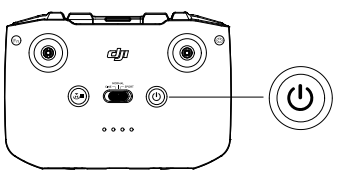
- Press the power button once to check the current battery level. If the battery level is too low, recharge.
- Press once, then press again and hold to power the remote controller on or off.
Charging the Battery
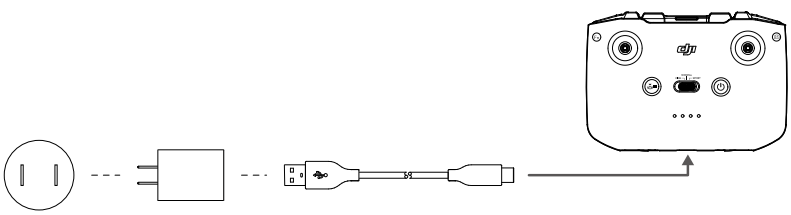
Use a USB-C cable to connect the USB charger to the USB-C port of the remote controller.
Controlling the Gimbal and Camera

- Shutter/Record Button: press once to take a photo or to start or stop recording.
- Photo/Video Toggle: press once to switch between photo and video mode.
- Gimbal Diauseduse to control the tilt of the gimbal.
- Press and hold the customizable button in order to be able to use the gimbal dial to adjust the zoom in video mode.
Controlling the Aircraft
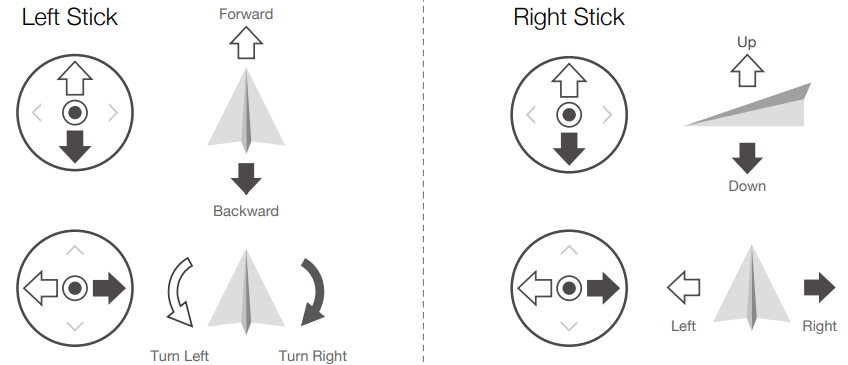
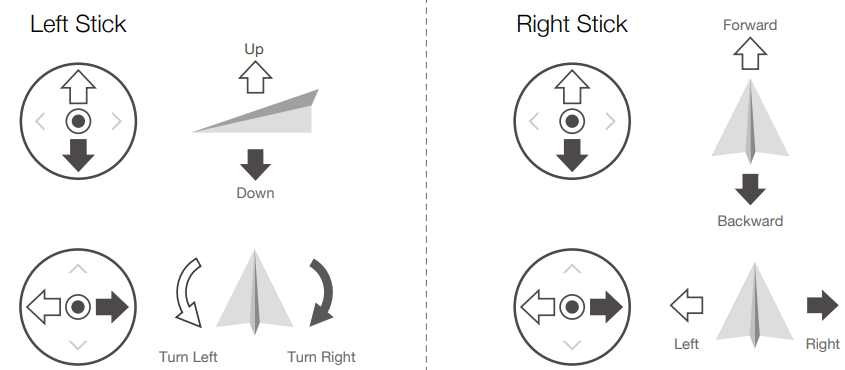
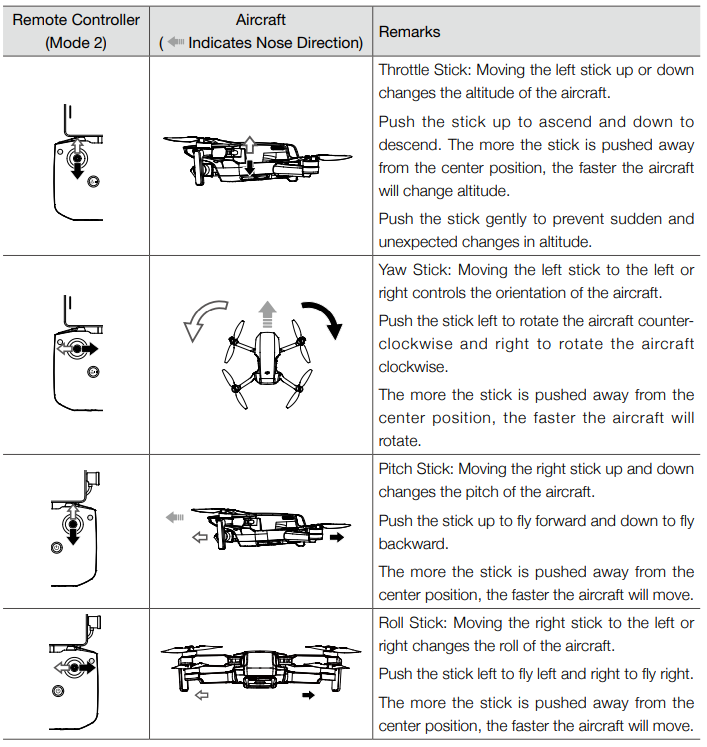
The control sticks control the orientation (pan), forward/backward movement (pitch), altitude (throttle),
and left/right movement (roll) of the aircraft. The control stick mode determines the function of each
control stick movement.
Mode 1
 Mode 2
Mode 3
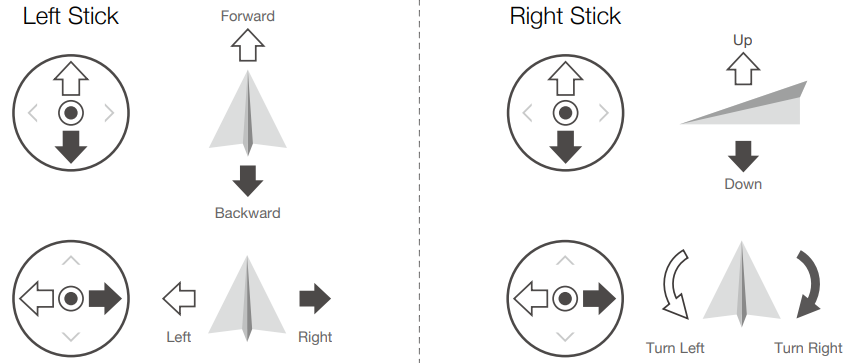
Three preprogrammed modes (Mode 1, Mode 2, and Mode 3) are available, and custom modes can be
configured in DJI Fly. The default mode is Mode 2. The figure below explains how to use each control
stick. usina Mode 2 aexampleamole.
Flight Mode Switch
Toggle the switch to select the desired flight mode.

Customizable Button
To customize the function of this button, go to System Settings in DJI Fly and select Control. Customizable functions include recentering the gimbal and toggling between the map and live view.
Remote Controller Alert
The remote controller sounds an alert during RTH. The alert cannot be cancelled. The remote controller
sounds an alert when the battery level is low (6% to 15%). A low battery alert level can be cancelled by
pressing the power button. A critical battery level alert (less than 5%), however, cannot be cancelled.
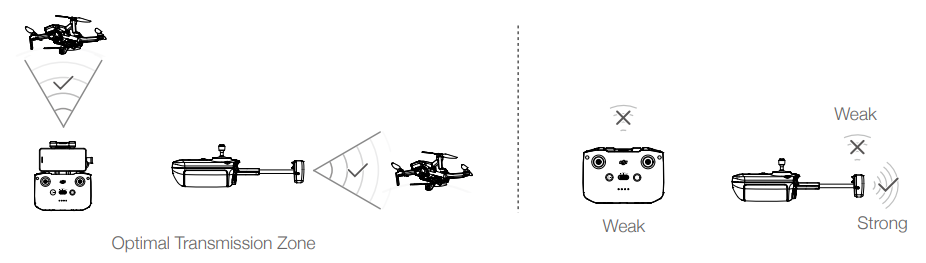
Optimal Transmission Zone
The signal between the aircraft and the remote controller is most reliable when the antennas are positioned in relation to the aircraft as depicted below.
Linking the Remote Controller
Follow these steps to link a new remote controller:
- Power on the remote controller and the aircraft.
- Launch DJI Fly. In camera view, tap •• and select Control and Pair to Aircraft (Link).
- The remote controller will beep continually.
- Press and hold the power button of the aircraft for more than four seconds.
- The aircraft beeps once to indicate it is ready to link.
- The aircraft beeps twice to indicate linking is successful.
- The battery level LEDs of the remote controller will glow solidly.
DJI Fly App
Home
The interface and functions of DJI Fly may vary as the software version is updated. Actual usage experience is based on the software version used. Launch Dul Fly and enter the Home screen to use the following features.
- Search for tutorial videos, user manuals, Fly Spots, flight tips, and more.
- Check regulatory requirements of different regions and gain information on Fly Spots.
- Log in with your Dul account to check your account information. Get after-sales service and support.
Camera View
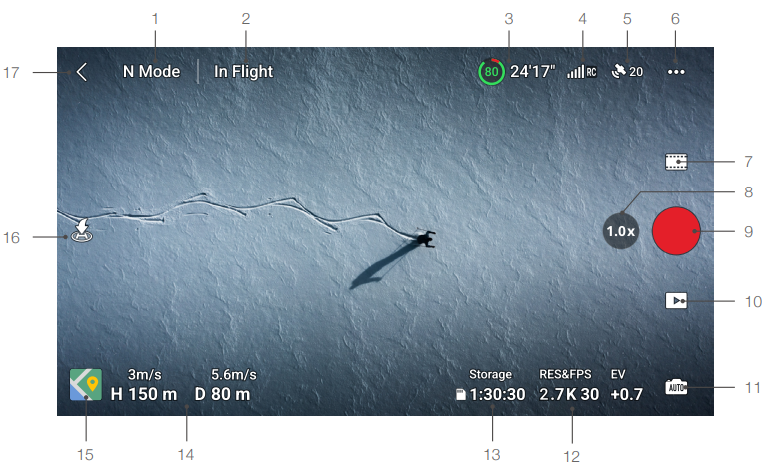
- Flight Mode
- N Mode: displays the current flight mode.
- System Status Bar
- In Flight: indicates the aircraft flight status and displays various warning messages.
- Battery Information
- (80) 24’26”: displays the current battery level and remaining flight time.
- Video Downlink Signal Strength
- Pill: displays the video downlink signal strength between the aircraft and the remote controller.
- GPS Status
- Displays the current GPS signal strength.
- System Settings
- Tap to view information about safety, control, camera, and transmission.
Functions
RTH
- Tap to set the Return to Home Altitude and update the Home Point.
Flight Protection
- Tap to set the max altitude and the max distance for flights.
Sensors
- Tap to view the compass and IMU statuses and start calibration if necessary.
Unlock GEO Zone
- Tap to view information about unlocking GEO Zones.
Find My Drone
- Use the map to find the location of the aircraft on the ground.
Advanced Safety Setting
- Includes the behavior settings for the aircraft when a lost signal, Emergency Propeller Stop, and Payload Mode.
Control
Aircraft Settings
Tap to set the measurement system.
Gimbal Settings
ap to set the gimbal mode, allow the gimbal rotation upward, recenter the gimbal, and calibrate the gimbal. Advanced gimbal settings include speed and smoothness for pitch and yaw.
Remote Controller Settings
Tap to set the function of the customizable button, to calibrate the remote controller, to enable phone charging when an iOS device is connected, and to switch control stick modes. Make sure to understand the operations of a control stick mode before changing control stick mode.
Beginner Flight Tutorial
- View the flight tutorial.
Connect to Aircraft
- When the aircraft is not linked to the remote controller, tap to start linking.
Camera
Photo
- Tap to set the photo size.
General Settings
- Tap to view and set histogram, overexposure warning, gridlines, white balance, and auto sync HD photos.
Storage
- Tap to check microSD card capacity and format.
Cache Settings
- Tap to set the cache when recording and the max video cache capacity.
Reset Camera Settings
- Tap to restore all the camera settings to default.
Shooting Mode
Photo
- Single, AEB, and Timed Shot.
Video
- Video resolution can be set to 4K@24/25/30 fps, 2.7K@24/25/30/48/50/60 fps, and 1080P@24/25/30/48/50/60 fps.
Pano
- Sphere, 180°, and Wide Angle. The aircraft automatically takes several photos according to the selected type of Pano and generates a panoramic shot in DJI Fly.
QuickShots
- Choose from Dronie, Circle, Helix, Rocket, and Boomerang.
Zoom
- The icon shows the zoom ratio. Tap to adjust the zoom ratio. Tap and hold the icon to the end.
The zoom bar and slide on the bar to adjust the zoom ratio.
Shutter/Record Button
- Tap to take a photo or to start or stop recording a video.
Playback
- Tap to enter playback and preview photos and videos as soon as they are captured.
Camera Mode Switch
AUTO
- Choose between Auto and Manual mode when in photo mode. In Manual mode, shutter and ISO can
be set. In Auto mode, AE lock and EV can be set.
Shooting Parameters
- RES&FPS| EV 2.7K 30 +0.7: Displays the current shooting parameters. Tap to access parameter settings.
MicroSD Card Information
- Storage 1:30:30:i displays the remaining number of photos or video recording time of the current microSD card. Tap to view the available capacity of the microSD card.
Flight Telemetry
- D 80m, H 150m, 5.6m/s, 3m/s: displays the distance between the aircraft and the Home Point, height from the Home Point, aircraft horizontal speed, and aircraft vertical speed.
Map
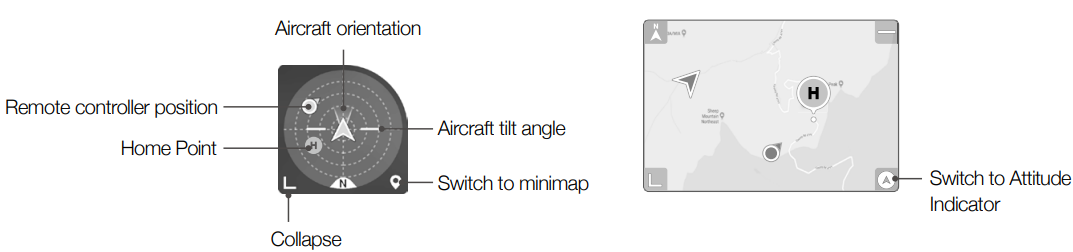
- Displays information such as the orientation and tilt angle of the aircraft, position of the remote controller, and position of the Home Point.
Auto Takeoff/Landing/RTH
Up & down
- Tap the icon. When the prompt appears, press and hold the button to initiate auto takeoff or landing.
- Tap & to initiate Smart RTH and have the aircraft return to the last recorded Home Point. 17.
- Tap to return to the home screen.
- Press the screen until a circle appears and drag the circle up and down to control the tilt of the gimbal.
Flight
Once pre-flight preparation is complete, it is recommended to hone your flight skills and practice flying safely. Make sure that all flights are carried out in an open area. Strictly abide by local laws and regulations when flying. Make sure to read the Safety Guidelines to understand the safety notices before flying.
Flight Environment Requirements
- Do NOT use the aircraft in severe weather conditions inc, including wind speeds exceeding 10.7.m/s,
snow, rain, and fog. - Only fly in open areas. Tall structures and large metal structures may affect the accuracy of the onboard compass and GPS. It is recommended to keep the aircraft at least 5 m away from structures.
- Avoid obstacles, crowds, high-voltage power lines, trees, and bodies of water. It is recommended to keep the aircraft at least 3 m above water.
- Minimize interference by avoiding areas with high levels of electromagnetism, such as locations near power lines, base stations, electrical substations, and broadcasting towers.
- Aircraft and battery performancareis subject to environmental factors such as air density and temperature. The maximum service ceiling above sea level of the aircraft is 13,123 ft (4,000 m) when flying with the Intelligent Flight Battery. Otherwise, the battery and aircraft performance may be reduced.
- Aircraft cannot use GPS within the polar regions. Use the Downward Vision System when flying in such locations.
- DO NOT take off from moving surfaces such as a moving boat or vehicle.
- DO NOT use the aircraft near accidents, fires, explosions, floods, tsunamis, avalanches, landslides, earthquakes, dust, or sandstorms.
- Use the battery charging hub in a temperature range of 5° to 40° C (41° to 104° F).
- Operate the aircraft, battery, remote control, lever,ler and battery charging hub in a dry environment.
- DO NOT use the battery charging hub in severe weather conditions,tions including snow, rain, ice, hail, or fog.
- DO NOT use the aircraft, remote controller, battery orrd battery charging hub in salt spray, bird flocks, or during thunderstorms and sandstorms.
Operating the Aircraft Responsibly
To avoid serious injury and property damage, observe the following rules:
- Make sure you are NOT under the influence of anesthesia, alcohol, or drugs, or suffering from dizziness, fatigue, nausea, or any other conditions, whether physical or mental, that could impair your ability to operate the aircraft safely.
- Upon landing, power off the aircraft first, then switch off the remote controller.
- Do not drop, launch, fire, or otherwise project any dangerous payloads on or at any buildings, persons,ersons or animals, or which could cause personal injury or property damage.
- Do not use an aircraft that has been crashed or accidentally damaged, or an aircraft that is not in good condition.
- Make sure you have been sufficiently trained and have contingency plans for emergencies or for when accidents occur.
- Make sure you have a flight plan and never fly the aircraft recklessly.
- Respect the privacy of others when using the camera. Make sure you comply with local privacy laws, regulations, and moral standards.
- Do not use this product for any reason other than general personal use. DO NOT use it for any illegal or inappropriate purpose (such as spying, military operations, or unauthorized investigations).
- Do not use this product to defame, abuse, harass, stalk, threaten, or otherwise violate the legal rights (such as the right of privacy and publicity) of others.
- Do not trespass onto the private property of others.
Flight Limits and GEO Zones.
DJL’s Geospatial Environment Online (GEO) System is a global information system that provides real-time information on flight safety and restriction updates and prevents UAVs from flying in restricted airspace. Before that, the user must submit an unlocking request based on the current restriction level in the intended flight area. The GEO system may not fully comply with local laws and regulations. Users shall be responsible for their own flight safety and must consult with the local authorities on the relevant legal and regulatory requirements before requesting to unlock a flight in a restricted area.
Flight Limits
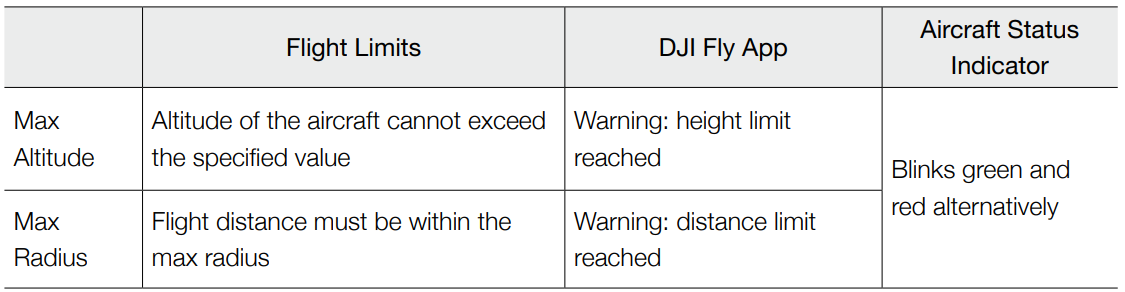
Unmanned aerial vehicle (UAV) operators should abide by the regulations from self-regulatory organizations such as the International Civil Aviation Organization, the Federal Aviation Administration, and local aviation authorities. Users can set flight limits on height and distance. Altitude limits, distance limits, and GEO zones function concurrently to manage flight safety when GPS is available.
Flight Altitude and Distance Limits
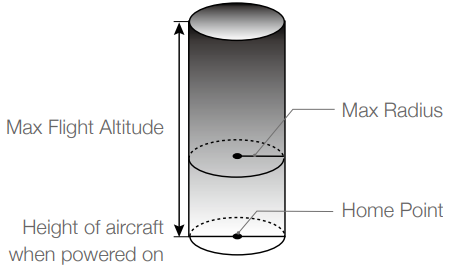
The flight altitude and distance limits can be changed in DUl Fly. Based on these settings, the aircraft will fly in a restricted cylinder as shown below:
GPS is available
GPS is weak
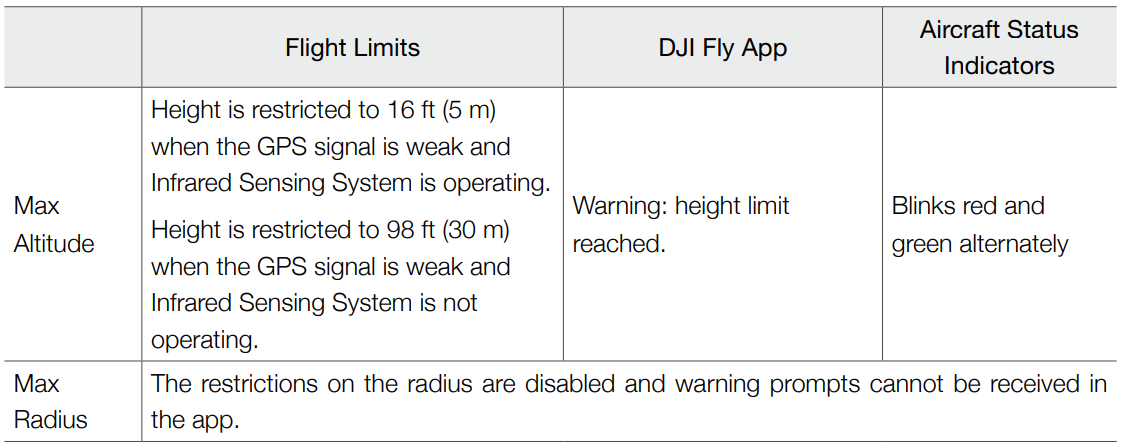
- If the aircraft is in a GEO zone and there is a weak or no GPS signal, the aircraft status indicator will glow red for five seconds every twelve seconds.
- If the aircraft reaches an altitude or radius limit, you can still control the aircraft, but you cannot fly it any further. If the aircraft flies out of the max radius, it will automatically fly back within range when the GPS signal is strong.
- For safety reasons, do not fly close to airports, highways, railway stations, railway lines, city centers, or other sensitive areas. Fly the aircraft only within your line of sight.
GEO Zones
By default, the GEO system limits flights into or takeoffs within zones that may cause safety or security concerns. You will receive a prompt in DJI Fly if your aircraft is approaching a GEO zone,e and the aircraft will be restricted from flying in the area.
Pre-Flight Checklist
- Make sure the gimbal and camera are functioning normally.
- Make surethat nothingg is obstructing the motors and that they are functioning normally.
- Make sure that the camera lens and Downward Vision System sensors are clean.
- Use only genuine DJI parts or parts certified by DJI.
- Unauthorized parts or parts from non-DJI-certified manufacturers may cause system malfunctions and compromise safety.
- DO NOT fly over densely populated areas.
- Make sure the aircraft and remote controller are functioning normally.
Auto Takeoff
Use auto takeoff when the aircraft status indicator blinks green.
- Launch Dul Fly and enter the camera view.
- Complete all steps in the pre-flight checklist.
- Tap &. If conditions are safe for takeoff, press and hold the button to confirm.
- The aircraft will take off and hover approx. 3.9 ft (1.2 m) above the ground.
Auto Landing
Use auto landing when the aircraft status indicator blinks green.
- Tap. If conditions are safe to land, press and hold the button to confirm.
- Motors stop after landing.
Starting the Motors
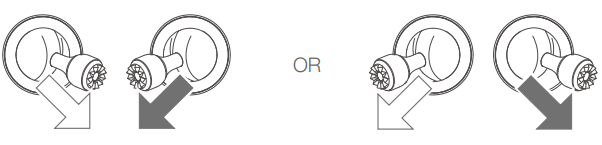
A Combination Stick Command (CSC) is used to start the motors. Push both sticks to the bottom inner or outer corners to start the motors. Once the motors start spinning, release both sticks simultaneously.
Stopping the Motors
There are two methods to stop the motors.
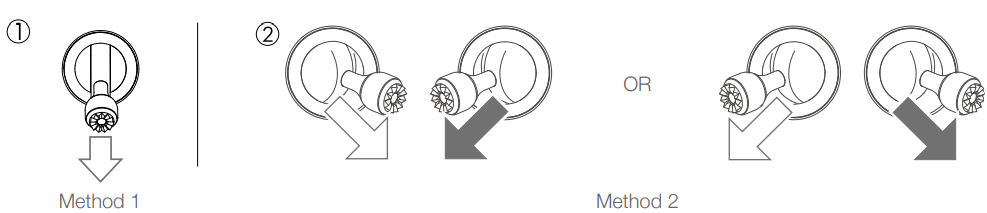
- Method 1: When the aircraft has landed, push and hold the throttle stick down. The motors will stop after three seconds.
- Method 2: Release both sticks once the motors have stopped.
Flight Test
Takeoff/Landing Procedures
- Place the aircraft in an open, flat area with the aircraft status indicator facing towards you.
- Power on the remote controller and the aircraft.
- Launch DJI Fly, connect the mobile device to the aircraft, and enter the camera view.
- Gently push the throttle stick to take off or use auto-takeoff.
- Pull the throttle stick or use auto-landing to land the aircraft.
- After landing, push the throttle down and hold. The motors stop after three seconds.
- Power off the aircraft before the remote controller.
Video Suggestions and Tips
- Select the desired gimbal operation mode in DJI Fly.
- DO NOT fly in bad weather conditions,s such as when it is raining or windy.
- Choose the camera settings that best suit your needs.
- Perform flight tests to establish flight routes and to preview scenes.
- Push the control sticks gently to keep thaircraft’sft movement smooth and stable.
Calibrating the Compass
It is recommended to calibrate the compass in the following situations when flying outdoors. A compass interference warning appears in DJI Fly, and/or the aircraft status indicator blinks red and yellow alternatively.
Calibration Procedure
Choose an open area to carry out the following procedure.
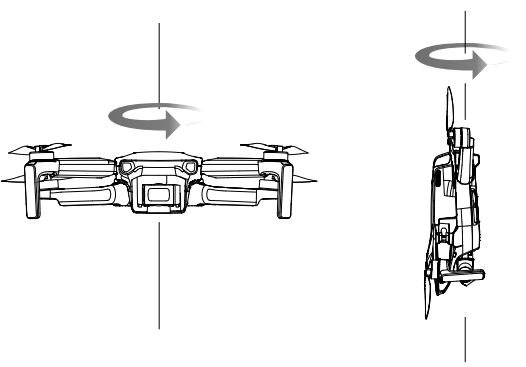
- Tap System Settings in DJI Fly, select Safety, then Calibrate, and follow the on-screen instructions.
- The aircraft status indicator is solid yellow, indicating calibration has started.
- Hold the aircraft horizontally and rotate it 360°. The aircraft status indicator will turn solid green.
- Hold the aircraft vertically and rotate it 360° around a vertical axis.
- If the aircraft status indicator blinks red, the calibration has failed.
- Change your location and try the calibration procedure again.
Specification
Aircraft
- Maximum Propeller Speed: 16928 RPM
- Maximum Take-Off Weight: 246 g
Dimensions
- Folded: 138×81×58 mm
- Unfolded: 159x203x56 mm
- Unfolded (with propellers): 245x289x56 mm
- Diagonal Distance: 213mm
- Max Ascent Speed
- 3 m/s (Normal Mode)
- 2 m/s (Cine Mode)
- 3.5 m/s (Sport Mode)
- Max Descent Speed
- 3 m/s (Normal Mode)
- 1.5 m/s (Cine Mode)
- 16 m/s (Sport Mode)
- Max Speed (near sea level, no wind)
- 16 m/s (Sport Mode)
- 10 m/s (Normal Mode)
- 6 m/s (Cine Mode)
- Max Service Ceiling Above Sea Level
- With Intelligent Flight Battery: 13,123 ft (4,000 m)
- Max Flight Time: 31 mins (measured while flying at 17 kph in windless conditions)
- Max Wind Speed Resistance: 10.7 m/s (Scale 5)
- Max Tilt Angle
- 25° (Normal Mode)
- 25° (Cine Mode)
- 40° (Sport Mode)
- Max Angular Velocity
- 250% (Normal Mode)
- 250% (Cine Mode)
- 250% (Sport Mode)
- Operating Temperature: 0° to 40° C (32° to 104° F)
- GNSS: GPS+GLONASS+ Galileo
- Operating Frequency: 2.400-2.4835 GHz, 5.725-5.850 GHz
- Transmission Power (EIRP)
- 2.4 GHz: <26 dBm (FCC), <20 dBm (CE/SRRC/MIC)
- 5.8 GHz: <26 dBm (FCC), <23 dBm (SRRC), <14 dBm (CE)
- Hovering Accuracy Range
- Vertical: +0.1 m (with Vision Positioning), #0.5 m (with GPS Positioning)
- Horizontal: +0.3 m (with Vision Positioning), #1.5 m (with GPS Positioning)
Gimbal
- Mechanical Range
- Tilt: -110° to +35°
- Roll: -35° to +35°
- Pan: -20° to +20°
- Controllable Range
- Tilt: -90° to 0° (default), -90° to +20° (extended)
- Stabilization: 3-axis (tilt, roll, pan)
- Max Control Speed (tilt): 100%
- Angular Vibration Range: +0.01°
Sensing System
- Downward Hovering Range: 0.5-10 m
- Operating Environment: Non-reflective, discernible surfaces with diffuse reflectivity of >20%; adequate lighting of lux >15
Camera
- Sensor: 1/2.3″ CMOS, Effective Pixels: 12 M
- Lens
- FOV: 83° 35 mm format equivalent: 24 mm
- Aperture: f/2.8 Focus range: 1 mto co
- ISO Range
- Video 100-3200
- Photo 100-3200
- Electronic Shutter Speed: 4-1/8000 s
- Max Image Size: 4000×3000
- Still Photography Modes
- Single shot
- Interval: 2/3/5/7/10/15/20/30/60 s (JPEG) 5/7/10/15/20/30/60 s (JPGE+RAW)
- Automatic Exposure Bracketing (AEB): 3 Frames at 2/3 EV Step
- Video Resolution
- 4K: 3840×2160@24/25/30 fps
- 2.7K: 2720×1530@24/25/30/48/50/60 fps
- FHD: 1920×1080@24/25/30/48/50/60 fps
- Supported File Formats
- FAT32 (≤ 32 GB)
- exFAT (> 32 GB)
- Video Format: MP4 (H.264/MPEG-4 AVC)
- Photo Format: JPEG/DNG (RAW)
Remote Controller (Model: RC231)
- Operating Frequency: 2.400-2.4835 GHz, 5.725-5.850 GHz
- Operating Temperature: -10° to 40° C (14° to 104° F)
- Transmitter Power (EIRP)
- 2.4 GHz: <26 dBm (FCC), <20 dBm (CE/SRRC/MIC)
- 5.8 GHz: <26 dBm (FCC), <23 dBm (SRRC), <14 dBm (CE)
- Battery Capacity
- RC-N1: 18.72 Wh
- RC-N1C: 9.36 Wh
- Operating Current/Voltage
- 1200 mA@3.6 V (with Android device)
- 700 mA@3.6 V (with iOS device)
- Supported Mobile Device Size: 180x86x10 mm (HeightxWidthxThickness)
- Supported USB Port Types: Lightning, Micro USB (Type-B), USB-C
- Video Transmission System: OcuSync 2.0
- Live View Quality: 720p@30fps
- Max Bitrate: 8 Moos
Charger
- Input: 100-240 V, 50/60 Hz, 0.5 A
- Output: 12V 1.5A / 9V 2A / 5V 3A
- Rated Power: 18 W
Intelligent Flight Battery
- Battery Capacity: 2250 mAh
- Voltage: 7.7 V
- Charging Voltage Limit: 8.8 V
- Battery Type: Li-ion
- Energy: 17.32 Wh
- Weight: 82.5 g
- Charging Environment Temperature: 5° to 40° C (41° to 104° F)
- Max Charging Power: 29 W
App
- App: DJI Fly
- Required Operating System: iOS v11.0 or later; Android v6.0 or later
SD Cards
- Supported SD Cards
- UHS-I Speed Grade 3 rating or above microSD card
- 16 GB: SanDisk Extreme
- 32 GB: Samsung Pro Endurance, Samsung Evo Plus, SanDisk Industrial,
- SanDisk Extreme V30 A2, SanDisk Extreme Pro V30 A1, SanDisk Extreme
- Pro V30 A2, Lexar 633x, Lexar 667x
- 64 GB: Samsung Pro Endurance. Samsung Evo Plus. SanDisk Extreme
Firmware Update
Use DJI Fly or DJI Assistant 2 (Consumer Drones Series) to update the aircraft and the remote controller firmware.
Using DJI Fly
When connecting the aircraft or remote controller to DJI Fly, you will be notified if a new firmware update is available. To start updating, connect your remote controller or mobile device to the internet and follow the on-screen instructions.
Update the aircraft firmware.
- Select DJI Mini 3 and click Firmware Updates.
- Select the firmware version.
- Wait for the firmware to download. The firmware update will start automatically.
- Wait for the firmware update to complete.
Update the remote controller firmware.e
- Launch DJI Assistant 2 (Consumer Drones Series) on your computer and log in with your DJI account.
- Power on the remote controller and connect it to the computer via the USB-C port.
- Select the corresponding remote controller and click Firmware Updates.
- Select the firmware version.
- Wait for the firmware to download. The firmware update will start automatically.
- Wait for the firmware update to complete.
Customer Service
- Ph: +1 818 235 0789.
- Website: https://fly-safe.dji.com/nfz/nfz-query.
- Address: Lobby of T2, DJI Sky City, No. 53 Xianyuan Road, Xili Community, Xili Street, Nanshan District, Shenzhen, China, 518055.
DJI is a trademark of DJI. Copyright © 2025 DJI All Rights Reserved.
FAQs