



Seeed Studio MR60BHA1 Heartbeat Detection Sensor
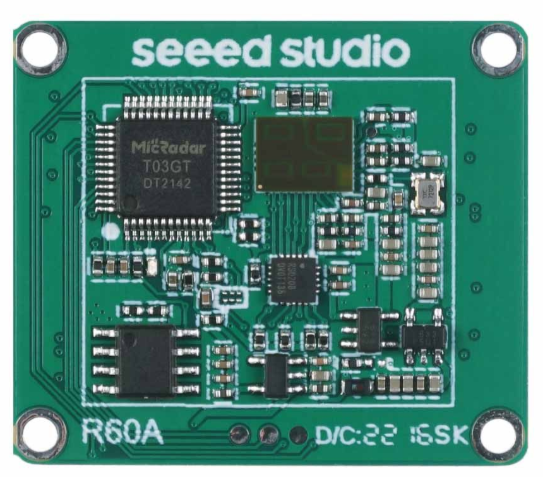
Introduction
From hardware circuit reference design, radar antenna, and housing layout requirements, the Seeed Studio MR60BHA1 Heartbeat Detection Sensor helps distinguish interference and supports multi-functional standard UART protocol output. This radar is a self-contained system, consisting of an RF antenna, a radar chip, and a high-speed MCU, providing accurate and reliable heartbeat detection for various applications.
Working Principle
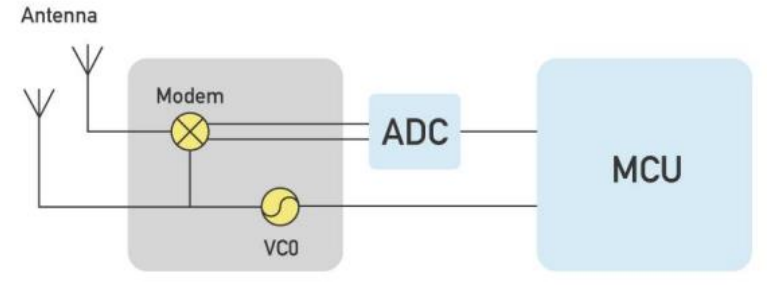
The radar transmits a 60 GHz millimeter wave signal, and the target reflects the electromagnetic wave signal, and demodulates it from the transmitted signal.
For applications that require fall detection and advanced movement monitoring, Seeed Studio also offers the MR60FDA1 Fall Detection Pro Module, which can be integrated alongside the MR60BHA1 sensor for comprehensive human monitoring solutions.
Hardware Design Considerations
The rated supply voltage of the radar needs to meet 4.9 – 6V, and the rated current needs to be 200mA or more. Input is required. The power supply is designed to have a ripple of ≤ 100mv.
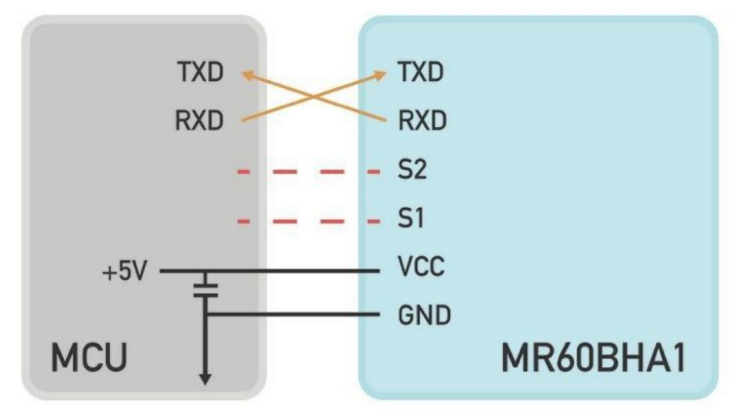
Power supply can refer to the following circuit de. sign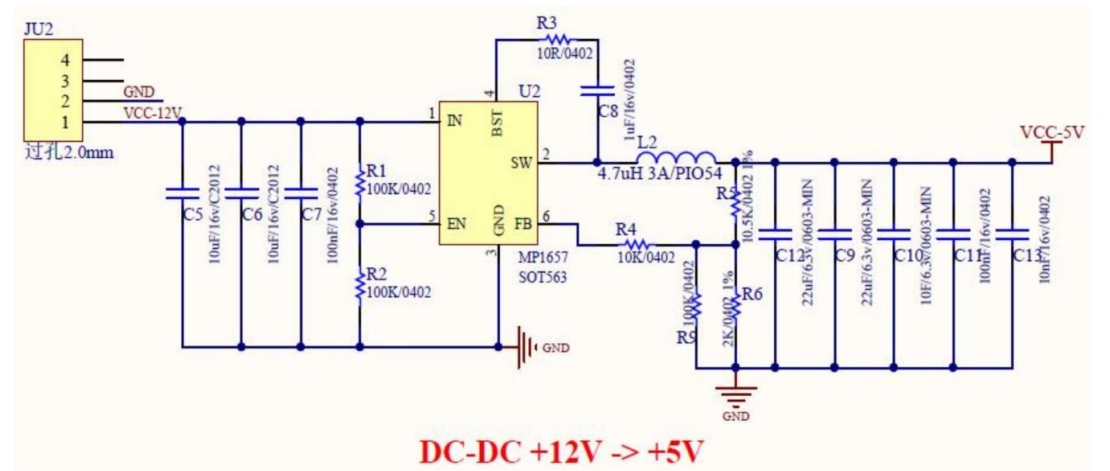
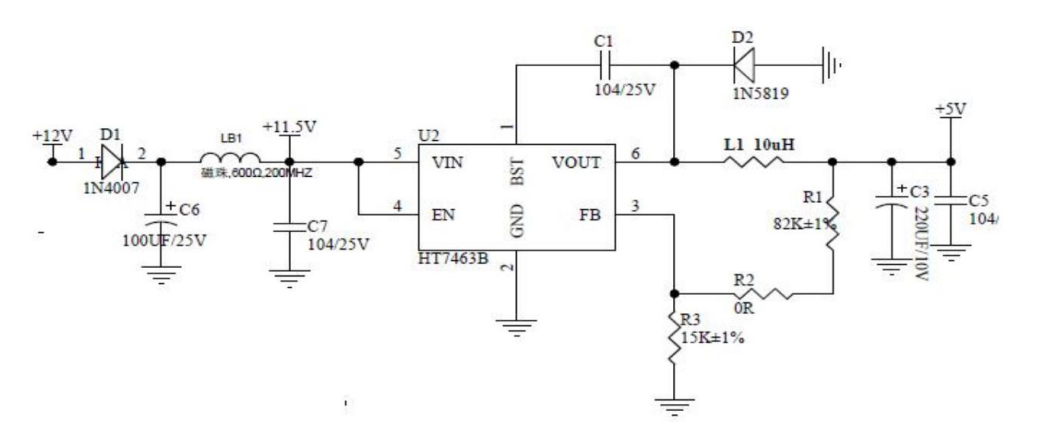
Wiring Diagram
Antenna and housing layout requirements
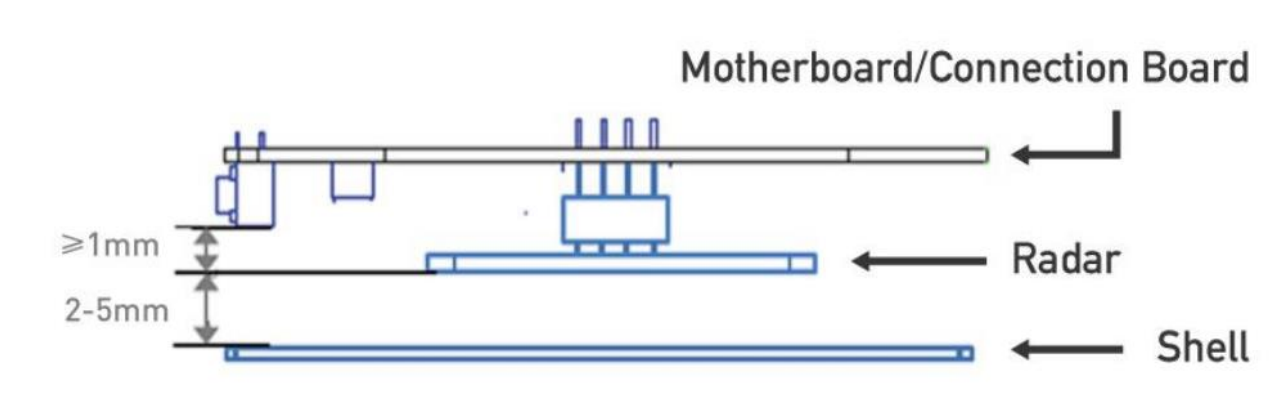
For the Seeed Studio MR60BHA1 Heartbeat Detection Sensor, the PCBA should keep the radar patch height ≥ 1mm higher than other components. The housing structure must maintain a 2–5mm distance between the radar antenna surface and the housing surface. The housing detection surface should be non-metallic and straight to avoid bending, which could affect the overall performance of the sensor.
Electrostatic Protection
Proper handling of the Seeed Studio MR60BHA1 Heartbeat Detection Sensor is essential during transportation, storage, and operation to prevent static damage. Avoid touching the radar module antenna surface or connector pins directly; only handle the corners. Always wear anti-static gloves when handling the MR60BHA1 sensor to ensure safe and reliable operation.
Detailed Explanation of Functions
Function Description
| Function | Status change time/function explanation |
| DP1: occupied/unoccupied | From unoccupied to occupied, report within 0.5s From occupied to unoccupied, report within 40s |
| DP2: Some people are stationary / some people are active | Static dynamic switching, report within 0.5 seconds |
| DP3: Heart rate | Outputs data once every 3 seconds, in units of times/minute |
| DP4: Body movement parameters 0 – 100 | Output data once every 5 seconds [Refer to: Body motion amplitude parameter output instructions]. |
| DP5: In-bed/out-of-bed | From bed-out to bed-in, 1 1-minute report in the presence of someone From bed-in to bed-out, about 40s output of bed-out status |
| DP6: Sleep state (awake/light sleep/deep sleep) | In the bed state, 10 minutes to determine and report sleep status once |
| DP7: Sleep quality score | At the end of the sleep process, a score of 0 to 100 is reported for the sleep period. |
| DP8: Respiratory/heart rate | Outputs data once every 3 seconds, in units of times/minute |
Communication,, Command,, and Parameter Definition
Definition of frame structure
| Frame header | Control word | Command word | Length identifier | Data | Checksum | End of frame | |
| 0x53 0x59 | Control | Command | Lenth_H | Lenth_L | Data | Sum | 0x54 0x43 |
| 2 Byte | 1 Byte | 1 Byte | 1 Byte | 1 Byte | n Byte | 1 Byte | 2 Byte |
Description of the frame structure
The following frame structure applies to the Seeed Studio MR60BHA1 Heartbeat Detection Sensor:
- Frame header: 2 Byte, fixed to 0x53,0x59;
- Control word: 1 Byte (0x01 – heartbeat packet identification, 0x02 – product information, 0x03 – OTA upgrade, 0x05 – operation status, 0x07 – radar detection range information, 0x80 – human presence, 0x81 – breath detection, 0x84 – sleep monitoring, 0x85 – heart rate monitoring)
- Command word: 1 Byte (to identify the current data content)
- Length identification: byteste, equal to the specific byte length of the data
- Data: n Byte, defined according to the actual function
- Checksum: 1 Byte. (Calculation method of checksum: “frame header + control word + command word length identifier + data” summed to the lower eight bits)
- End of frame: 2Byte, fixed to 0X54,0X43;
Description
| Function Category | Function Description | Transfer direction | Frame header | Control word | Command word | Length Identification | Data | Checksum field | End of frame | Note | |
| System Functions | Heartbeat Pack Report | Report | 0x53 0x59 | 0x01 | 0x01 | 0x00 | 0x01 | 0F | sum | 0x54 0x43 | |
| Heartbeat Package Inquiry | Send | 0x53 0x59 | 0x01 | 0x80 | 0x00 | 0x01 | 0F | sum | 0x54 0x43 | ||
| Response | 0x53 0x59 | 0x01 | 0x80 | 0x00 | 0x01 | 0F | sum | 0x54 0x43 | |||
| Module Reset | Send | 0x53 0x59 | 0x01 | 0x02 | 0x00 | 0x01 | 0F | sum | 0x54 0x43 | ||
| Response | 0x53 0x59 | 0x01 | 0x02 | 0x00 | 0x01 | 0F | sum | 0x54 0x43 | |||
| Information Inquiry | |||||||||||
| Product Information | Product Model | Send | 0x53 0x59 | 0x02 | 0xA1 | 0x00 | 0x01 | 0F | sum | 0x54 0x43 | |
| Response | 0x53 0x59 | 0x02 | 0xA1 | 0x00 | len | len B Product Info | sum | 0x54 0x43 | |||
| Product ID | Send | 0x53 0x59 | 0x02 | 0xA2 | 0x00 | 0x01 | 0x0F | sum | 0x54 0x43 | ||
| Response | 0x53 0x59 | 0x02 | 0xA2 | 0x00 | len | len B Product ID | sum | 0x54 0x43 | |||
| Hardware Model | Send | 0x53 0x59 | 0x02 | 0xA3 | 0x00 | 0x01 | 0x0F | sum | 0x54 0x43 | ||
| Response | 0x53 0x59 | 0x02 | 0xA3 | 0x00 | len | len B Hardware model | sum | 0x54 0x43 | |||
| Firmware Version | Send | 0x53 0x59 | 0x02 | 0xA4 | 0x00 | 0x01 | 0F | sum | 0x54 0x43 | ||
| Response | 0x53 0x59 | 0x02 | 0xA4 | 0x00 | len | len B Firmware version | sum | 0x54 0x43 | |||
Appendix
About the calculation of the check digit
Let’s take the command to send a human presence information query as an example. The data construction for the presence information query was confirmed by the protocol table
above is
- Frame header: 0x53 0x59
- Control word: 0x80
- Command word: 0x81
- Length identifier: 0x00 0x01
- Data: 0x0F
- Checksum: 1Byte (SUM)
- End of frame: 0x54 0x43
Customer Support
- Website: www.seeedstudio.com
- Ph: +86-0755-86095676
2008-2025 Seeed Technology Co., Ltd. All rights reserved.
FAQs
Q: What is the MR60BHA1 sensor?
An animal or human’s pulse rate can be non-invasively measured with the MR60BHA1 heartbeat detection module. It detects changes in blood volume in microvascular tissue using optical sensing technology (PPG, or photoplethysmography).
Q: How does the sensor detect a heartbeat?
The sensor measures the intensity of the reflected light after shining infrared (IR) light onto the skin. The reflected light’s periodic variation is equivalent to the variations in blood volume brought on by heartbeats. The waveform and pulse rate are computed by processing this signal.
Q: Does it require skin contact?
Indeed, the sensor functions best when applied directly to the skin. Accuracy is decreased by thick barriers, jewellery, and clothing. Better readings are guaranteed with less pressure.
Q: Can it detect irregular heartbeats?
Although the sensor can identify changes in pulse rate, it is not a diagnostic tool for medicine. Waveform output may show irregular patterns, but any health concerns must be verified by a doctor.
Q: Can I measure multiple people with one sensor?
No, only one person at a time can be detected by the sensor. Use multiple sensors or sequential readings for multiple measurements.
Q: Is the sensor safe?
Indeed. Low-intensity infrared light is used by the MR60BHA1, which is safe for both people and animals. There is no chance of electrical shock, and it is non-invasive.
4 Comments
Pingback: Seeed Studio Wio-E5 TM32WLE5JC Wireless Module | Full Guide
Pingback: Ozeri BP2M Blood Pressure Monitor | Setup, Usage & Guide
Pingback: Seeed Studio MR60FDA1 Fall Detection Pro Module User Manual
Pingback: NANNY BM-02 Baby Breathing Monitor User Manual & Guide