

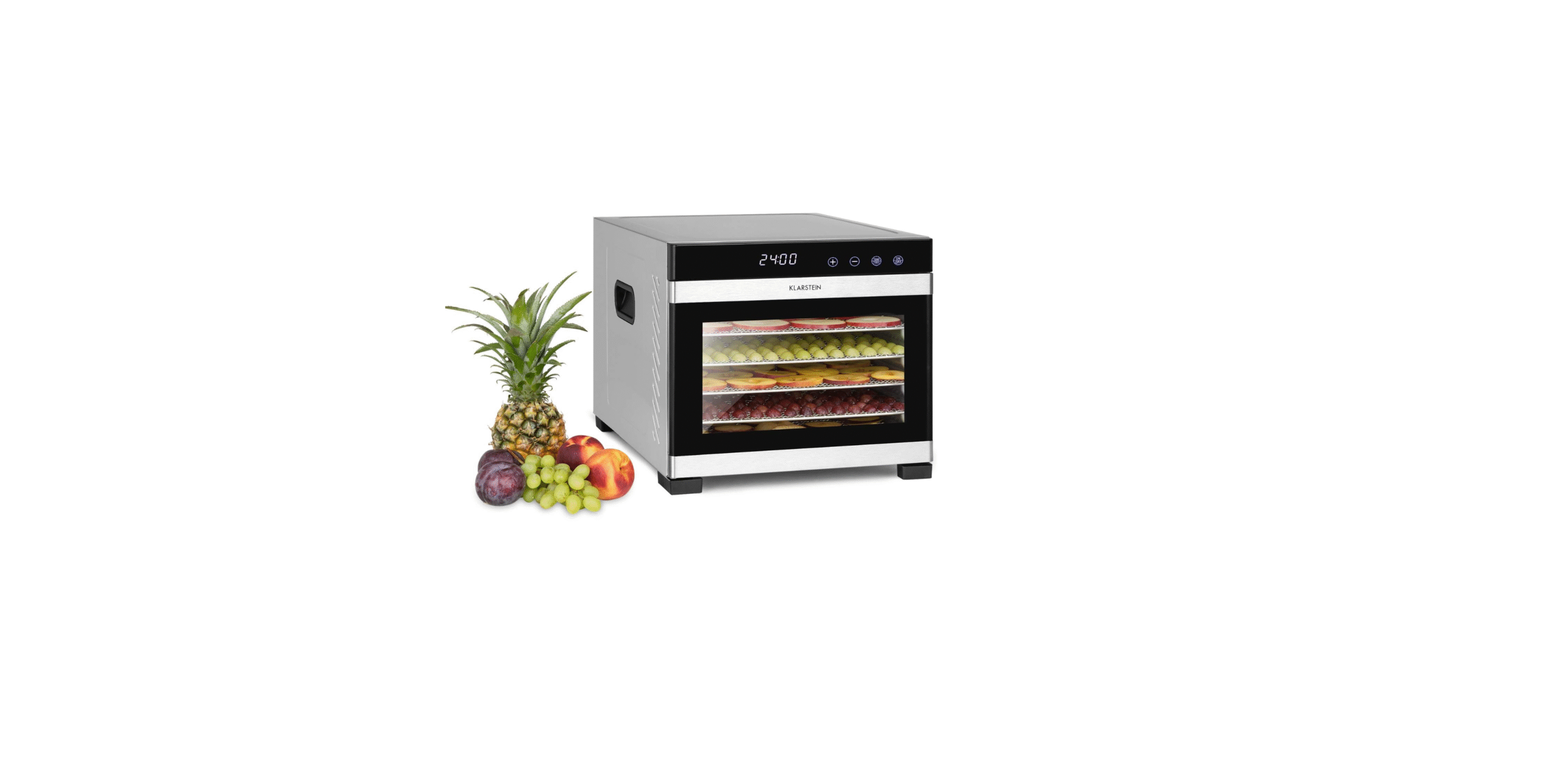

KLARSTEIN 10034423 FLAVOUR DRY Dehydrator

SAFETY INSTRUCTIONS
- Read all the safety and operating instructions carefully and retain them for future reference.
- Do not operate this appliance on a flammable material, such as a wood surface, or on any tablecloth.
- Be sure the ehydrator is stable during use. All four feet should be secure on a level surface.
- The dehydrator should not move during operation.
- Use in a well-ventilated location. Do not block air vents on the door or at the rear of the dehydrator.
- Keep the dehydrator at least (30 cm) away from any wall to allow for proper air circulation.
- Do not operate the dehydrator on flammable surfaces such as carpeting.
- To prevent electric shock. Do not immerse the unit and control panel in water or liquid.
- Serious injury from electric shock could result.
- Do not use the appliance with wet hands or bare feet. Do not operate near running water.
- Disconnect from the power outlet before cleaning components.
- Read all instructions before cleaning the dehydrator.
Overview

- Mesh tray
- Door
- Control panel
- Housing
- Grip
- Feet
- Stainless steel grid
- Fruit roll grid
| Netz | Legen Sie das Netz auf das Edelstahlgitter. Für kleinere Lebensmittel wie Kräuter und Beeren geeignet und klebrige Lebensmittel, wie beispielsweise Bananen und Tomaten. |
| Fruchtrollengitter | Legen Sie das Netz auf das Edelstahlgitter und machen Sie köstliche Fruchtrollen auf natürliche Weise. Wenn Sie das Fruchtrollengitter nicht als solches verwenden, stellen Sie es als Krümelfach unten in das Gerät hinein. |
Operation
- Remove all packing materials from the unit and remove all accessories.
- Clean the grilles with a damp cloth.
- Place the unit on a stable, level surface. Plug the power plug into the wall outlet. Slide the grille into the unit.
- Leave the appliance for 30 minutes without adding food. Ensure that the room in which the appliance is placed has adequate ventilation, as the appliance will produce smoke or odours the first time it is used. This is normal.
- Rinse the grilles with water and dry all components.
Commissioning
- Place the cleaned food on the grilles – do not place too much food on the grilles and make sure that the food is not on top of each other. Close the door.
- Plug the power plug of the appliance into the wall socket. The appliance beeps once. The „on/off“ indicator lights up, and the screen displays „0000“.
- Press the „on/off“ button. The LED screen shows the preset time „10:00“ and the temperature setting „70 °C“. The motor and fan start first, and the heater starts 5 seconds later. The „:“ symbol flashes on the LED screen to indicate the time setting.
- Press the temp/time button. The temperature indicator will flash on the screen. To change the temperature, use the + or – button (the temperature range is between 35 °C and 75 °C).
- After setting the temperature, press the TEMP/TIME button again to set the time. The time will flash on the screen. To change the time, press the + or – button (time range between 00:30 and 24:00).
- After you have set the temperature and time, the unit will start.
- Once the time has elapsed, the heating elements will stop operating. The fan will run for about 10 seconds, and the alarm will beep 20 times (1 time/second).
- After drying, unplug the appliance from the wall outlet.
- Noticing the moisture and weight of food before and after drying is helpful for future drying processes.
Recommended Tools
- Paring knife (Stainless Steel Blade)
- Cutting board
- Storage containers
Additional tools that make the job easier and faster can include
- A food processor or other similar appliance for faster and consistent slicing.
- A steamer and basket, or a kettle and a collapsible steamer for blanching.
- Blender for making fruit puree for fruit leather.
- A small notebook to keep track of the length of time and recipes that work for you, as well as th, those that don‘t.
FoodPreparationn
- Fruit and vegetable peel often contains much of the food‘s nutritional value. Therefore, it is better not to peel if the dried food is to be eaten as snack or used in cookies.
- On the other hand, you will want to peel apples intended for a pie or tomatoes intended for soup. Generally, if you normally peel the food for a specific recipe, then peel the food before it is to be dehydrated.
- One of the most important factors in successful dehydration is how the food is sliced. When drying fruits it helps to ge,,t all the slices about the same thickness so they all dryto the same dry texture level, at the same time.
- Thick slices dry more slowly than thin slices. The thickness you choose is up to you, but slicing all the pieces as close to the same size as possible while ensuring success and consistency.
- The skin of many foods naturally protects the food, but it can hamper the dehydration process. During dehydration, moisture escapes best from a cut or broken surface, not through the tough skin.
- For this reason thin stalked v, thin-stalked vegetables like green beans, asparagus, and rhubarb should be cut in half the long way, or with an extreme diagonal cut to expose as much of the inner parts of the food as possible.
- Broccoli stems should be halved or quartered, depending on diameter. Only the fruits like strawberries can be cut in half. Even smaller berries should either be cut in half or blanched slightly to break the skin.
Filling the Drying Trays
- When loading the food into the trays, you can use all of the tray‘s surface, but some airflow must be maintained. Try to place the food in a single layer whenever possible.
- This is particularly important with foods like banana slices and pineapple rings, and not quite as important with beans.
- If some of the pieces come out with too much moisture when you are finished, one of the reasons is that they might have been covered by other pieces of food.
- Dehydration removes the moisture and will cause the food to shrink as it dries. This allows you to store the same amount of food in a smaller space.
- Chopped food should not be spread thicker than 1.2 cm. It may be necessary to stir the finely chopped food once or twice during dehydration to ensure even drying of all the pieces.
- To do so, turn the machine off, unplug it, remove the trays, stir, then reassemble and restart the machine according to the instructions.
Prevent Dripping
- Some foods, such as very ripe tomatoes and citrus or sugared fruits, may drip.
- Dripping from a tray above can change the flavour of different foods on lower trays.
- To help lessen dripping after placing food on drying trays and before placing them on the dehydrator base, tap the tray firmly downward on a towel laid on the countertop a few times to remove excess moisture.
Vegetable Dehydration
- Dried vegetables are every bit as flavourful and versatile as dried fruits. With dried vegetables, you can make delicious soups, stews, casseroles and more.
- Basically, anywhere you would use fresh vegetables, you can use dehydrated vegetables. Before preparing and dehydrating your chosen vegetables, always wash them in cold water.
- A certain amount of coring, slicing, peeling or shredding is required. A food processor can be a handy tool when processing vegetables, taking seconds to slice up a large batch ready for the dehydrator.
- Be creative when drying vegetables. Placing vegetables in diluted lemon juice or similar flavourings for approximately 2 minutes will add a hint of flavour to such vegetables as green beans and asparagus.
Pre-treatment of Vegetables
- For the most part, vegetables need little in the way of special treatment for dehydration, although there are some exceptions.
- Here are some preparation guidelines that will help you get the most from your dried vegetables.
- A few vegetables, such as onions, garlic, peppers, tomatoes and mushrooms, ms can be dried and reconstituted successfully without pre-treatment.
- In general, if vegetables must be steamed or blanched for freezing they must be t, treated for drying.
- With the above-named exceptions in mind, most remaining vegetables will need to be steamed or blanched before drying.
- Many vegetables have enzymes that help the fruit ripen, and leaving th, these enzymes active in the food will cause them to continue to bring about flavour and aroma, which can be undesirable.
- Although untreated vegetables, which are dehydrated can still be g, good for as long as three to four months, heat-treated treated constitute in less time keep longer, and generally retain more flavour when reconstituted.
Steaming
- Steaming is the best method of pre-treatment. Place a single layer of chopped or sliced vegetables in a colander or steam basket.
- Shredded vegetables can be 1.2 cm deep in the colander or basket. Set vegetables in a pot above a small amount of boiling water and cover. Water should not touch the vegetables.
- Begin timing immediately. When ready to remove, vegetables should be barely tender. Drop in bowl of cold water to stop cooking and for food to retain its colour. Pat dry and spread on trays to dehydrate.
Blanching
- Blanching is recommended for green beans, cauliflower, broccoli, asparagus, potatoes and peas.
- Since these vegetables are often used in soups or stews, blanching will ensure that they retain a desirable color.
- To blanch prepared vegetables in a pot of boiling water for 3 to 5 minutes only. Strain and pat dry and place vege,, tables in the dehydrator.
- Blanching is faster than steaming, but many nutrients are lost in the blanching water.
- It is not recommended for chopped or shredded vegetables, which would easily overcook during sliced. Vegetables into a large pot of boiling water. Do not add more than 1 cup (200 ml)of food per quart of boiling water.
- Begin timing immediately. For timing, follow standard freezing directions. Timing is approximately one-third to one-half that of steaming or until vegetables are barely tender.
Fruit Dehydration
- Dried fruit is a superb food treat. Try it plain as fruit leather, or in ice cream cobblers and pies. It’s hard to find a better-tasting, more nutritious,s snack than dried fruit.
- Dried fruit is naturally sweet, has no preservatives, and is inexpensive.
- Your food dehydrator makes drying fruit easy. With all fruits, it is best to wash them before beginning.
- After that, most fruits just need halving, coring or pitting and slicing before placing them in the dehydrator.
- You do not have to pre-treat fruits to get good results, but some fruits, such as apples, pears, peaches, apricots and bananas tend to darken somewhat with drying or storage beyond six to seven months.
- Although still edible when darkened, they tend not to appear as tempting to the palate.
Lemon, Pineapple or Orange Juice
- Fresh or bottled lemon, pineapple or orange juices are the best because of their natural sweetness. Pineapple and orange juice can be used full strength or diluted to taste.
- If you use lemon juice, it is best to dilute it with 1 part juice to 8 parts water and soak the fruit pieces for two minutes.
- Be aware that the taste of these juices can overpower the taste of the fruit being dried and may not always prevent discolouration of food. Experiment with the dilution and soaking times to suit your taste.
Ascorbic Acid
- Crystalline ascorbic acid or products with ascorbic acid made for preserving fruits for canning may be obtained from drug stores or from stores selling canning supplies.
- Most grocery stores sell it with their canning supplies as well. Mix 1 tablespoon in four cups of water and soak the fruit for about two minutes.
- Like lemon juice, the taste can be quite overpowering. KLARSTEIN 10034423 FLAVOUR DRY Dehydrator, so experiment with concentrations and soaking times.
Making Fruit Leather
- Sometimes referred to as Fruit Rolls, Fruit Strips, or FruitJerky, fruit that is pureed and dried in thin sheets becomes a tasty, chewy, candy-like snack we will call fruit leather.
- You have probably sampled the commercial versions from the market, but once you‘ve tasted it made fresh at home with quality fruit, you‘ll never go back to store-bought!
- Fruit leather is a good way to make use of leftover or overripe fruit that might otherwise be discarded.
- Feel free to experiment with your recipes. Single fruit flavours will work just fine, but there are lots of various fruit combinations that combine to make flavourful snacks.
- Strawberry-Banana
- Strawberries-Rhubarb
- Pineapple-Peach
- Apple-Cinnamon
- Honey-CranberryOrange
- Pineapple-Orange
- Pineapple-Apricot
- Raspberry-Apple
- Raspberry-BananaCoconut
- Mixed Berry
- Apple-Blueberry
Meat & Fish Dehydration
- When drying meat or game for stews, soups, etc., remember that these types of meat must be cooked prior to drying. Cook, cut into small cubes and place in the dehydrator.
- Dry until all moisture has been removed, approximately 2 to 8 hours. When ready to use in your KLARSTEIN 10034423 FLAVOUR DRY Dehydrator favourite stew, simply rehydrate by soaking in water or broth for at least 1 1/2 hours, or until tender and about the size they were before dehydrating
- Beef: Choose lean cuts. Beef flank steak, round or rump is better than chuck or rib.
- Poultry: All poultry MUST be cooked before drying. Steaming or roasting are the best methods. Chicken breasts are leaner than dark meat.
- Fish: A good idea is to steam the fish before dehydrating or, if you choose to bake it, preheat your conventional oven to 100 °C and bake for 20 minutes or until fish is flaky. Then, drying fish, sole and flounder are good choices.
Making Beef Jerky
- As with nearly all foods, it is important to start with a quality cut of meat.
- Select a lean flank or round steak about 2.5-3.5 cm thick. Trim off all fat and connective tissue.
- Fat hampers the ability of the meat to dry, and the connective tissue will make for tough jerky to chew.
- For easier cutting, place the meat in the freezer for about 30 minutes to partially freeze.
- Then turn it over and freeze for an additional 15 minutes.
- Cut KLARSTEIN 10034423 FLAVOUR DRY Dehydrator across the grain into strips about 0.3 cm thick.
- Marinate the strips for at least 3 hours, or even overnight. T
- his gives the meat a unique flavour and at the same time tenderises the meat.
- Increase the marinating time for a stronger flavoured jerky.
- Meat may be seasoned with salt, pepper, garlic or onion powder, or other spices.
- Because flavours intensify during dehydration, use salt sparingly.
- There are lots of jerky recipes available. Try them or create your own unique flavour
Flower & Herbs Dehydration
- Flowers: The flowers should be picked after the dew has dried and before the evening dampness. Flowers should be dried as quickly and as soon as possible after picking. Discard any damaged or brown leaves. Place in trays without overlapping. Drying times will vary depending on the size and type of flower. Dry for approximately 2 to 36 hours.
- Herbs: Rinse and shake off excess water. Pat dry. Remove dead or discoloured leaves. If using seed, pick when pods have changed colour. You should leave herbs on the stem and remove them when drying is complete.d Spread herbs loosely on n tray. Drying times will vary according to size and type. Dry for approximately 2 to 6 hours.
STORING DRIED FOODS
- By following these storage techniques, your food will stay fresh and ready to use for the longest time possible.
General Food Storage
- Heat and light will cause food to deteriorate. Keep food in a dry, cool, and dark place.
- Remove all the air you possibly can from the storage container and close it tightly.
- The ideal storage temperature is 15 °C or lower.
- Never store food directly in a metal container. Avoid containers that breathe or have a weak seal.
Other Reconstitution
- If you drain reconstituted foods, save the liquid. This liquid has great nutritional value. Freeze this liquid for later use in soups, leathers, pies or compotes.
- There is no need to reconstitute ahead of time when making soups. Dried vegetables can be added directly to the soup about one hour before serving.
- Do not add spices, salt, bouillon cubes or tomato products until vegetables are\ reconstituted and cooked. These items considerably hinder rehydration.
- Some foods take longer to reconstitute than others. Carrots and beans require more time than green peas or potatoes. A rule of thumb: those that take the longest to dehydrate will take the longest to reconstitute.
- Try not to use more liquid than necessary for reconstitution because nutrients will be drained away with the excess water. Place dehydrated food in a container and use just enough water to cover the food. Add more water later as needed to replace what the food absorbs.
Preparation & Drying Times
- Meat Preparation Table (Set temperature from 63-68 °C)
- Meat Preparation Table (Set temperature from 63-68 °C)
| Meat | Preparation | Dryness | Time |
| Beef Jerky | Lean flank or round steak slices about 2.5 to 3.5 cm thick. | Slightly chewy but
not brittle |
6-15 hours |
Fruit Prer Table
| Fruit | Preparation | Dryness | Time |
| Apples | Pare, core and cut slices or rings. | pliable | 5-6 hours |
| Aprocots | Clean, cut in halves or in slices. | pliable | 12-38 hours |
| Bananas | Peel and cut into 1 cm slices. | crisp | 8-38 hours |
| Berries | Cut strawberries into 1 cm slices. Other berries are whole. | dry | 8-26 hours |
| Cherries | Pitting is optional, or pit when 50 % dry. | pliable | 8-34 hours |
| Cranberries | Chop or leave whole. | pliable | 6-26 hours |
| Dates | Pit and slice. | leathery | 6-26 hours |
| Figs | Slice. | leathery | 6-26 hours |
| Grapes | Leave whole. | pliable | 8-38 hours |
| Nectarines | Cut in half, dry with skin side down. Pit when 50 % dry. | pliable | 8-26 hours |
| Orange Rind | Peel in long strips. | brittle | 8-16 hours. |
| Fruit | Preparation | Dryness | Time |
| Peaches | Pit when 50 % dry. Halve or quarter with the cut side up. | pliable | 10-34 hours |
| Pears | Peel and slice. | pliable | 8-30 hours |
Vegetable Prep Table
| Vegetable | Preparation | Dryness | Time |
| Artichokes | Cut into 0.8 cm strips. Boil for about 10 minutes. | brittle | 6-14 hours |
| Aspargus | Cut into 2.5 cm pieces. Tips yield a better product. | brittle | 6-14 hours |
| Beans | Cut and steam blanch until translucent. | brittle | 8-26 hours |
| Beets | Blanch, cool, and remove tops and roots. Slice. | brittle | 8-26 hours |
| Brussel Sprout | Cut sprouts from the stalk. Cut in half lengthwise. | crispy | 8-30 hours |
| Broccoli | Trim and cut. Steam tender, about 3 to 5 min. | brittle | 6-20 hours |
| Cabbage | Trim and cut into 0,3 cm strips. Cut the core into 0,6 cm strips. | leathery | 6-14 hours |
| Carrots | Steam until tender. Shred or cut into slices. | leathery | 6-12 hours |
| Cauliflower | Steam blanch until tender. Trim and cut. | leathery | 6-16 hours |
| Celery | Cut stalks into 0.6 cm slices. | brittle | 6-14 hours |
| Chives | Chop. | brittle | 6-10 hours |
| Cucumber | Pare and cut into 1.2 cm slices. | leathery | 6-18 hours |
| Eggplant | Trim and slice 0.6-1.2 cm thick. | brittle | 6-18 hours |
| Vegetable | Preparation | Dryness | Time |
| Garlic | Remove the skin from the clove and slice it. | brittle | 6-16 hours |
| Hot Peppers | Dry whole. | leathery | 6-14 hours |
| Mushrooms | Slice, chop, or dry whole. | leathery | 6-14 hours |
| Onions | Slice thinly or chop. | brittle | 8-14 hours |
| Peas | Shell and blanch for 3 to 5 minutes. | brittle | 8-14 hours |
| Peppers | Cut into 0.6 cm strips or rings. Remove seeds. | brittle | 4-14 hours |
| Potatoes | Slice, dice or cut. Steam blanch 8 to 10 min. | brittle | 6-18 hours |
| Rhuburb | Remove the outer skin and cut into 0.3 cm lengths. | dry | 6-38 hours |
| Spinach | Steam blanch until wilted, but not soggy. | brittle | 6-16 hours |
| Tomatoes | Remove skin. Cut in half or into slices. | leathery | 6-24 hours |
| Zucchini | Slice into 0.6 cm pieces. | brittle | 6-18 hours |
Cleaning & Care
- Clean the slots and the inside of the housing before using the dryer for the first time and after each use.
- Turn the power switch and the timer knob to the OFF position. Unplug the power cord from the wall outlet.
- Allow the dryer to cool completely before cleaning.
- Remove the racks from the dryer.
- Wipe the drying cabinet with a damp sponge or washcloth (inside and outside).
- Be careful, the edges can be sharp! Do not splash water on the heating element.
- Water can damage the electrical components and increase the risk of electric shock.
- Do not immerse the unit in water.
- Clean the shelves of the dehydrating device with warm, soapy water.
- Rinse with clear water and dry immediately.
Technical Data
- Item number 10034423
- Power supply 220-240 V ~ 50/60 Hz
- Timer 00:30-24:00 hours
- Rack size 330 mm x 305 mm
Troubleshooting
| Problem | Possible Cause | Prevention |
| Moisture around the container | Incomplete drying. Foods that are cut unevenly, making drying incomplete. Dried foods that have been stored at room temperature for too long after cooling have reabsorbed moisture. | Test the foods for dryness before taking them out of the dehydrator. Cut food evenly. Cool quickly and pack immediately. |
| Mould on food | Incomplete drying. Foods that have not been checked for moisture content within a week. The storage container is not airtight. Storage temperature too warm/humidity in food. | Test several pieces of food for dryness. Check the storage container for moisture within 1 week and dry the food again if necessary. Use airtight containers for storage. Store food in cool areas that have a temperature of 21 °C or lower. Dry food at appropriate temperatures / use the drying instructions as a guide. |
| Brown stains on vegetables | Too high a drying temperature was used. The vegetables were dried too much. | Dry food at appropriate temperatures / use the drying instructions as a guide. Check food regularly for dryness. |
| Food sticks to the drawers | The food was not turned around. | After one hour of drying, use a spatula and turn the food over. |
Disposal
By disposing of it according to the rules, you are protecting the environment and the health of your fellow human beings from negative consequences. For information about the recycling and disposal of this product, please contact your local authority or your household waste disposal service.
Environmental Safety
- During cooking, make sure that there is sufficient air KLARSTEIN 10035380 ELEONORA Range Hood supply so that the cooker hood can operate efficiently and with low operating noise.
- Adjust the fan speed to the amount of steam produced during cooking. Use the intensive mode only when necessary.
- Switch off the cooker hood when you no longer need it.
- Switch off the lighting when you no longer need it.
- Clean the filter at regular intervals and replace it if necessary to increase the effectiveness of the ventilation system and prevent fire hazards.
- Always put the lid on when cooking to reduce cooking steam and condensation.
Customer Service
Manufacturer & Importer (UK)
- Manufacturer: Chal-Tec GmbH, Wallstrasse 16, 10179 Berlin, Germany.
- Importer for Great Britain: Berlin Brands Group UK Ltd PO Box 42 272 Kensington High Street, London, W8 6N, D United Kingdom
- Website: http://www.klarstein.com
- Scan the QR code to get access to the latest user manual KLARSTEIN 10035380 ELEONORA Range Hood and more product information.

Dear Customer
Congratulations on purchasing this device. Please read the following instructions carefully and follow them to prevent possible damage. We assume no liability for damage caused by disregard of the instructions and improper use.
FAQs
Q: How many trays does this model include, and are they adjustable?
Ans: Because the trays are height-adjustable, you can fit thicker food slices or larger products.
Q: Can I use parchment paper or silicone mats on the trays?
Ans: Indeed! To stop small objects or sticky foods from sticking, use mesh or silicone dehydrator sheets or parchment paper with holes. Make sure there is still free air circulation.
Q: How noisy is the Flavour Dry dehydrator?
Ans: This type produces a mild fan noise of about 40 to 50 dB, which is about as quiet as a calm conversation.
Q: Can I stack fewer trays if I’m drying small batches?
Ans: Indeed! If drying little amounts, the equipment can function with fewer trays.
Q: Does the unit shut off automatically?
Ans: Indeed. For simplicity and safety, the dehydrator automatically turns off when the timer goes off.