



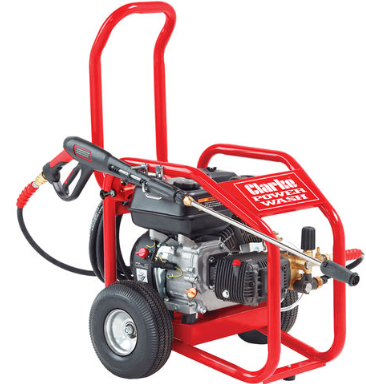
Clarke PLS195B Petrol Power Washer
Safety Instructions
- Avoid body contact with earthed or grounded surfaces such as pipes, radiators, ranges, or refrigerators.
- DO NOT expose power tools to rain or wet conditions. Water entering a power tool will increase the risk of electric shock.
- Avoid accidental starting. Ensure the switch is in the off position before connecting to the power supply.
- DO NOT overreach. Keep proper footing and balance at all times. This enables better control of the power tool in unexpected situations.
- Dress properly. DO NOT wear loose clothing or jewellery. Keep your hair, clothing, and gloves away from moving parts.
- Disconnect the power before making any adjustments, changing accessories, or storing power tools. Such preventive safety measures reduce the risk of accidentally starting the power tool.
- Store idle tools out of the reach of children and DO NOT allow persons unfamiliar with the power tool or these instructions to operate the power tool. Power tools are dangerous in the hands of untrained users.
- Maintain power tools. Check for misalignment or binding of moving parts, breakage of parts, and any other condition that may affect the power tool’s operation. If damaged, have the power tool repaired before use.
- Keep all parts of the body away from the saw chain when the chainsaw is operating. Before you start the Petrol Generator. Make sure the Petrol Generator is not contacting anything.
- A moment of inattention while operating chainsaws may cause entanglement of your clothing or body with the Petrol Generator.
Unpacking
Contact your CLARKE dealer immediately if any parts are missing or damaged.
| Power Washer | High-Pressure Delivery Hose |
| Gun/Lance Assembly | Lance / Nozzle Assembly |
| 2 x Wheels | 2 x Rubber Feet c/w fittings |
| Supply (Suction) Hose | Detergent Hose with filter |
| 2 x Axles c/w fittings | Tommy Bar |
| Hose / Lance Storage Bracket | Spark Plug Box Spanner |
| Separate engine user manual |
Symbols
- Read this manual and make sure that all warnings and instructions are clear before you use this pressure washer.
- Risk of fire or explosion. Stop the engine before you refuel the pressure washer. Keep flammable materials away from the work area. DO NOT spray flammable liquids.
- Risk to breathing. Engine exhaust fumes can kill. For outdoor use only. Work in a well-ventilated area.
- Risk of injection or severe injury. DO NOT directly discharge he stream at persons or animals. Keep clear of the nozzle. This machine should only be used by qualified operators.
- Risk of spray injury. Spray can propel objects. Always wear ANSI-approved Z87.1 Safety Glasses.
- Risk of chemical burn. NEVER spray acids, corrosive, or toxic chemicals. Use only cleaners formulated for power washers.
- Risk of electrocution. NEVER direct the spray toward any electrical device or electrical outlet.
- Risk of unsafe operation. Keep children away from this equipment. Gun kicks back. Hold with both hands.
- Risk of hot surfaces. Avoid contact with hot engine exhaust components. DO NOT allow hoses to contact the engine muffler during or after use.
Overview
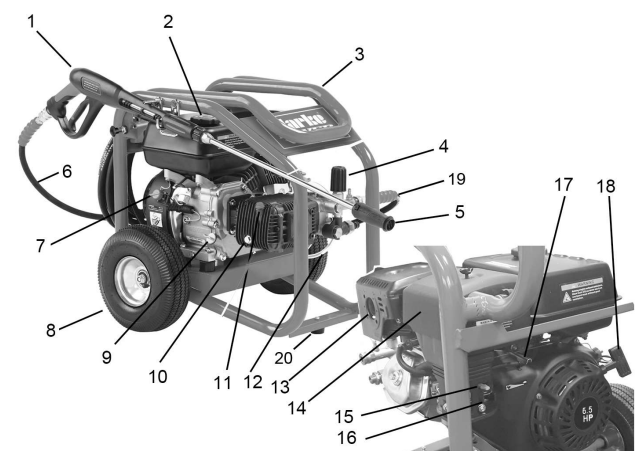
Dscription
- Gun/lance
- Fuel Filler
- Foldable handle
- Pressure regulator
- Adjustable nozzle
- High-pressure delivery hose
- On/Off Switch
- Wheel/tyre assembly
- Engine oil filler
- Pump oil drain
- Pump oil filler
- Chemical (detergent) hose
- Exhaust muffler
- Air filter housing
- Fuel Shut-off Valve
- Choke
- Throttle
- Engine starter
- Engine starter
- Rubber foot
Assembly
FITTING THE WHEELS
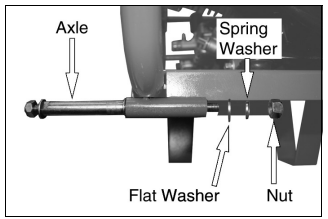
- Fit the axles into the axle ports as shown, secure with the nut, spring washer and flat washer.
- Fit the wheels to the axles and secure with the nut and washer.

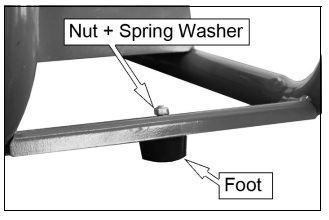
- Fit the rubber foot to the leg as shown.
Assembling the Lance
- Connect the spray wand to the lance and tighten securely.
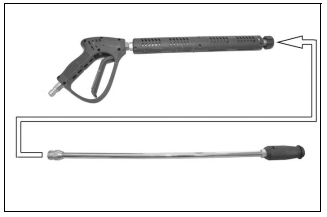
Connection
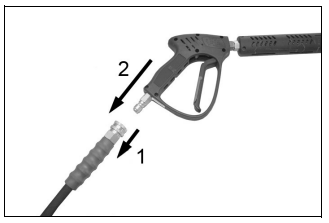
Hose To The Gun
- Slide the connector on the hose backwards.
- Push the gun into the connector.
- Release the connector.
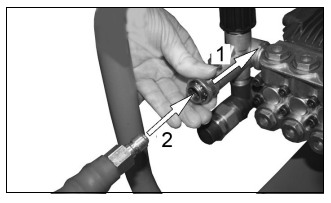
Hose To Machine
- Slide the connector on the power washer towards the machine.
- Push the hose into the connector.
- Release the connector.
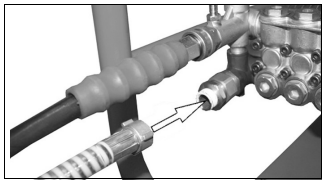
Water Inlet Hose
- Remove the travel cap if fitted.
- Connect the water supply hose to the water inlet.
Lance Storage Bracket
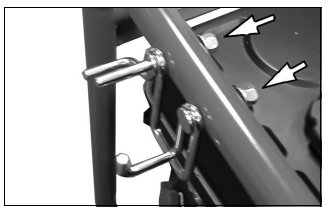
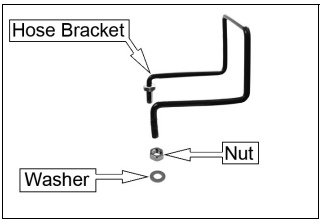
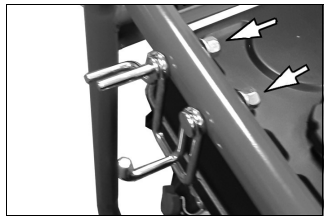
- Fit the bracket into the position shown and secure using the washers and nuts supplied.
- Screw a nut and washer onto each leg of the hose bracket.
- Fit the hose bracket in place and secure using a washer, spring washer, and nut.
Removing the Plug
- Remove the red travel plug before use.
- Inside the small bag attached is the oil filler cap, which needs to be fitted in its place.
Before Use
THE PUMP OIL LEVEL
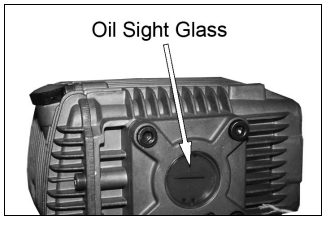
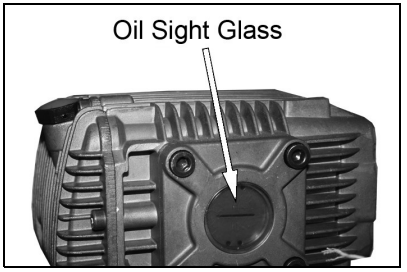
The sight glass on the pump displays the oil level inside. If required, top up with oil.
- We recommend the use of SAE30 oil in this pump.
ENGINE OIL LEVEL
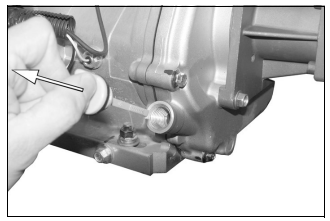
- Turn the oil filler cap/dipstick anticlockwise and remove it from the oil filler tube. Wipe the dipstick with a clean cloth.
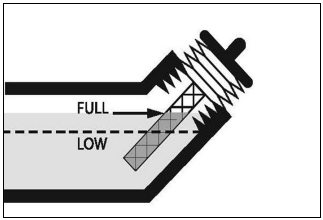
- Insert the oil filler cap/dipstick back into the oil filler tube and then remove it again. DO NOT screw it in when doing this.
- If the oil is low, fill the oil reservoir to the edge of the oil filler hole.
- Replace the oil filler cap.
Fuel Level
- To check the fuel level, remove the fuel tank cap.
- Just inside the fuel tank is a fuel strainer.
- Check this filter periodically and remove any contaminants which may have accumulated.
- Refuel in a well-ventilated area before starting the engine. If the engine has been running, allow it to cool.
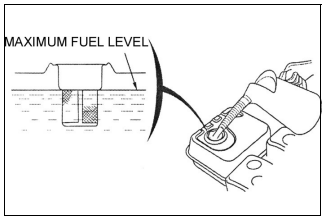
- Refuel carefully to avoid spilling fuel. DO NOT fill above the fuel strainer shoulder.
- After refuelling, gg replace the fuel filler cap securely.
Adjustment
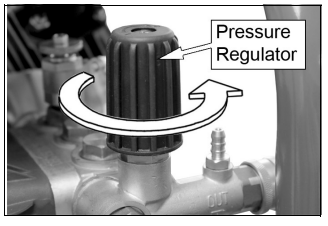
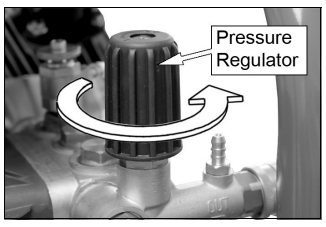
When supplied, the pressure regulator may be set to a minimum. Turn the pressure regulator on the pump fully clockwise to allow water pressure to build up when the pressure washer is running. If you find the pressure is too high, you can adjust this later.
Design Features
Bypass mode: In bypass mode, the pump recirculates the water because the trigger of the spray gun is not being pulled. If the unit is left in bypass mode for more than two minutes, the water temperature will rise to a dangerous level and could damage internal components of the pump.
Thermal Relief Valve: In an effort to prevent extreme damage, pumps are equipped with a thermal relief valve. This valve will open when the temperature inside the pump becomes too high. This valve will then release a gush of water to lower the temperature inside the pump. Immediately after this occurs, the valve will close.
Chemical Injection System: This mixes cleaners or cleaning solvents with the pressurised water to improve cleaning effectiveness.
Starting the Machine
Prior to starting, refer to your engine manual for proper starting procedures for your engine type.
- Make sure the engine has sufficient fuel.
- Check the engine oil level.
- Turn the water supply on.
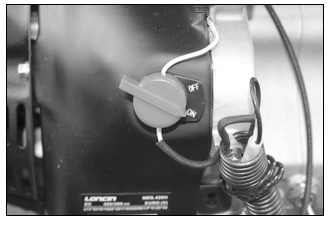
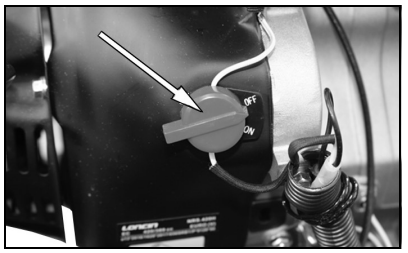
- Set the engine switch to ‘ON’.
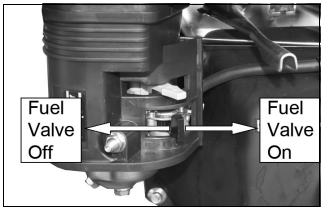
- Set the fuel valve lever to the ‘ON’ position.
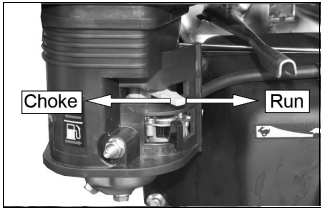
- If you are starting the power washer ‘cold’, set the choke lever to the CHOKE position (left).
- If the power washer is warm, skip this step.
- Set the throttle to the 1/3rd of the way towards the fast setting
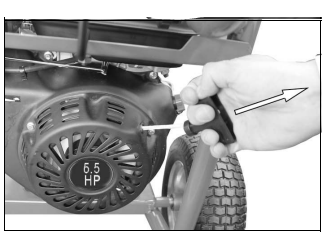
- Pull the starting handle lightly until you start to feel resistance, and then pull up sharply to start the power washer.
- Once the engine has warmed up, set the choke lever to the ‘RUN’ (right) position.

Power Washer
- Pull the trigger on the gun to start the water flow.
- Stand on a stable surface and grip the gun/spray wand firmly with both hands.
- Expect the gun to kick when the trigger is pulled.
- Release the trigger to stop the water flow.
Spray
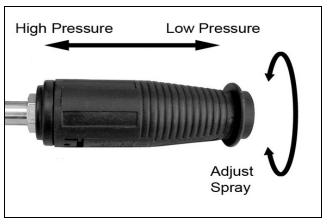
- The nozzle is adjustable to allow you to change the spray from a narrow jet of water to a wide spray.
Nozzle
- Hold the shaft of the lance and twist. The nozzle with the other hand.
- To vary the spray between narrow and wide, turn the nozzle counterclockwise through a half-turn.
Pressure
- Adjust the pressure regulator on the pump. Turn the pressure regulator knob counterclockwise to lower the pressure. Once you have finished work, return the pressure regulator to its original position.
- Back away from the surface to be cleaned. The further away you are, the less the pressure will be on the surface being cleaned.
- Reduce the speed of the engine. Slow the engine down, and the water pressure will drop.
- Adjust the spray to a wider angle.
- Slide the nozzle forward for low pressure and backwards for high pressure.
Using Chemicals & Cleaning Solvents
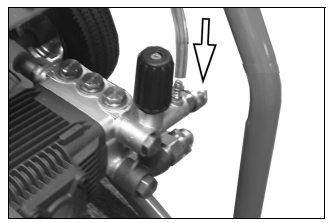
- Push the chemical hose onto the ridged fitting as shown.
- Place the other end of the chemical hose with the filter on it into a container holding the chemical/ cleaning solution.
- Slide the nozzle forward for low-pressure operation.
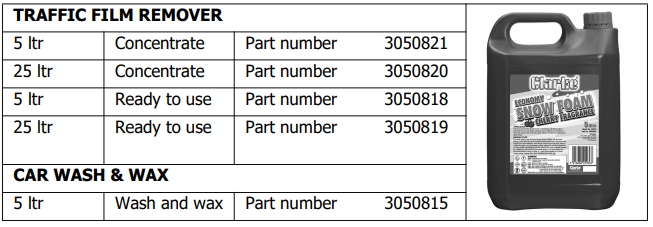
- The following products are available from your CLARKE dealer.
Shutting Down
- After each use, if you have applied chemicals, place the chemical hose into a container of clean water and run clean water through the chemical injection system to flush the system thoroughly.
- Turn the engine off. See the engine owner’s manual.
- Turn the water supply off.
- Pull the trigger on the spray gun to relieve any water pressure.
- See the storage section in this manual for proper storage procedures.
Maintainance
CHANGING THE PUMP OIL
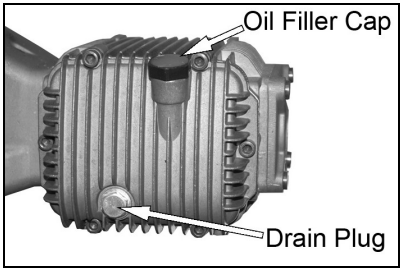
- Unscrew and remove the oil filler cap.
- Place an oil collection tray (not supplied) under the drain plug.
- Unscrew the drain plug, and allow the used oil to drain from the crankcase into the oil collection tray.
- Replace the drain plug and its ring seal.
- With the power washer in a level position, fill to Clarke PLS195B Petrol Power Washer the centre of the sightglass with the recommended oil.
- Replace the oil filler cap.
Cleaning The Nozzle
If the nozzle becomes partially clogged or restricted by dirt or other foreign material, excess pump pressure may develop. Clean the nozzle immediately by Clarke PLS195B Petrol Power Washer following the instructions below.
- Shut off the power washer and turn off the water supply.
- Pull the trigger on the gun handle to relieve any water pressure.
- Disconnect the spray wand from the gun.
- Remove any obstructions and back-flush with clean water.
- Direct the water supply into the spray wand end for 30 seconds to back flush loosened particles.
- Reconnect the spray wand to the gun, and Clarke PLS195B Petrol Power Washer, turn on the water supply.
Water Inlet
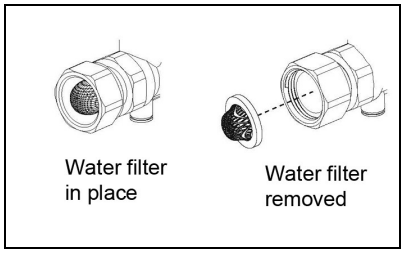
This water inlet should be checked regularly and cleaned if necessary.
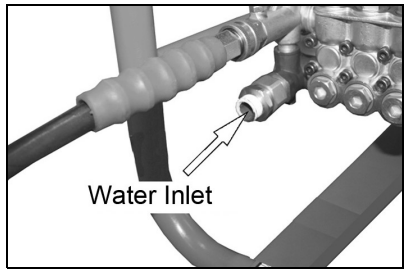
- Remove any fittings from the water inlet.
- Remove the water filter from the water inlet.
- Clean the filter by flushing it with water on both sides.
- Replace the water filter.
Changing Spark Plug
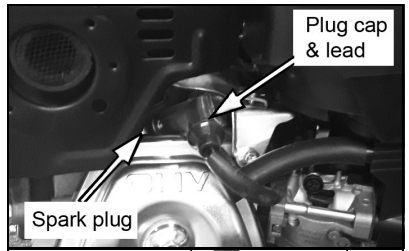
- Remove the spark plug cap/lead from the spark plug.
- Use the spark plug spanner, supplied, to remove the spark plug.
- Remove any carbon that has accumulated Clarke PLS195B Petrol Power Washer around the electrode.
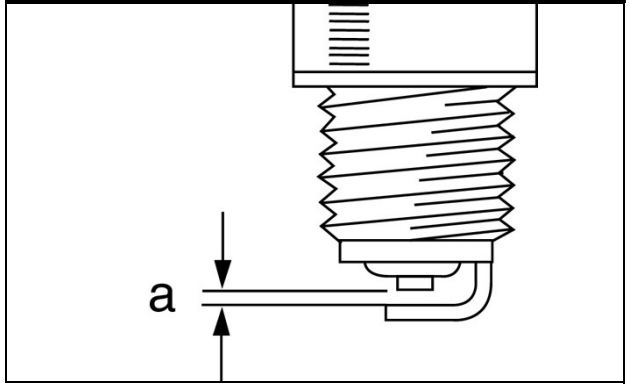
- Check the spark plug gap (a) and adjust if necessary.
- Check the overall condition of the spark plug and replace it if poor.
- Reinstall the spark plug and refit the spark plug cap.
Air Filter
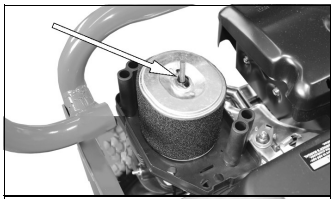
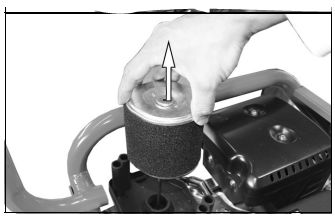
- Remove the wingnut and remove the air filter cover.
- Remove the second wingnut shown.
- Remove the air filter element.
- Make sure that the air filter is clean and not damaged.
Storage
- Drain all water from the high-pressure hose, coil it and store it on the gun/hose holder, located on the side of the power washer handle.
- Drain all water from the spray gun and spray wand by holding the gun/wand vertically with the nozzle pointing down, and pulling the trigger. Store in the gun/ hose holder.
- Store all other parts so that they are protected from damage.
| Model Number | PLS195B |
| Part Number | 7330362 |
| Engine Model & Type | G200F, Petrol Air Cooled |
| Engine Power & Capacity | 6.5HP, 4.8kW, 3600rpm, 196cc |
| Starting System | Recoil |
| Fuel Capacity (Maximum) | 3.6 Litre |
| Emissions (CO, HC, NOx, HC+NOx, CO2) | 380.35, 5.31, 2.24, 7.55, 811.46 (g/kWh) |
| Max. Permissible Pressure | 182bar / 2639psi |
| Working Pressure (From Mains Supply) | 170bar / 2465psi |
| Working Pressure (From Barrel) | 170bar / 2465psi |
| Water Inlet Pressure Range | 3 – 6bar / 43 – 87psi |
| Max. Flow Rate (From Mains Supply) | 12.5L/min / 750L/hr |
| Working Flow Rate (From Mains Supply) | 10L/min / 600L/hr |
| Max. Flow Rate (From Barrel) | 12.2L/min / 732L/hr |
| Working Flow Rate (From Barrel) | 9.1L/min / 546L/hr |
| Water Type | Clean Cold Water |
| Ambient Operating Temperature | 400C (1040F) |
| Input Water Temperature | 10C (340F) – 600C (1400F) |
| Water Supply Hose Diameter | Suitable Snap Connector – 1/2” or 3/4” Hose |
| Water Supply Suction Depth | Less Than 1m |
| Detergent Hose Length | 1.5m |
| High-Pressure Hose Length | 10m |
| Sound Pressure Level (LPA) | 86dB |
| Sound Power level (LWA) | 99dB |
| Guaranteed sound power level (LWA) | 101dB |
| Sound Uncertainty Factor K | 1.24dB |
| Vibration (measured at the lance) | <2.5m/s2 |
| Uncertainty Factor | 1.5m/s2 |
| Max. Dimensions (L x W x H) | 962mm x 575mm x 650mm |
| Weight | 41.2kg |
Part Diagram
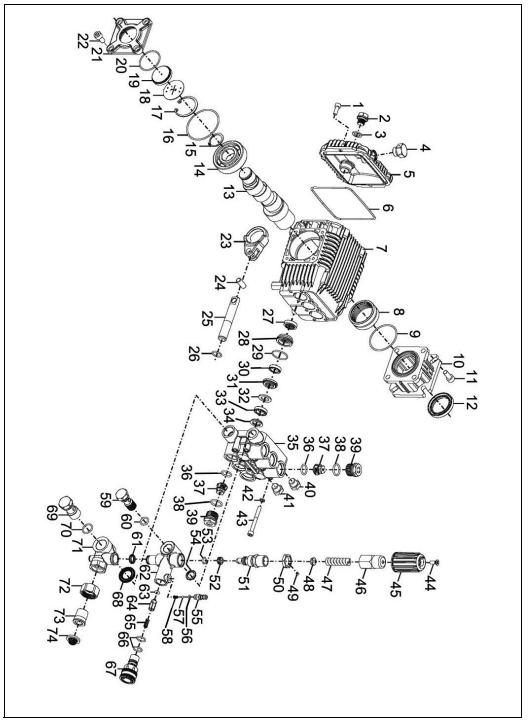
Part List
| 1 | Bolt M6x16 | 38 | O-ring (valve cap) | |
| 2 | Oil Drain Plug | 39 | Check valve cap | |
| 3 | O-ring | 40 | Manifold outlet plug | |
| 4 | Vented Oil Cap | 41 | Thermal relief valve | |
| 5 | Crankcase Cover | 42 | Washer | |
| 6 | Gasket | 43 | Socket bolt M6x55 | |
| 7 | Crankcase | 44 | Screw | |
| 8 | Needle Bearing | 45 | Regulator hand grip | |
| 9 | O-ring | 46 | Regulator adjusting knob | |
| 10 | Flange | 47 | Spring | |
| 11 | Bolt | 48 | Spring seat | |
| 12 | OIl Seal | 49 | Screw, jam nut | |
| 13 | Crankshaft | 50 | Jam nut | |
| 14 | Ball Bearing | 51 | Valve body | |
| 15 | Scrap ring | 52 | Valve seat | |
| 16 | O-ring | 53 | O-ring | |
| 17 | Circlip | 54 | Gasket | |
| 18 | Oil Level Plate | 55 | Detergent injector fitting | |
| 19 | Oil Sightglass | 56 | O-ring -injector fitting | |
| 20 | O-ring | 57 | Ball – injector fitting | |
| 21 | Crankshaft cover | 58 | Spring – injector fitting | |
| 22 | Bolt M8 x16 | 59 | Water outlet banjo bolt | |
| 23 | Connecting rod | 60 | O-ring | |
| 24 | Pin | 61 | O-ring | |
| 25 | Ceramic-coated plunger | 62 | Unloader valve housing | |
| 26 | O-ring | 63 | O-ring | |
| 27 | Oil seal | 64 | Outlet checking valve | |
| 28 | Locating ring | 65 | Spring – outlet checking valve | |
| 29 | Locating O-ring | 66 | O-ring – outlet fitting | |
| 30 | Low-pressure water seal | 67 | Quick disconnect outlet fitting | |
| 31 | Compression ring | 68 | Gasket – bypass housing | |
| 32 | Compression Seal | 69 | Water inlet banjo bolt | |
| 33 | High-pressure water seal | 70 | O-ring – inlet banjo bolt | |
| 34 | Supporting ring | 71 | Bypass housing | |
| 35 | Manifold | 72 | Swivel nut – inlet connector | |
| 36 | O-ring (check valve) | 73 | Body – inlet connector | |
| 37 | Check valve | 74 | Filter washer – inlet connector |
Frame & Accessories Diagram
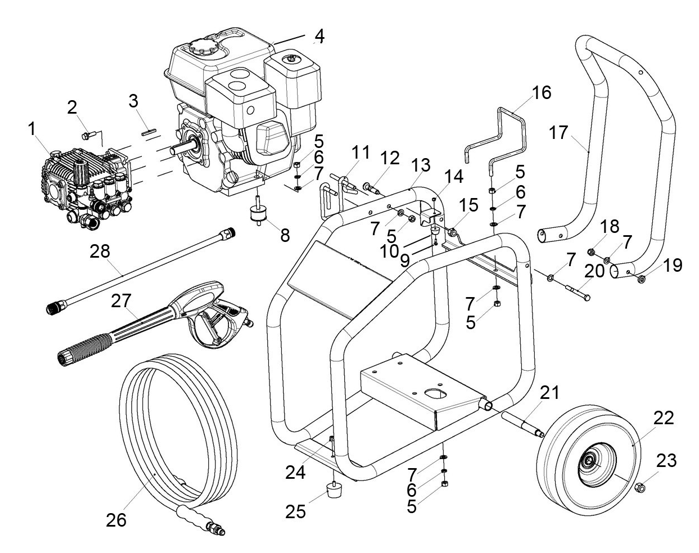
| 1 | Pump assembly | 15 | Nut | |
| 2 | Bolt | 16 | Hose support bracket | |
| 3 | Key | 17 | Handle | |
| 4 | Engine assembly | 18 | Nut | |
| 5 | Nut | 19 | Spring washer | |
| 6 | Spring washer | 20 | Bolt | |
| 7 | Plain washer | 21 | Axle | |
| 8 | Rubber foot (engine) | 22 | Wheel | |
| 9 | Bolt | 23 | Nut | |
| 10 | Rubber Pad | 24 | Nut | |
| 11 | Lance support bracket | 25 | Rubber foot – (frame) | |
| 12 | Pull Pin | 26 | High-Pressure Hose | |
| 13 | Frame | 27 | Gun | |
| 14 | Nut | 28 | Lance |
Troubleshooting
| PROBLEM | CAUSE | SOLUTION |
| The engine will not start (see engine manual for further engine troubleshooting) | No fuel | Add fuel (see page 100) |
| Low oil | Add oil (see page 9) | |
| Pressure builds up after two pulls on the recoil starter or after initial use.. | Squeeze the gun trigger to relieve the pressure | |
| Spark plug wire not attached correctly | Attach the spark plug wire | |
| The engine switch is in the OFF position | Set the engine switch to the ON position | |
| The choke lever is set to the choke position when the engine is warm | Set the choke lever to the NO CHOKE position | |
| Fuel valve closed | Open the fuel valve | |
| Lack of pressure (initial use) | The water supply is not adequate | Make sure your water supply can deliver 5 gallons per minute at 20psi |
| Leak in the high-pressure hose fitting | Tighten the fitting, use sealant tape if required | |
| The nozzle is obstructed | Clear the nozzle | |
| The water filter screen is clogged | Remove and clean the filter | |
| Air in the supply hose | Turn off the engine. Turn off the water supply Disconnect the water supply from the pump inlet and turn on the water to expel the air from the hose. When all the air has been removed, turn off the water supply and reconnect the hose. Turn on the water supply and pull the trigger to expel any air in the gun/wand. |
Environmental Protection
Recycle unwanted materials instead of disposing of them as waste. All unwanted accessories and packaging should be sorted and taken to a recycling centre for disposal in a manner which is compatible with the environment.
Through the purchase of this product, the customer is taking on the obligation to deal with the WEEE in accordance with the WEEE regulations in relation to the treatment, recycling & recovery and environmentally sound disposal of the WEEE.
In effect, this means that this product must not be disposed of with general household waste. It must be disposed of according to the laws governing Waste Electrical and Electronic Equipment (WEEE) at a recognised disposal facility.
One of the most damaging sources of pollution is oil. DO NOT throw away used oil with your domestic rubbish or down drains and sinks. Place it in a Clarke PLS195B Petrol Power Washer leak-proof container and take it to your local waste disposal site.
Customer Service
- Call: 0208 988 7400
- Website: parts@clarkeinternational.com
- Visit: service@clarkeinternational.com
FAQs
What type of engine does the Clarke PLS195B use?
The PLS195B has a dependable 4-stroke gasoline engine that is built for effective and aggressive cleaning.
What is the maximum pressure output of this power washer?
For difficult cleaning tasks, its maximum pressure of about 195 bar (2830 PSI) is appropriate.
What is the water flow rate?
The unit provides an efficient water volume for cleaning with a flow rate of about 7.5 litres per minute.
Can I use detergent with this power washer?
Indeed, the PLS195B features an integrated detergent tank and an injector to make cleaning solutions simple to use.
What type of hose and nozzles come with the washer?
It comes with a high-pressure hose and several nozzle tips, including detergent nozzles for different spray patterns and 0°, 15°, and 25° nozzle tips.
How do I start the power washer?
Pull the starter cord firmly until the engine starts after filling the fuel and oil reservoirs, connecting the water supply, priming the pump, and setting the choke.
What safety precautions should I take while operating?
Wear safety gear at all times, such as goggles, gloves, and sturdy shoes. Never aim the spray pistol towards fragile surfaces, people, or animals.
Can this power washer be used for commercial cleaning?
Yes, it is appropriate for light commercial and domestic cleaning jobs because to its pressure and flow rate.