

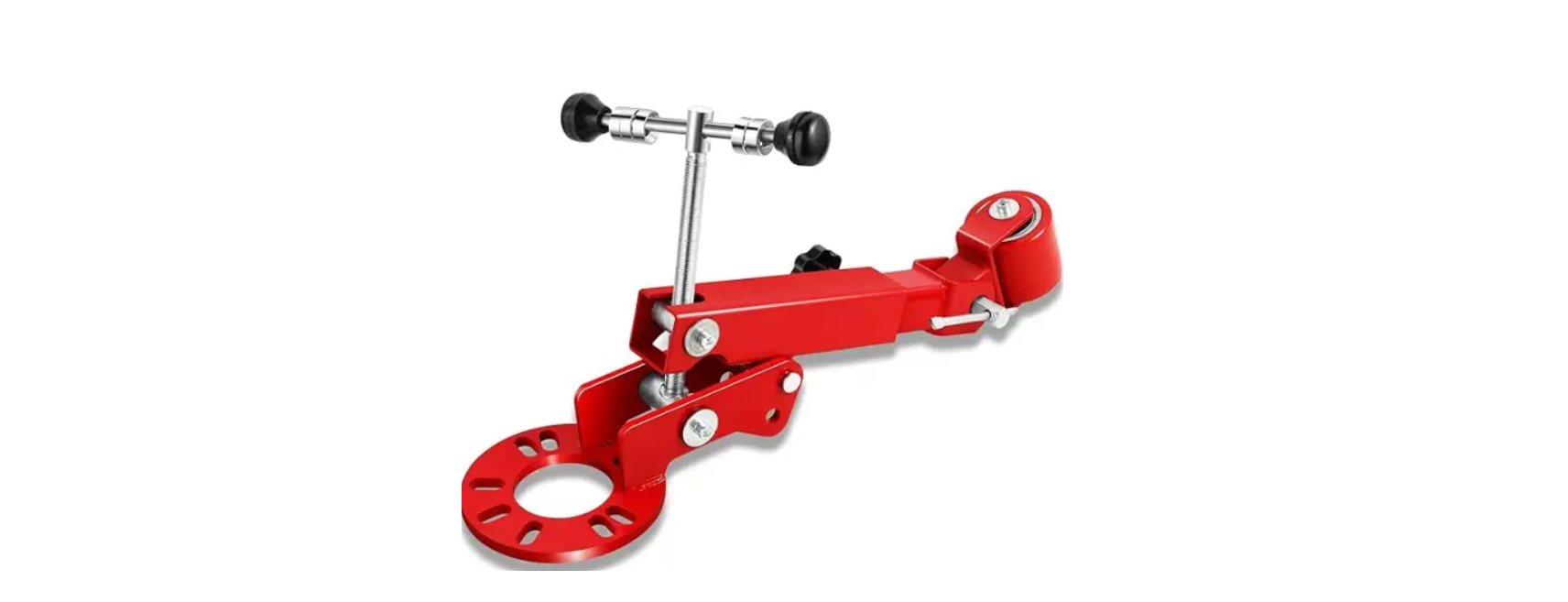

EASTWOOD 12124Q Pneumatic Fender Finisher
Warning
Read all instructions before attempting to use this tool! Failure to do so can result in severe personal injury or vehicle damage. This tool, as with many pneumatic tools, is capable of exerting tremendous force, which can quickly cause severe personal injury and/or damage to metal body panels. Please review instructions completely before beginning, and start on the lowest setting.
Operation
Please note that many variables may affect the resistance to the paint cracking in the work area, such as the type of finish, age, thickness, and the amount of forming required in the area. Please be aware that
paint and metal damage can occur with the use of this tool, and the user assumes all responsibility for such damage. The use of a Heat Gun, such as EASTWOOD 12124Q Pneumatic Fender Finisher Eastwood # 43522, will greatly reduce the chance of paint cracking by allowing it to soften and flex with the metal.
Tool Set-Up and Adjustment
- Minimum air requirements: 6 cfm @ 90 psi.
- It is strongly advisable to practice on a scrap fender or a metal object
with a similar configuration to become familiar with the tool and
avoid severe personal injury or damage to your vehicle. - Loosen the Outer and Inner Adjustment Wheels (Fig X) so that the Floating Outer Pad Assembly is fully extended (Fig X).
- With the Control Knob at the lowest setting, attach the air supply, then cautiously depress the trigger and quickly release it. Do not keep finger pressure on the trigger or damage my tool.
- With masking tape, outline the area to be modified. (Fig X). Make note of and mark the center of the outlined area.
- Before supplying air to the tool, be sure the Pressure Control is at its lowest setting
- . Using a Heat Gun, warm the outlined area to a temperature above 120°F but no greater than 150°F. Using an IR thermometer, such as Eastwood # 11476 or 11477, is highly recommended to avoid overheating and damaging the finish. The use of heat softens and
- minimizes the chance of paint cracking. Place the jaws of the tool over the fender lip (Fig X) with the wider pivoted jaw on the outside against the painted surface.
Optional Items
- # 43522 Heat Gun.
- # 11476 or 11477 IR Thermometer.
- 16031 Z Eastwood Heavy Duty Anti-Rust
Customer Support
- Website: https://help.eastwood.com/
- Ph: 1 (800) 343-9353
- Timings: Monday – Friday, 9:00 AM to 6:00 PM.
FAQs
What are the benefits of using a pneumatic fender finisher?
Using a pneumatic fender finisher speeds up the metal finishing process, reduces operator fatigue, enhances precision in shaping, minimizes surface imperfections, and helps achieve a professional, smooth finish on automotive bodywork.
What air pressure is required for optimal operation?
Optimal operation requires an air pressure between 70 and 90 PSI to ensure consistent vibration intensity and effective finishing results without overloading the tool.
How do I connect the fender finisher to my air compressor?
Connect the tool to your air compressor using a standard 1/4-inch NPT quick-connect fitting. Make sure your air hose is compatible, securely attached, and free from leaks to maintain proper airflow.
How do I operate the finisher for the best results?
Operate by holding the tool steady and moving it smoothly over the metal surface. Apply consistent light to moderate pressure, allowing the vibrating hammer head to do the work. Avoid lingering too long in one spot to prevent uneven finishes.
Are there any risks of damage to the metal surface?
Yes. Excessive pressure, slow movement, or overworking one area can cause metal distortion or thinning. It is essential to practice technique on scrap metal and use even, flowing motions to avoid damage.
Can I use aftermarket attachments or replacement heads?
While some aftermarket parts may fit, it’s best to use EASTWOOD-approved attachments to guarantee compatibility, safety, and optimal performance with your 12124Q Fender Finisher.
Where can I find replacement parts?
Replacement parts can be purchased directly from EASTWOOD’s official website or through authorized distributors and retailers. Ensure parts are genuine for quality and warranty coverage.