

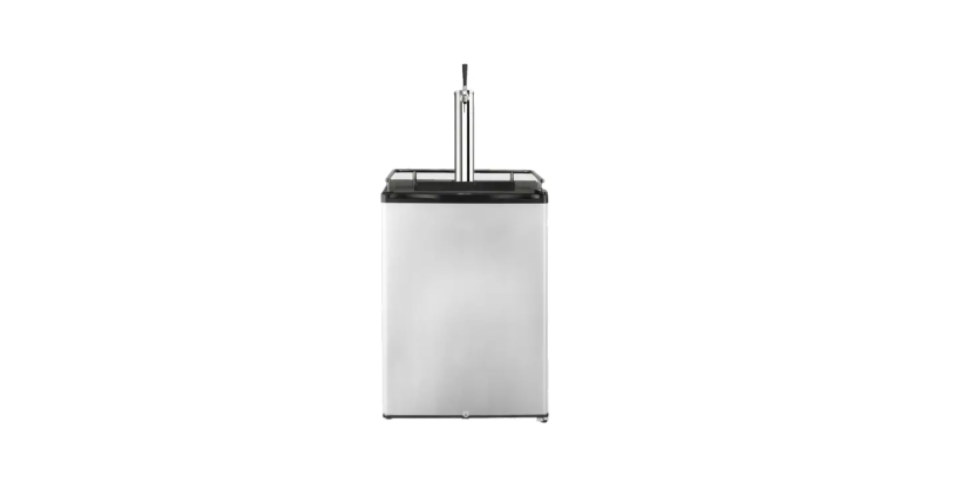

HARBOUR HBRKBC185X 185L Generator

Safety Instructions
Read this manual thoroughly before first use, even if you are familiar with this type of product. The safety
precautions enclosed herein reduce the risk of fire, electric shock, and injury when correctly adhered to.
- Do not damage the refrigerant circuit! Never use an appliance with a damaged refrigerant circuit! If the refrigerant circuit becomes damaged during transport or installation, avoid proximity to open fires and all types of heat and ignition sources. Thoroughly ventilate the room in which the appliance is located. The room for installing the appliance must be at least 1m³ per 8g of refrigerant. The amount and type of refrigerant in the appliance can be found in the technical specifications on page 13 and on the appliance rating plate.
- It is hazardous for anyone other than an authorised service person to service this appliance. In Queensland, the authorised service person MUST hold a Gas Work Authorisation for hydrocarbon refrigerants to carry out servicing or repair that involves the removal of covers.
Unpacking the Appliance
Important! If the appliance has been recently transported, please leave the appliance in an upright position for a minimum of 24 hours before connecting to power and use.
- Move the fridge as close to the final location as possible before unpacking.
- Remove the packaging, including protective packaging, from the inside of the fridge.
- Please pay attention to the correct disposal of the various packaging elements, many of which can be recycled (kerbside)
Installation
Location
- Install the appliance in a well-ventilated area, protected from outside elements. The appliance has been designed with an IPX4 rating, allowing it to be used outside within Alfresco areas. The appliance should be located to avoid full sun.
- The appliance should have at least 70 mm clearance at the sides and rear between itself and any surrounding walls or cabinetry.
- Give consideration to where the nearest power point is located. The appliance should be plugged directly into the power outlet and not connected to an extension cord.
Keep it upright
Do not tilt the fridge more than 45° from upright when moving it.
Handle with care
Do not apply force to any part of the appliance, such as the condenser or door.
Ventilation
To ensure proper ventilation, keep any ventilation openings in the appliance enclosure or in the built-in structure clear of obstructions. Ensure adequate air circulation around the appliance to prevent overheating.
Level
Install the appliance in an area that meets the following requirements:
Ambient temperature
The ambient temperatures must correspond to the climate class (T) indicated on the rating plate of the appliance: 16°C-43°C.
Floor surface
The floor must be sturdy, level (or nearly level), and strong enough to support the unit when it is fully loaded.
Product Overview
Due to continued product improvement, images and illustrations in this manual may vary slightly from the product purchased. All images in this manual are for reference purposes only. Parts are not necessarily pictured to scale.
Key
- Draft beer tower with faucet/tap
- Guardrail
- Drip tray
- Upper hinge cover plate
- Upper hinge
- Door with a gasket seal
- Compressor cover
- Lower hinge
- Door lock plate
- Adjustable Feet or Optional Caster wheels (including two with locks for the front)
- Light switch
- LED light
- Rear cover ventilation grill

The default configuration of the Kegerator includes Adjustable Feet as standard. The kegerator includes optional Caster Wheels, should you wish to install them.
Key 2
- 1A. Beer tap handle
- 1B. Beer faucet/tap
- Draft beer tower, including beer line
- Keg coupler (included with the kegerator is 1 × domestic D-Type Sankey coupler and 1 × domestic A-Type coupler)
- CO2 regulator
- Air line (Red CO2 hose with clamp)

Included components/parts not pictured
- 1 × Faucet spanner wrench
- 1 × Hose clamp
- 1 × Drip tray base
- 1 × Drip tray insert
Components required (sold separately)
- 1 × Carbon Dioxide (CO2) tank. Required installation tools (not supplied):
- Level
- Philips head screwdriver
- Adjustable spanner wrench
Get To Know
Knowing these components of equipment and having a basic understanding of how they work will help keep the system running smoothly and get the best results from the setup. The kegerator is a standard system for delivering draft beer from keg to tap across a short distance. Carbon dioxide (CO2) is used to push the beer from the keg through the beer line up to the draft tower and to the faucet/tap. The kegerator allows you to set a temperature between 0°C and 10°C, to suit your preferred taste.
Co2 Regulator
The carbon dioxide inside the tank (not supplied and to be purchased separately) builds up a tremendous amount of pressure. If you’re not careful about controlling this pressure, the beer dispensed will be a foamy mess that no one wants to drink. The CO2 regulator helps prevent this problem and ensures that the gas does its job. The CO2 regulator includes two gauges — a high-pressure gauge and a low-pressure gauge so you can quickly identify and troubleshoot any problems.
Key
- Low-pressure gauge (reads the amount of internal keg pressure)
- High-pressure gauge (indicates existing pressure in the CO2 cylinder/tank)
- Pressure adjustment knob (screw anti-clockwise for lower pressure/CO2 flow and clockwise for higher pressure/C
- CO2 inlet nipple
- CO2 inlet nut (which connects to the CO2 cylinder/tank)
- Pressure relief valve
- Optional shut-off valve (isolation lever)
- Outlet barb fitting (connect to gas tube)

Air Line
The air line (or hose) is a food-grade vinyl tube that will be used to transport the Carbon Dioxide (CO2)
from the CO2 tank/cylinder (purchased separately), via the CO2 regulator, to the keg coupler. There is a
hose clamp fitted onto one end of the air line hose.
Keg Coupler
The keg coupler attaches directly to the chosen keg with an air-tight seal. The probe of the coupler pushes directly into the keg valve and acts as a critical junction point in the draft beer dispensing. The coupler has two ports: one for the air line to attach (so the gas gets pushed into the keg) and one for the beer line to attach (so the beer can flow out).
D-Type coupler supplied
A-Type coupler supplied
Key
- Probe
- Hinge Pin
- Lever Handle
Beer Line (Clear Hose)
The beer line is essentially the exact same thing as the air line, except that it carries beer instead of gas! It attaches directly to the keg coupler on one side and the faucet on the other. It is also made using a food-grade vinyl and is secured in place using the supplied hose clamps.
Draft Beer Tower
A draft beer tower is where the beer line is housed and provides a mount for the draft beer faucet/tap. Inside the beer tower, beer lines attach to the draft shank, which carries the beer on the final leg of its journey to the draft faucet. This particular model includes a single draft beer faucet/tap.
Draft Beer Faucet/tap
The draft beer faucet is the tap from which the beer is dispensed. The kegerator includes a quality
304 grade stainless steel tap. Like the beer lines, this tap should be regularly disassembled and cleaned
for optimal performance and health/hygiene reasons.
Tap Handle
The tap handle screws onto the Draft Beer Faucet/Tap and makes it easier to open and close the tap
when pouring. The kegerator is supplied with a standard black tap handle; however, there is a range of
novelty handles available within the marketplace should you wish to give the kegerator more personality!
Drip Tray
The plastic drip tray is designed to sit directly below the Draft Beer Faucet/Tap, to catch any
accidental spills or drips.
Krg Tyres
Before setting up the kegerator, it is important to understand the difference between the two categories
of kegs that exist and the fittings that are required to carbonate and dispense from these. You will need
to match the fittings to the keg type you are using. There are two main categories of kegs, which come in
multiple sizes. Commercial-stylee Kegs
- Homebrew style (Cornelius) Kegs
Commercial Keg Style
Commercial kegs come in a variety of sizes: 20 L, 25 L, 35 L, and 50 L. The 50 L size is the most common size that you will come across. Commercial kegs come in three main styles: A-Type, D-Type, and S-Type.
Common keg coupler types
- Type D
Used by CUB, Fosters, Carlton draft, VB. This coupler is also commonly known as the “American Sankey Coupler” as it is the most common coupler used in the USA. - Type A
Used by Tooheys, Coopers. Commonly referred to as the “German Slider Coupler”. - Type S
Used by Asahi, Heineken, and Hofbräu Kegs. Commonly referred to as the “Twist On Coupler”.
Homebrew Style (Cornelius) Kegs
Kegs used for homebrewing come in two main categories: Cornelius kegs and mini kegs. The Cornelius keg
category can be split into two main types: ball-lock and pin-lock. Fittings and adapters for these keg types
aren’t included and would need to be purchased separately from your local home brewing supplier.
Technical Specifications
- Model: HBRKBC185X
- Temperature: Range 0-10°C
- Climate Class: T
- Storage Volume: 185 L
- Protection Class: I
- Voltage: 220-240V/50Hz
- Input Current: 0.6 A
- Lamps Power: 1 W
- Refrigerant: R600 a/25 g
- Dimensions (W×D×H): 605×630×857 mm
- Foaming Agent: Cyclopentane
Compliance
This product has been fully tested and meets all requirements as set out by standards AS/NZS 60335.1 and AS/NZS 60335.2.24. The RCM Mark (Regulatory Compliance Mark) indicates that the product complies with the relevant guidelines of the ACMA as well as corresponding government requirements for the safety of electrical devices. This marking indicates that the appliance is suitable for use in tropical climates under ambient temperatures.
Getting Started & Set-Up
Unpacking
Plastic
Wrapping can be a suffocation hazard for babies and young children, so ensure all packaging materials are out of their reach and disposed of safely.
Parts
Check to ensure you have all the parts listed in the Product Overview section.
Damage
When unpacking, check the appliance carefully for damage. If it is damaged, do not install the appliance. Contact our after-sales support team for advice on examination or return of the damaged appliance.
Power cord
Unwind the power cord to its full length and inspect it for damage. Do not use the appliance if the appliance or its cord has been damaged or is not working properly. In case of damage, contact our after-sales support team for advice on examination, repair, or return of the damaged product.
Read the manual
Before installing the new fridge, read all safety instructions, especially the sections on installation and electrical safety on pages 6–7. Installation instructions follow on the next pages.
Clean
Make sure the appliance is disconnected from the power supply before cleaning the interior. Remove any tape that secured drawers, trays, and shelves during transport. Clean the interior surfaces and all internal accessories with lukewarm water, a soft cloth, and a neutral/mild soap/detergent. This will remove any dust from transit and storage and help remove the typical smell of a brand-new product. Then dry thoroughly.
Setting up the Kegerator
Caster Installation Procedure
-
- Preparation
Clear the cabinet of all contents and place the unit on a clean, dry, and padded surface. - Caster Installation
Insert the casters into the designated holes located on the bottom of the unit, as illustrated below, and securely tighten them using a wrench.
- Caster Positioning
Ensure that the two casters equipped with locks are affixed to the front of the unit. - Unit Re-positioning
Once all four casters are securely attached, carefully return the beer dispenser to an upright position. - Refrigerant Settling
Allow the unit to sit undisturbed for 4 hours before plugging it in. This allows the refrigerant to settle properly within the system.
- Preparation
Install the guardrail
-
- Screw the guardrail lugs into the top of the kegerator.
- Install the guardrail posts onto the guardrail lugs.
- Using the screws provided, fasten the guardrail posts onto the guardrail lugs.

Ensuring appliance stability
-
- It’s essential to confirm that the appliance is on a level surface. Check the floor for levelness, or if applicable, adjust the appliance’s feet to achieve balance. This is critical to ensure correct operation and reduce vibration within the compressor.
Electrical Connection
- Before plugging in the new kegerator, let it stand upright for at least 4 hours. This will allow
the refrigerant to settle into the compressor and reduce the possibility of a malfunction within
The cooling system. - The appliance must be earthed. The plug of the power supply cord is equipped with a contact for this purpose. Do not under any circumstances cut or remove the third (earth) prong from the power cord. If the plug does not fit the outlet, please consult a licensed electrician for advice to have the outlet changed.
- Plug the unit into a dedicated, properly installed, and earthed wall outlet. Ensure that the outlet voltage and circuit frequency correspond to the voltage stated on the appliance rating label.
- Secure the power supply cord behind the unit. Do not leave it exposed or dangling to prevent injury and accidental disconnection from the power supply.
- Adjust the temperature by using the controls outlined within the Instructions section on page 21.
Operating Instructions
- Tap/Open the keg by squeezing (or pulling) the coupler handle and pushing it downwards. You should see a small amount of beer enter the beer line.
- Pull the handle on the draft beer faucet/tap to allow the beer to flow through the beer line, out the faucet/tap, and into a jug or glass.
- Adjust the CO2 regulator and kegerator temperature as required to suit your beer and taste.
Before operating the kegerator
- Proper Installation
Mount the draft tower as close to the kegerator’s top as possible and seal any openings to prevent heat transfer. - Temperature Management
To achieve optimal results, refrain from frequently opening and closing the kegerator door, thereby maintaining a consistent internal temperature. Beer dispenses best within the range of 0-3.3°C (factory preset temperature is 4°C). Deviating from this range may lead to foam-related issues. - Environmental Placement
Position the kegerator in an area where the ambient temperature falls between 10-43°C (50-109.4°F). Extreme temperatures beyond this range could impact the unit’s performance, causing interior temperature fluctuations. Extreme cold or hot conditions, for instance, may lead to undesirable effects. Please note that desired temperatures may vary based on ambient temperature and keg orientation.
Temperature settings guide
- Temperature Adjustment
The settings, ranging from 0 (OFF) to 7 (M, AX), control the internal temperature of the kegerator. - Setting 0 (OFF): This position signifies that the refrigerator is not operating. To set it to this mode, press the knob and turn it until it reaches the “0” position.
- Setting 1 (MIN)
This is the lowest setting, resulting in the warmest internal temperature within the kegerator. - Setting 7 (MAX)
This setting indicates the highest level, leading to the coldest internal temperature achievable within the kegerator.
Troubleshooting Guide
| Issue/Fault | Possible Causes | Corrective Action |
| Warm beer | Fridge thermostat set too high. | Set the fridge thermostat to a lower setting. |
| Insufficient ventilation and airflow. | Ensure that the fridge has sufficient ventilation at the sides and rear (minimum 70 mm). | |
| Warm beer is placed in the fridge. | Allow adequate time for the beer keg to cool down. We suggest leaving a new keg in the fridge overnight to reach temperature. | |
| The fridge is powered off. | Check that the appliance is plugged in correctly, the power outlet is switched on, a fuse hasn’t blown or tripped on the circuit breaker, etc. | |
| Prolonged door open or ajar. | Ensure that the fridge door is fully closed and sealing correctly. | |
| Evaporator coil iced over. | Unplug the fridge, leave the door open, and allow the fridge to defrost. | |
| Excessive beer foam | 1. The beer keg is too warm. | After replacing a keg or installing a new keg, please allow adequate time for the keg to cool down and reach the correct temperature (ideally overnight). |
| 2. Keg pressure is too low. | Set the CO2 pressure according to the beer type and keg temperature.
Refer to Table 277. |
|
| 3. Over-carbonated keg. | Depressurise the keg. | |
| 4. Dirty beer lines. | Perform a beer line clean. | |
| Excessive noise | 1. Vibration | Ensure that the kegerator is located on a flat, level, and solid surface. Legs all wound down to the ground. |
| 2. Loose parts inside | Ensure that internal parts are all secure and tubing is free from contact with other components or tubing. |
Cleaning and Maintenance
- To reduce the risk of electric shock or injury, always switch off the appliance and disconnect it from the power supply before cleaning or maintenance.
- Never clean the appliance with a steam cleaner. Moisture could accumulate within the electrical components, danger of electric shock! Hot vapours can lead to damage to plastic parts.
- We recommend cleaning your Kegerator components by hand. Do not use a dishwasher.
- Ethereal oils and organic solvents can attack plastic parts, e,g. lemon juice or the juice from orange peel, butyric acid, or cleansers that contain acetic acid. Do not allow such substances to come into contact with the appliance parts.
Cleaning the Interior Cabinet
When cleaning the cabinet interior, use a mix of warm soapy water with a soft cloth. Do not use steel wool,
caustic soap, abrasive cleaners, or bleach wh which may damage the surface. After cleaning, use a soft cloth to thoroughly dry. Ensure that the door gasket remains lean. A. Use a mix of warm, soapy water and a soft cloth to wipe down the gasket. After cleaning, thoroughly dry.
Cleaning the Door
For stubborn marks or stains, you can use stainless steel cleaners available from your local supermarket.
Cleaning the Keg Couplers
Disconnect the keg coupler
- Turn off the CO2 or nitrogen and disconnect the coupler from the keg. Remove the air line from the coupler and unscrew the hairline barb/nozzle from the coupler.
Disassemble the coupler
- Start disassembling the coupler by removing the hinge pin, the lever handle, and the probe. Place all of the parts in a small container or bucket to wash them.
Washing the coupler parts
- Fill the container or bucket with warm water and the beer line cleaning solution.
Warranty
The benefits HARBOUR HBRKBC185X 185L Generator conferred by this warranty are in addition to all rights and remedies in respect of the product that the consumer has under the Competition and Consumer Act 2010 HARBOUR HBRKBC185X 185L Generator and similar state and territory laws.
Responsible Disposal
Packaging materials are recyclable. Please dispose of them responsibly for recycling. At the end of its working life, do not throw this appliance out with your HARBOUR HBRKBC185X 185L Generator household waste. Electrical and electronic products contain substances that can have a detrimental effect on the environment and human health if disposed of inappropriately.
Observe any local regulations HARBOUR HBRKBC185X 185L Generator regarding the disposal of electrical consumer goods and dispose of them appropriately for recycling. Contact your local authorities for advice on recycling facilities in your area. Or find recycling scheme services listed on Planet Ark’s website at http://www.recyclingnearyou.com.au, or call Planet Ark on 1300 733 712.
Customer Service
- Call Us: 1300 11 43 57
- Write to us: 165 Barkly Avenue, Burnley VIC 3121 Australia
- Email: support@residentiagroup.com.au
- Visit: SUPPORT@RESIDENTIAGROUP.COM.AU
- Helpline hours of operation: Mon–Fri 9:00 AM – 5:00 PM