

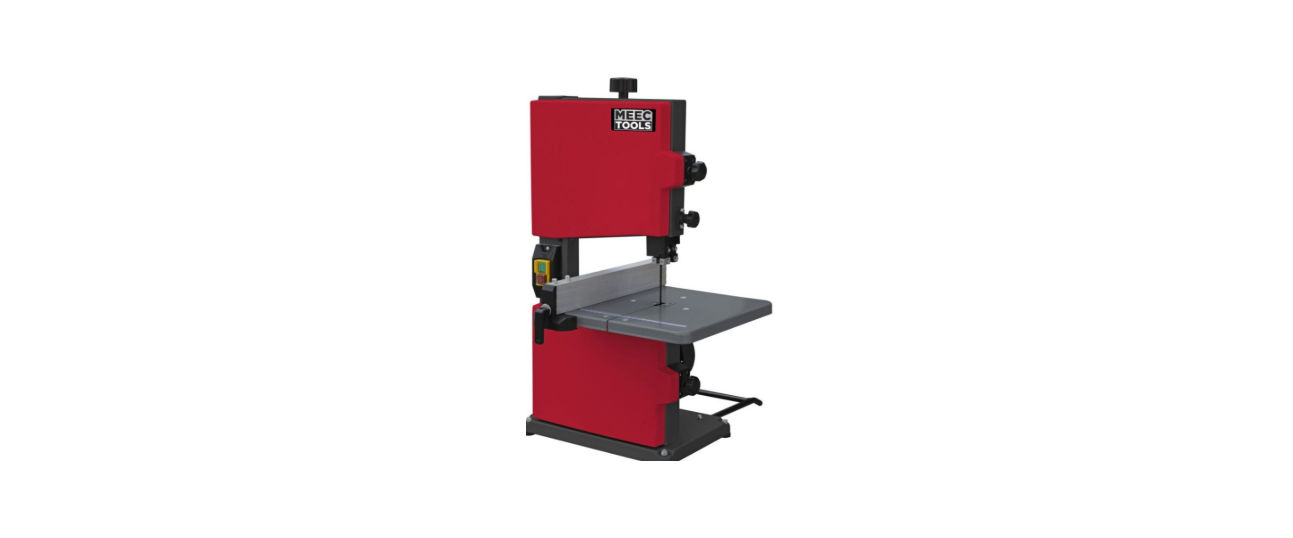

Meec Tools 023441 Metal Cutting Bandsaw

DESCRIPTION
- Clamping screw
- The top wheel for the saw blade
- Locking device for casing
- Guard for the saw blade
- Top saw blade guide
- Saw table plastic insert
- Saw table
- Rubber rings
- Bottom wheel for saw blade
- Foot
- Bottom side casing
- Power switch
- Top side casing

- Adjusting the screw for the top wheel of the saw blade
- Locking screw for the top wheel of the saw blade
- Machine stand
- Power cord
- Motor
- Tip guard
- Connection for the extractor device
- Scale dial for tilt angle
- Saw blade
- Adjustment knob for saw blade guide
- Locking handle for saw blade guide

- Hex key (5 mm)
- Hex key (4 mm)
- Hex key (3 mm)
- Nut
- Washer
- Rubber foot
- Screw

- Lock lever
- Washer
- Saw table
- Feeder
- Parallel fence
- Saw table plastic insert
- Washer
- Locking handle for saw table

- Nut
- Hex screw
- Tip guard
- Washer

PREPARATIONS
- Lift the bandsaw out of the packaging with both hands.
- Place the bandsaw on a level and stable surface, such as a workbench.
- Check that no parts are missing or damaged.
WARNING!
- Careless handling can result in a risk of personal injury.
- Keep children, onlookers, and pets at a safe distance when unpacking the bandsaw.
- Keep the packaging material out of the reach of children – risk of suffocation.
- Do not use the bandsaw if any parts are missing or damaged – contact the retailer.
INSTALLATION
FITTING RUBBER FEET/TILT GUARD
- Fit the 4 rubber feet (30) underneath the bandsaw with screw (31), washer (29), and nut (28).

- Put the tilt guard (42) in the foot and lock in place with the hex screw (41), washer (43), and (40).

INSTALLATION OF SAW TABLE
- Remove the fitting

- Put the saw table (34) on the machine stand from the back.
- Lock the saw table in place with washers (38), locking handle (39), and locking lever (32).

CONNECTION OF DUST EXTRACTOR
Fasten the suction hose to a suitable dust extraction device (industrial vacuum cleaner or equivalent) with a hose clip.
NOTE: Do not use a normal household vacuum cleaner as a dust extractor.
USE
WARNING!
- Unintentional starting and incorrect handling can result in a risk of serious personal injury.
- Switch off the bandsaw, pull out the plug, and wait until all moving parts have completely stopped before making adjustments.
- Wear safety gloves when handling and working with the bandsaw.
PROCEEDURES AND ADJUSTMENTS BEFORE SAWING
Adjusting the tension of the band
The band (22) is correctly tensioned when it cannot be pushed in more than 1 to 2 mm
sideways with a finger
- Turn the set screw (1) clockwise to increase the tension of the band.
- Turn the set screw anticlockwise to reduce the tension.
WARNING!
If the band is too tight, it can break – risk of personal injury!
IMPORTANT:
- Release the tension of the band if it is not going to be used for some time.
- Always check and, if necessary, adjust the tension of the band before use.
Adjusting the tracking of the band
- Check that the band is correctly tensioned before adjusting the tracking of the band.
- Open the top casing lock (turn the knob anticlockwise) and open the casing (13).
- Open the bottom casing lock (turn the knob anticlockwise) and open the casing (11).
- Turn the top band wheel (2) slowly clockwise. Check that the band runs in the middle of the band wheel. If the band does not run in the middle of the wheel, adjust the tracking as follows:
- Turn the band wheel several turns after adjusting, and check that the band runs in the middle of the band wheel.
- When the band runs in the middle of the top band wheel, continue turning the top band wheel until the band also runs in the middle of the bottom band wheel.
- Check that the band runs past the top guide roller (44), past the bottom guide roller(45), and between both guide pins (46). The gap between the band and the guide rollers and guide pins should be about 0.5 mm.


- Adjust, if necessary, the gap of the guide rollers and guide pins to the band. Undo the hex screw for the top guide roller and the hex screws for the bottom guide roller and guide pins.
- Adjust the guide rollers and guide pins to the correct distance from the band, tighten the hex screws, and close the band guard.
Height of the top saw blade guide
- Release the locking handle (23).
- Turn the knob (24) so that the top saw blade guide lowers as close as possible to the workpiece. The gap should be 2–3 mm.
- Tighten the locking handle.
- Check the gap for each cut and adjust if necessary.

Adjusting the angle of the saw table
- Release the locking handle (39) and the lock lever (32), and open the casing at the saw blade guide.
- Place a set square between the blade and the table.

- Tilt the saw table by turning it until the angle between the table and the blade is 90°.
- Tighten the locking handle and lock lever, and close the casing.
- Undo the nut (47).

- Adjust the screw (48) to contact the machine stand.
- Tighten the nut to lock the screw.
Choice of saw blade
The supplied saw blade is of the universal type. Take the following into consideration when choosing a saw blade.
- Thinner blades can be used for sawing a smaller radius than a wider saw blade.
- Wide saw blades are used for straight cuts. This is important when sawing wood, because the blade tends to follow the grain in the wood and therefore deviates from the saw line.
- Fine-toothed blades produce finer cuts than coarse-toothed blades, but the sawing is slower.
NOTE
Never use deformed or damaged saw blades.
SAWING
NOTE
- Always use the parallel fence when sawing diagonally.
- Saw a test piece every time a setting is changed, to check that it works.
- Check and, if necessary, clear the extraction duct at regular intervals.
Starting and stopping
- Press the green power switch button I to start. Wait until the band has reached top speed before starting to saw.
- Press the red power switch button 0 to switch off.
- Unplug the power cord.
- Wait until the band has stopped and then remove the workpiece from the saw table.
- Allow the bandsaw to cool.
Parallel fence
- Lift the clip on the parallel fence.
- Move the parallel fence along the saw table to the left or right of the blade to the required position.
- Push down the clip on the parallel fence. If the clip does not lock the parallel fence firmly in place, turn it clockwise to lock he fence.
- Check that the parallel fence is parallel with the blade

Lengthwise sawing is sawing the workpiece in the direction of the grain. The workpiece would lie flush with the table with one side pressed against the parallel fence.
- Adjust the parallel fence to the height of the workpiece and the required cutting width.
- Set the top band guide.
- Start the dust extraction first, and then start the bandsaw.
- Clench your hands, hold them flat on the workpiece, and push it along the parallel fence to the band (14).
- After sawing, first switch off the bandsaw and then the dust extraction.

Diagonal/bevelled cuts
- Adjust the table to the required angle.
- Fit the parallel fence to the width and height of the workpiece.
- Saw according to the width of the workpiece.

Freehand sawing
- Lower the blade guide to the workpiece.
- Start the product.
- Hold the workpiece firmly on the table.
- Move the workpiece slowly past the blade to follow the saw line.
- It can help to first saw off parts to about 6 mm from the saw line.
- For curved lines with such a small radius that they cannot be sawn correctly, it can help to make several cuts and right angles to an almost up to the saw line. The sawn material will fall off when the curved line is sawn.
- After sawing, first switch off the bandsaw and then the dust extraction.
- Wait until the band has completely stopped before cleaning the saw table.

Removing jammed material
Switch off the bandsaw immediately and pull out the plug if the band fastens in the workpiece, or if a blockage occurs.
WARNING!
Wear safety gloves when removing the blockage. Do not touch the band with your bare hands – risk of cut injury.
Changing the band
- Remove the side casing.

- Move the blade guide so that it is between the table and the machine stand.
- Undo the locks and open the side casing.
- Remove the fitting.
- Relieve the blade by turning the tensioning screw anticlockwise.
- Remove the saw blade from the wheels and take it out through the slot in the table.
- Centre the new saw blade on the wheels. The teeth on the blade must point down towards the table.
- Tension the blade.
- Close the side casing.
- Replace the fitting.
- Replace the casing.
- Turn the band wheels by hand a Meec Tools 023441 Metal Cutting Bandsaw few turns and check that the band runs smoothly in the band wheels and does not wander to the side.
- Adjust the tracking of the band, if necessary
MAINTENANCE
WARNING!
- Switch off the bandsaw, pull Meec Tools 023441 Metal Cutting Bandsaw out the plug, and wait until all moving parts have completely stopped before cleaning, adjusting, maintaining, and/or replacing accessories.
- Wear safety gloves.
- The bandsaw has no internal parts that can be maintained or repaired by the user. Never attempt to repair the bandsaw yourself. Contact an authorised service centre.
TESTING AND CHECKING
Test the bandsaw at regular intervals and check that:
- The power switch is working correctly and is undamaged.
- That the accessories are working correctly and are undamaged.
- The power cord and plug are undamaged.
- The ventilation openings are free from dirt, foreign objects, and anything else that can hinder the flow of cool air. Clean the ventilation openings if necessary with a soft brush.
CLEANING
- Always clean the bandsaw after use.
- Keep safety devices free from dust and dirt.
- Wipe the bandsaw with a clean, or carefully blow it clean with compressed air. Wear safety glasses when working with compressed air.
- When very dirty, the bandsaw can be cleaned with a cloth moistened with a soapy solution.
WARNING!
- Switch off the bandsaw, unplug the power cord, and wait until all moving parts have completely stopped before cleaning.
- Wear safety gloves.
- The band gets hot when in use – risk of burn injury. Allow the band to cool before cleaning.
REPLACING THE RUBBER RINGS ON THE BLADE WHEELS
- Open the side casing.
- Remove the saw blade.
- Lift the edge of the rubber ring on the top wheel with a small screwdriver and pull off the rubber ring from the wheel.

- Repeat for the bottom wheel.
- Fit the new rubber rings, replace the blade, and close the side casing.
REPLACING THE SAW TABLE INSERT
- Undo the 4 crosshead screws Meec Tools 023441 Metal Cutting Bandsaw holding the table insert.

- Remove the table insert.
- Follow the instructions in reverse order to install a new saw table insert.
TRANSPORT AND STORAGE
- Carefully clean the bandsaw before putting g into storage.
- Slacken the band before putting the storage.
- Store the bandsaw in a dry, cool place out of the reach of children.
- Cover all the bandsaw to protect it from dust and other impurities.
- When moving the bandsaw by hand, it should be lifted by gripping the foot and the stand.
- Before transporting w the bandsaw should be completely dismantled.
TECHNICAL DATA
- Sawing height 80 mm
- Band size 1400 x 7 x 0.37 mm
- Sawing speed 900 m/min Sawing width 200 mm
- Weight 17 kg
- Size 69 x 45 x 61 cm
- Sound pressure level, LpA 84.3 dB (A)
- Uncertainty, KpA 3 dB
- Sound power level, LwA 96.0 dB(A)
- Uncertainty, KwA 3 d