



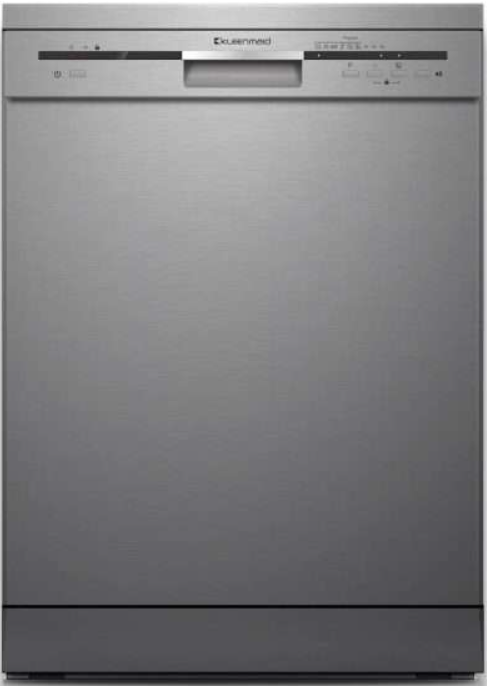
Kleenmaid DW6020X Stainless Steel Dishwasher
Safety Instructions
- Use a soft cloth moistened with mild soap, and then use a dry cloth to wipe it again.
- Improper connection of the equipment-earthing conductor can result in the risk of an electric shock.
- Do not modify the plug provided with the appliance.
- If it does not fit the outlet, have a proper outlet installed by a qualified electrician.
- Do not abuse, sit on, or stand on the door or dish rack of the dishwasher.
- Do not operate your dishwasher unless all enclosure panels are properly in place.
- Open the door very carefully if the dishwasher is operating, as there is a risk of water squirting out.
- Check that the detergent powder dispenser is empty after completion of the wash cycle.
- Do not wash plastic items unless they are marked “ dishwasher safe” or the equivalent.
- For unmarked plastic items not so marked, check the manufacturer’s recommendations.
- Use only detergent and rinse agents recommended for use in an automatic dishwasher.
- Never use soap, laundry detergent, or hand washing detergent in your dishwasher.
Overview
To get the best performance from your dishwasher, read all operating instructions (Part 1 and Part 2) before using it for the first time.
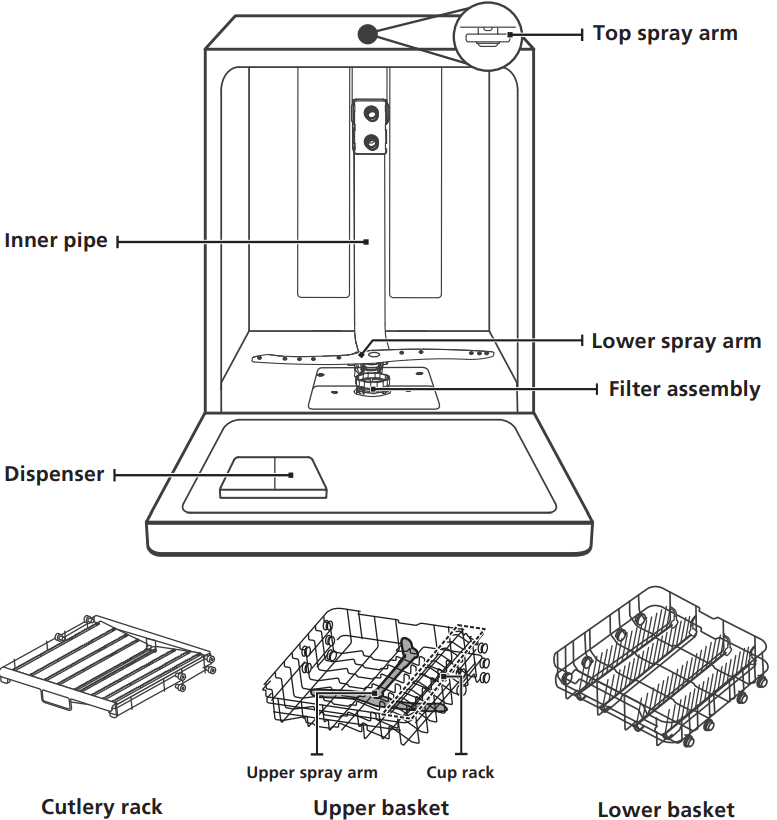
Using the Device
Before using your dishwasher:

- Loading the basket
- Fill the rinse aid dispenser (Please check section 1 of PART Ⅱ: Special Version)
- Fill in detergent (Please check Section 1 of PART Ⅱ: Special Version)
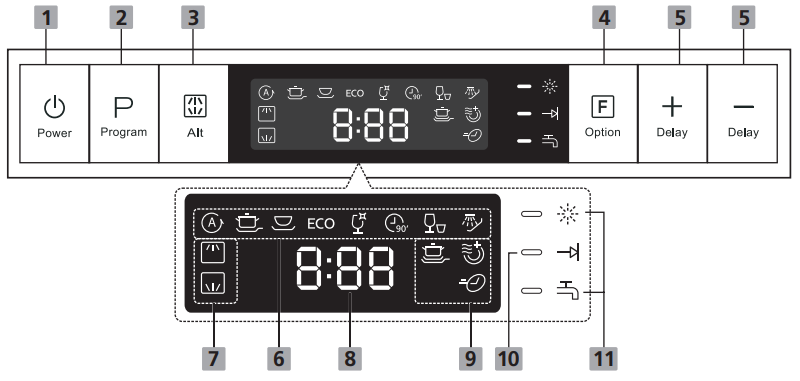
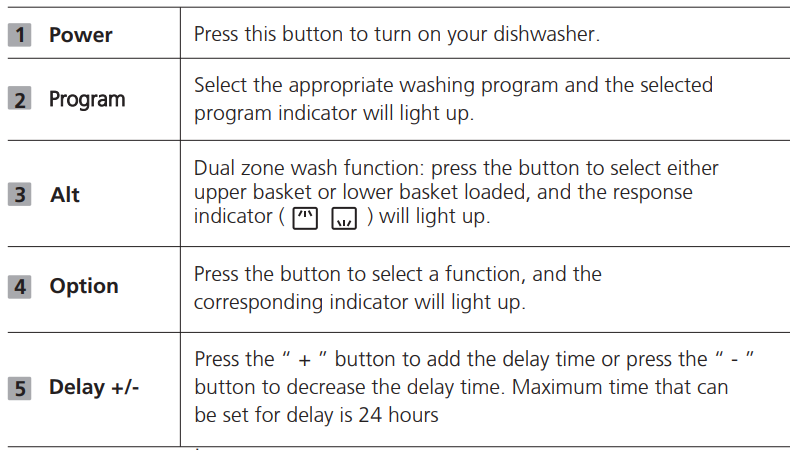
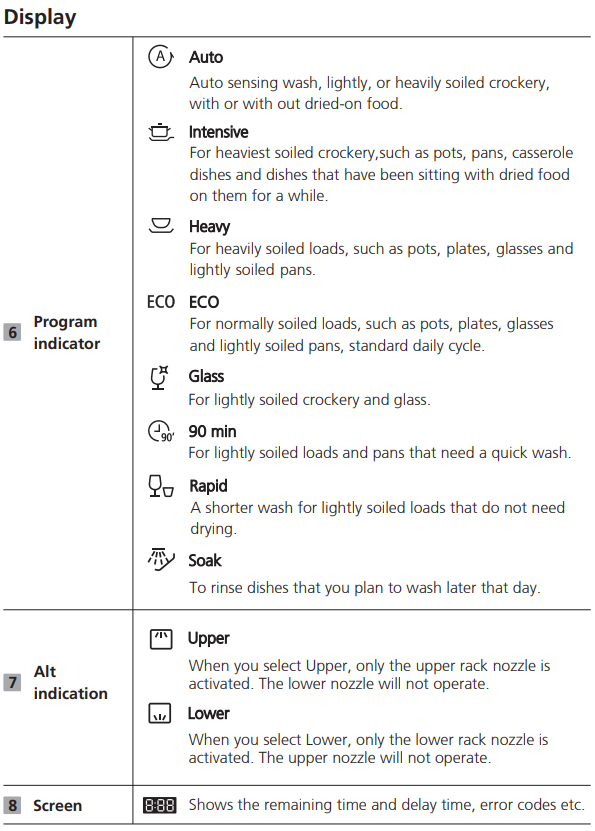
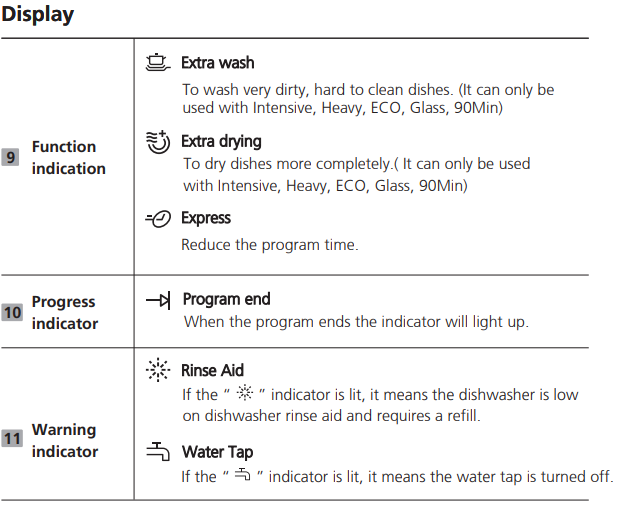
Control Panel
Preparing And Loading Dishes
- Consider buying utensils which are identified as dishwasher-proof.
- For particular items, select a program with the lowest possible temperature.
- For washing the following cutlery/dishes, a dishwasher is not suitable:
- Cutlery with wooden, horn, china or mother-of-pearl handles
- Plastic items that are not heat-resistant
- Older cutlery with glued parts, which are not temperature-resistant
- Bonded cutlery items or dishes
- Pewter or copper items
- Crystal glass
- Steel items are subject to rusting
- Wooden platters
- Items made from synthetic fibres
Are of limited suitability
- Some types of glasses can become dull after a large number of washes
- Silver and aluminium parts tend to discolour during washing
- Glazed patterns may fade if machine-washed frequently
Loading the dishwasher
Scrape off any large amounts of leftover food. Soften remnants of burnt food in pans. It is not necessary to rinse the dishes under running water. To obtain the best performance from the dishwasher, follow these loading guidelines.
Place Objects in the Dishwasher
- Items such as cups, glasses, pots/pans, etc. are faced downwards.
- Curved items, or ones with recesses, should be loaded aslant so that water can run off.
- All utensils are stacked securely and cannot tip over.
- All utensils are placed so that the spray arms can rotate freely during washing.
- Check before starting the dishwasher.
- Dishes and items of cutlery must not lie inside one another or cover each other.
- To avoid damage, glasses should not touch one another.
- Long-bladed knives loaded in an upright position are a potential hazard!
- Please do not overload your dishwasher.
- This is important for good results and for reasonable consumption of energy.
Adjusting the Upper Basket
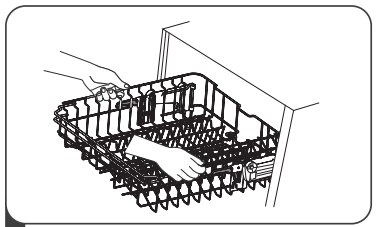
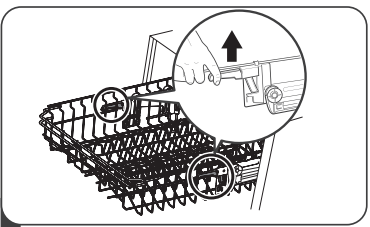
The height of the upper basket can be easily adjusted to accommodate taller dishes in either the upper or lower basket. To adjust the height of the upper rack, follow these steps.
- To raise the rack to the upper position, lift the rack until both sides are at the same height.
- The rack will click into place.

- To lower the rack, push down on the handle and release.

Folding back the cup shelves
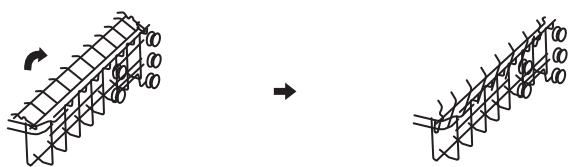
To make room for taller items in the dishwasher basket, raise the cup rack upwards. You can then lean the tall glasses against it. You can also remove it when it is not required for use.
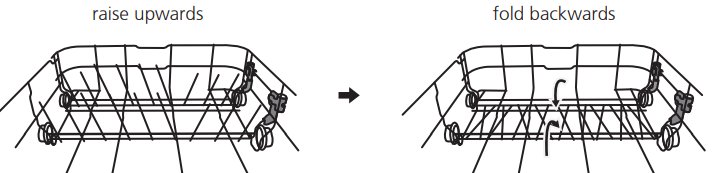
The spikes are used for holding plates. They can be lowered to make more room for large items.
Loading the Upper Basket
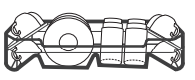
The upper basket is designed to hold more delicate and lighter dishware such as glasses, coffee and tea cups and saucers, as well as plates, small bowls and shallow pans (as long as they are not too dirty. Position the dishes and cookware so that they will not be moved by the spray of water.
Loading the Lower Basket
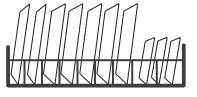
We suggest that large items and the most difficult to clean items be placed into the lower basket: such as pots, pans, lids, serving dishes and bowls, as shown in the figure below. It is preferable to place serving dishes and lids on the side of the racks to avoid blocking the rotation of the top spray arm. The maximum diameter advised for plates placed in front of the detergent dispenser is 19 cm, so as not to hamper its opening.
Loading the Cutlery Basket
Cutlery items should be placed in the cutlery rack separately from each other in the appropriate positions. Make sure the utensils do not nest together, as this may affect optimum performance. For flexibility in loading the dishwasher, the third-level cutlery tray has five available shelving configurations. This includes the ability to slide one half of the tray on top of the other half to accommodate taller items placed in the basket below. The diagrams on the tray front indicate the various options.
Technical Specification
| Height (H) | 845mm |
| Width (W) | 598mm |
| Depth (D1) | 600mm (with the door closed) |
| Depth (D2) | 1175mm (with the door opened 90°) |
Product Data
| Manufacturer | Kleenmaid |
| Type / Description | DW6030 |
| Standard place settings | 15 |
| Energy efficiency class | |
| Water consumption class | |
| Standard cleaning cycle | ECO |
| Energy consumption of the standard cleaning cycle | 0.641 kWh |
| Water consumption of the standard cleaning cycle | 11.8 litres |
| Program duration of the standard cleaning cycle | 195 min |
| Noise level | 45 dB(A) re 1 pW |
| Mounting | Free-standing |
| Can it be built under? | YES |
| Power consumption | 1700-2000W |
| Rated voltage/frequency | AC 220-240V/50Hz |
| Water pressure (flow pressure) | 0.04-1.0MPa=0.4-10 ba |
Installation
Cold water connection
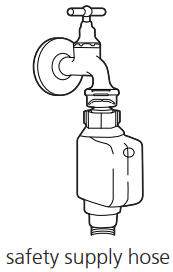
- Connect the cold water supply hose to a threaded 3/4 (inch) connector and make sure that it is fastened tightly in place.
- If the water pipes are new or have not been used for an extended period of time, let the water run to make sure that the water is clear.
- This precaution is needed to avoid the risk of the water inlet becoming blocked and damaging the appliance.
Connection Of Drain Hoses
Insert the drain hose into a drain pipe with a minimum diameter of 40mm, or let it run into the sink, making sure to avoid bending or crimping it. The height of the drain pipe must be less than 1000mm. The free end of the hose must not be immersed in water to avoid backflow.
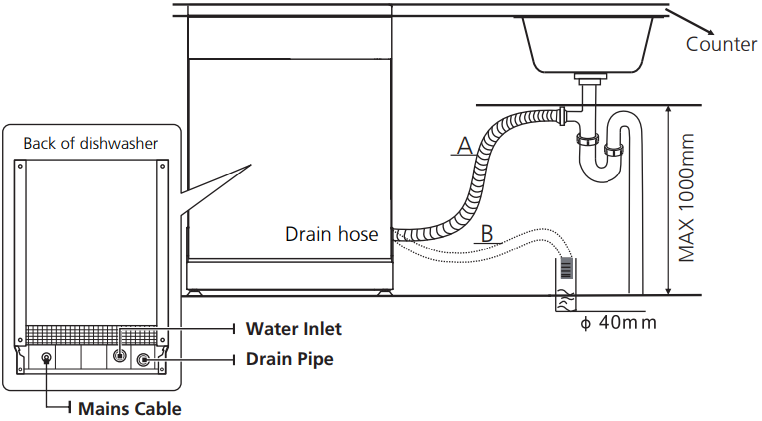
- The drain hose length is 1.874m
- Securely fix the drain hose in either position A or position B.
Drainage
If the sink is higher than 1000mm from the floor, the excess water in the hoses cannot be drained directly into the sink. It will be necessary to drain excess water from hoses into a bowl or suitable container that is held outside and lower than the sink.
Water outlet
Connect the water drain hose. The drain hose must be correctly fitted to avoid water leaks. Ensure that the water drain hose is not kinked or squashed.
Extension hose
If you need a drain hose extension, make sure to use a similar drain hose. It must be no longer than 4000mm; otherwise, the cleaning effect of the dishwasher could be reduced.
Syphon connection
The waste connection must be at a height less than 1000mm (maximum) from the bottom of the dishwasher. The water drain hose should be fixed.
External Care
The door and the door sea.l Clean the door seals regularly with a soapy, damp cloth to remove food deposits. When the dishwasher is being loaded, food and drink residues may drip onto the sides of the dishwasher door. These surfaces are outside the wash cabinet and are not accessed by water from the spray arms. Any deposits should be wiped off before the door is closed.
The control panel
If cleaning is required, the control panel should be wiped with a soft, damp cloth ONLY. To avoid penetration of water into the door lock and electrical components, do not use a spray cleaner of any kind. Never use abrasive cleaners or scouring pads on the outer surfaces because they may scratch the finish. Some paper towels may also scratch or leave marks on the surface.
Position The Appliance
Position the appliance in the desired location. The back should rest against the wall behind it, and the sides, along the adjacent cabinets or walls. The dishwasher is equipped with water supply and drain hoses that can be positioned either to the right or the left sides to facilitate proper installation.
Levelling the Appliance
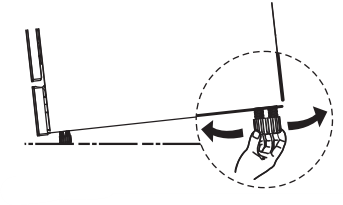
Once the appliance is positioned for levelling, the height of the dishwasher may be altered by adjusting the level of the screw in feet.
Fitting Between Existing Cabinets
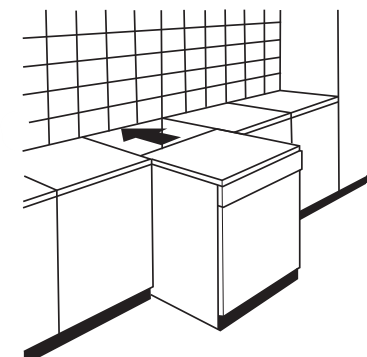
- The height of the dishwasher, 845 mm, has been designed to allow the machine to be fitted between existing cabinets of the same height in modern fitted kitchens.
- The feet can be adjusted so that the correct height is reached.
- The laminated top of the machine does not require any particular care since it is heat, scratch and stain resistant.
Fitting Under Existing Work Top
If the dishwasher is to be fitted under a permanent worktop, remove the top cover of the dishwasher by unscrewing the screws under the rear edge of the top.
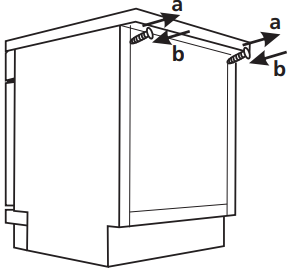
- The maximum adjustable leg extension height used for determining the maximum height of free-standing/built-under models is 25mm. See height range in the table below.
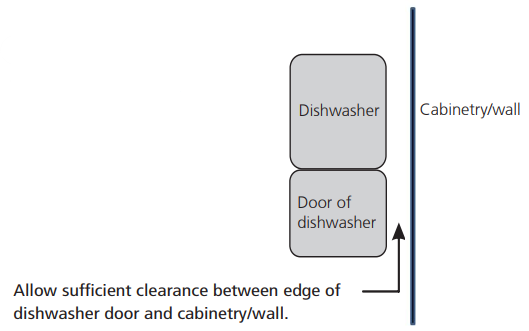
Worktop Installed Worktop not installed Min Height Max Height Min Height Max Height 845 mm 870 mm 815 mm 840 mm - If the dishwasher is installed at the corner of the cabinet, allow sufficient space for the door to open freely.
Tension Adjustment of the Door Spring
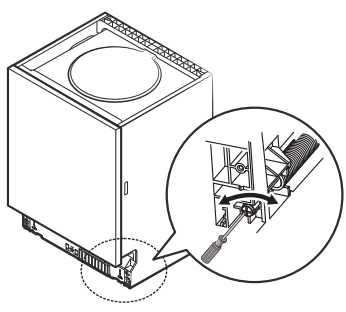
- The door springs are set at the factory to the proper tension and should not need adjustment.
- Door spring tension is correct when the door remains horizontal in the fully opened position, yet rises to a close with the slight lift of a finger.
- If necessary, adjust the tension of the door springs by using an Allen key, turning in a counterclockwise motion to tighten the left and right door springs.
Loading the Baskets
Upper basket
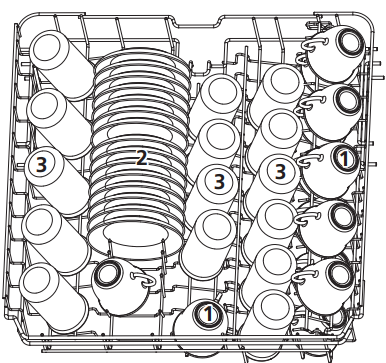
| Number | Item |
| 1 | Cups |
| 2 | Saucers |
| 3 | Glasses |
Lower Basket
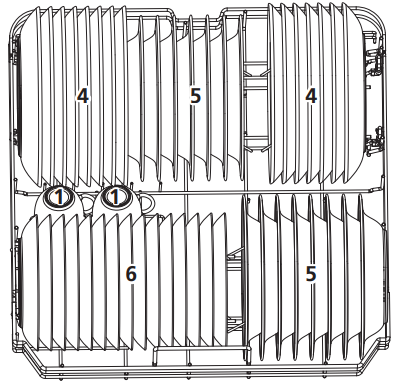
| Number | Item |
| 4 | Dinner plates |
| 5 | Soup plates |
| 6 | Dessert dishes |
Cultery Basket
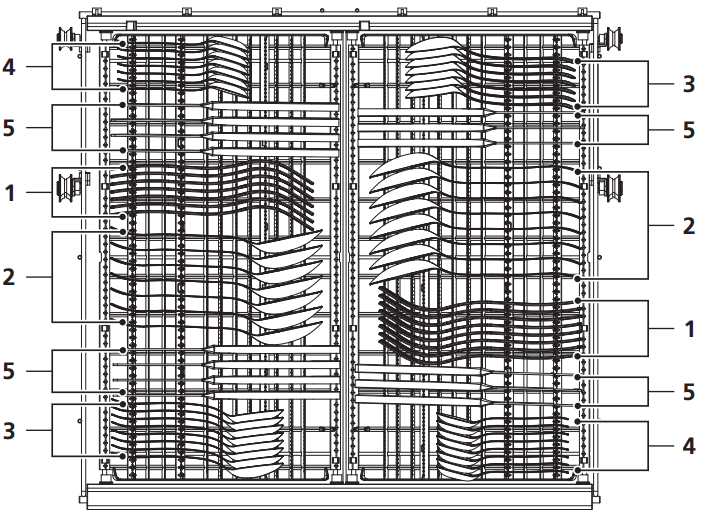
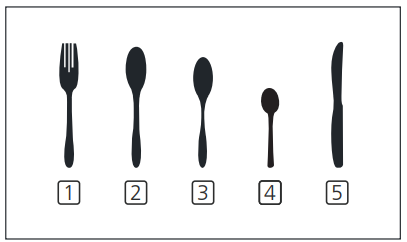
| Number | Item |
| 1 | Forks |
| 2 | Soup spoons |
| 3 | Dessert spoons |
| 4 | Teaspoons |
| 5 | Knives |
Information for comparability tests in accordance with (*AS/NZS 2007.1 )
- Capacity: 15 place settings
- Position of the upper basket: lower position
- Program: ECO
- Rinse aid setting: 6
- Detergent(Pre/main): 5g/28.75g
- The door is open at the end of the drying cycle for the drying performance test.
- (Door position: Open 50 mm)
Rinse Aid And Detergent
The rinse aid is released during the final rinse to prevent water from forming droplets on your dishes, which can leave spots and streaks. It also improves drying by allowing water to roll off the dishes. Your dishwasher is designed to use liquid rinse aids.
When to Refill
- Unless the rinse-aid warning light ( ) on the control panel is on, you can always estimate the amount from the colour of the optical level indicator located next to the cap.
- When the rinse-aid container is full, the indicator will be fully dark. The size of the dark dot decreases as the thinning aid diminishes. You should never let the rinse aid level be less than 1/4 full.
- As the rinse aid level diminishes, the size of the black dot on the rinse aid level indicator changes, as illustrated below.
- Full
- 3/4 full
- 1/2 full
- 1/4 full
- Empty
Function of Detergent
The chemical ingredients that compose the detergent are necessary to remove, crush and dispel all dirt from the dishwasher. Most commercially available quality dishwasher detergents are suitable for this purpose.
Filling
- Remove the rinse aid reservoir cap 2 by rotating it counterclockwise.

- Pour the rinse aid into the dispenser, being careful not to overfill.

- Close the rinse aid reservoir cap by rotating it clockwise.

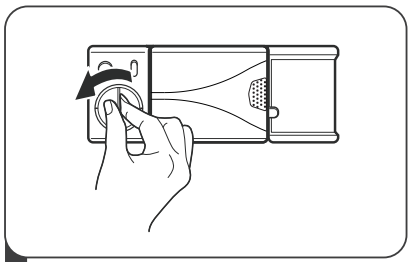
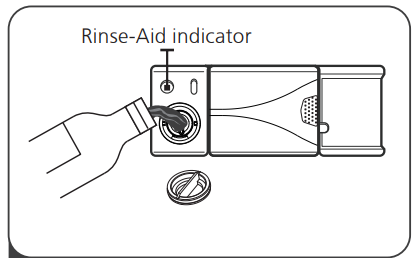
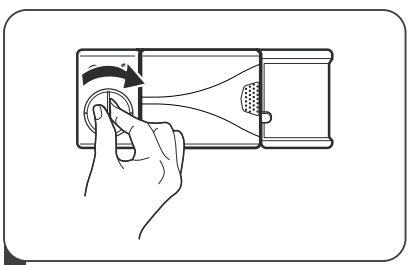
Adjusting the Rinse Aid Reservoir
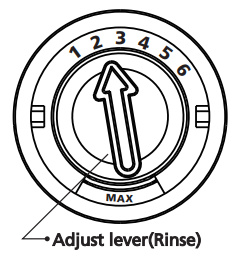
The rinse aid reservoir has six settings. The recommended setting, set by the factory, is “3”. If the dishes are not drying properly or are spotted, adjust the dial to the next highest number until your dishes are spot-free. Reduce it if there are sticky, whitish stains on your dishes or a bluish film on glassware or knife blades.
Filling The Detergent Dispenser
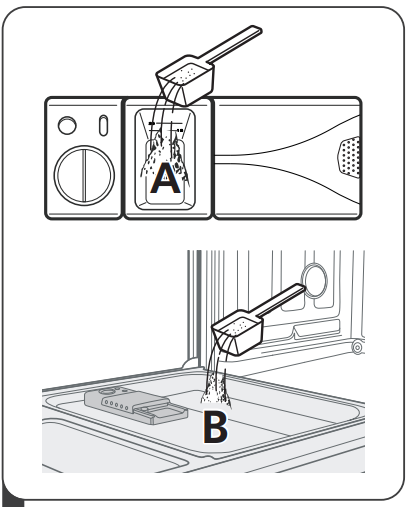
- Open the detergent dispenser flap by pushing the detergent dispenser release catch.

- Add detergent into the larger cavity (A) for the main wash cycle. For better cleaning results, especially if you have very dirty items, pour a small amount of detergent onto the door (B).
- The additional detergent will activate during the pre-wash phase.

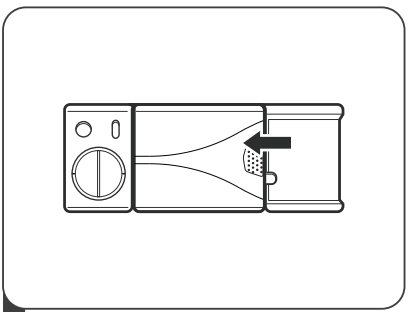
- Close the flap by sliding it to the left and then pressing it down.
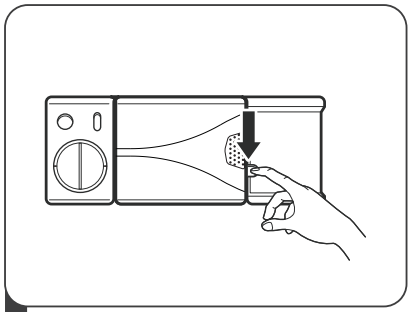
Programming the Dishwasher
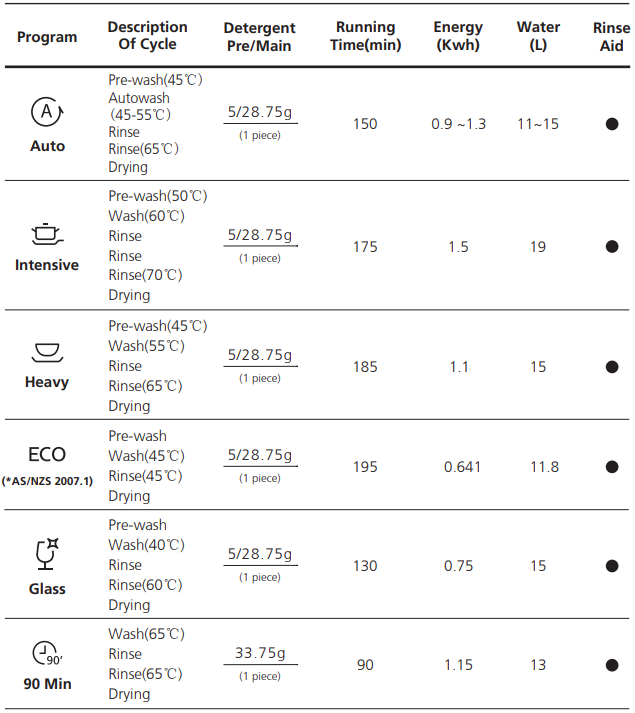
Wash Cycle Table
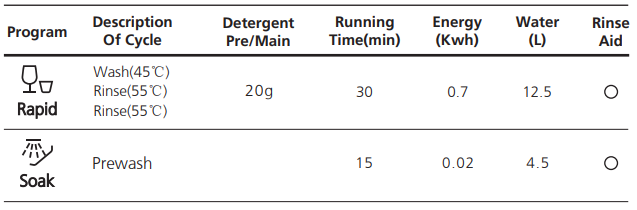
The table below shows which programs are best for the levels of food residue on dishes and how much detergent is needed. It also shows information about the programs.
- (.)Means: need to fill the Rinse-Aid Dispenser.
Starting A Wash Cycle
- Draw out the lower and upper baskets, load the dishes and push them back.
- Pour in the detergent.
- Insert the plug into the socket. For power supply information, refer to ”Product data” on the last page.
- Open the door, press the Power button.
- Choose a program, then the response light will turn on.
Changing The Program Mid-cycle
To reset the dishwasher, follow the instructions below.

- Open the door a little to stop the dishwasher, then after the spray arm stops working, you can open the door completely.
- Press the Program button for more than three seconds so the machine will be in the standby state.
- You can change the program to the desired cycle setting.
Forgot to add a dish?
A forgotten dish can be added at any time before the detergent dispenser opens. If this is the case, follow the instructions below.

- Open the door a little to stop the washing.
- After the spray arm stops working, you can open the door completely.
- Add the forgotten dishes.
- Close the door.
- The dishwasher will start running again.
Internal Care
Filtering system
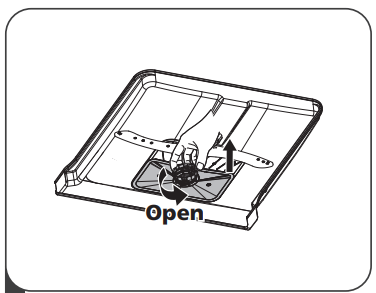
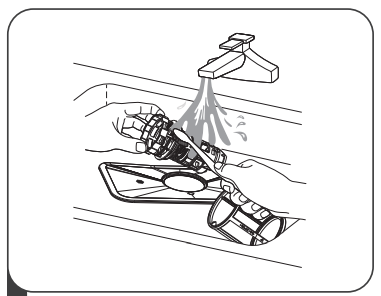
The filtering system at the base of the wash cabinet retains coarse debris from the washing cycle. The collected coarse debris may cause the filters to clog. Check the condition of the filters regularly and clean them if necessary under running water. Follow the steps below to clean the filters in the wash cabinet.
- Hold the coarse filter and rotate it 2 anticlockwise to unlock the filter. Lift the filter upwards and out of the dishwasher.

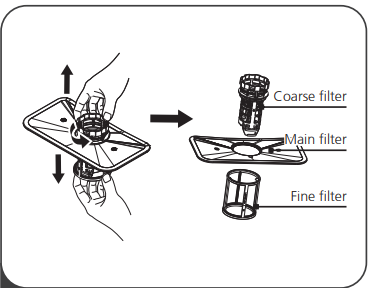
- The fine filter can be pulled off the bottom of the filter assembly. The coarse filter can be detached from the main filter by gently squeezing the tabs at the top and pulling it away.

- Larger food remnants can be 4 cleaned by rinsing the filter under running water. For a more thorough clean, use a soft cleaning brush.

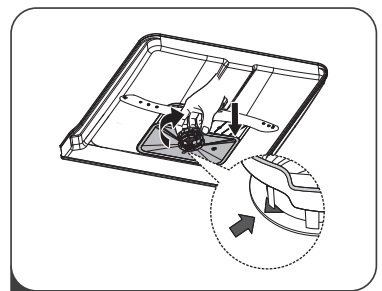
- Reassemble the filters in the reverse order of the disassembly, replace the filter insert, and rotate clockwise to the closed arrow.

Spray arms
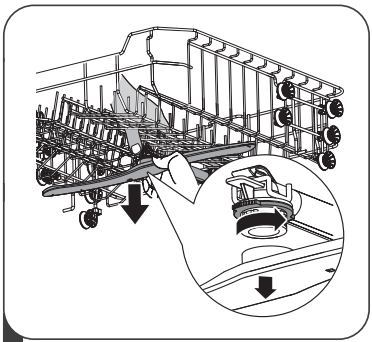
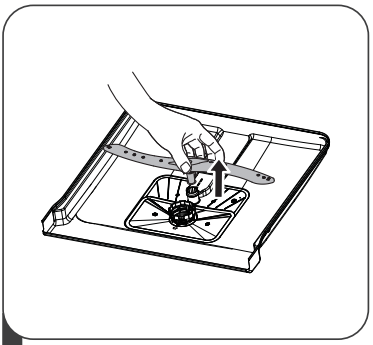
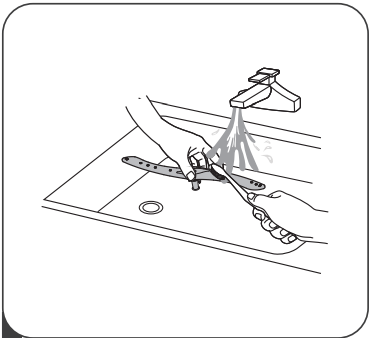
It is necessary to clean the spray arms regularly, as hard water chemicals will clog the spray arm jets and bearings. To clean the spray arms, follow the instructions below.
- To remove the upper spray arm, hold the nut in the centre still and rotate the spray arm counterclockwise to remove it.

- To remove the lower spray arm, pullitl out the spray arm upward.

- Wash the arms in soapy and warm water and use a soft brush to clean the jets. Replace them after rinsing them thoroughly.

Caring For The Dishwasher
Frost precaution
Please take frost protection precautions for the dishwasher in winter, especially if the ambient temperature is likely to be below 0 °C. After every washing cycle, please operate as follows:
- Cut off the electrical power to the dishwasher at the supply source.
- Turn off the water supply and disconnect the water inlet pipe from the water valve.
- Drain the water from the inlet pipe and water valve. (Use a pan to gather the water)
- Reconnect the water inlet pipe to the water valve.
- Remove the filter at the bottom of the tub and use a sponge to soak up water in the sump.
Remove the plug
- Before cleaning or performing maintenance, always remove the plug from the socket.
No solvents or abrasive cleaning
To clean the exterior and rubber parts of the dishwasher, do not use solvents or abrasive cleaning products. Only use a cloth with warm, soapy water. To remove spots or stains from the surface of the interior, use a cloth dampened with water and a little vinegar, or a cleaning product made specifically for dishwashers.
When not in use for an extended period
- This will help the door seals to last longer and prevent odours from forming within the appliance.
Error Codes
If there is a malfunction, the dishwasher will display error codes. To identify these:
| Codes | Meanings | Possible Causes |
| E1 | Longer inlet time. | Tap is not opened, or water intake is restricted, or water pressure is too low. |
| E3 | Not reaching the required temperature. | Malfunction of the heating element. |
| E4 | Overflow. | An element of the dishwasher leaks. |
| E8 | Failure of the orientation of the distributary valve. | Open circuit or break of the distributary valve. |
| E9 | Keep pressing a button for more than 30 seconds. | Water or something on the button. |
| Ec | The washing control system failed. | PCB or motor fail. |
Troubleshooting
Before Calling For Service
Reviewing the charts on the following pages may save you from calling for service.
| Problem | Possible Causes | What To Do |
| The dishwasher doesn’t start | Fuse blown, or the circuit breaker tripped. | Replace the fuse or reset the circuit breaker. Remove any other appliances sharing the same circuit as the dishwasher. |
| The power supply is not turned on. | Make sure the dishwasher is turned on, and the door is closed securely. Make sure the power cord is properly plugged into the wall socket. | |
| Water pressure is low. | Check that the water supply is connected properly and the water is turned on. | |
| The door of the dishwasher is not properly closed. | Make sure to close the door properly and latch it. | |
| Water is not pumped from the dishwasher | Twisted or trapped drain hose. | Check the drain hose. |
| Filter clogged. | Check and clean the filter. | |
| Kitchen sink clogged. | Check the kitchen sink to make sure it is draining well. If the problem is the kitchen sink not draining well, you may need a plumber rather than a dishwasher service. | |
| Suds in the tub | Wrong detergent. | Use only the special dishwasher detergent to avoid suds. If this occurs, open the dishwasher and let the suds evaporate. Add 4.5 L of cold water to the bottom of the dishwasher. Close the dishwasher door, then select any cycle. Initially, the dishwasher will drain out the water. Open the door after the draining stage is complete and check if the suds have disappeared. Repeat if necessary. |
Disposal
- To dispose of the packaging and the appliance, please go to a recycling centre.
- For safety, cut off the appliance power supply cable and disable the door closing device.
- For more detailed information about the recycling of this product, please contact your local council office and your household waste disposal service.
Warranty
Terms & Condition
- Compass Capital Services Pty Ltd ABN 96 138 214 525 trading as Kleenmaid will provide parts and labour to you, the customer, as set out herein.
Product Identification
- Kleenmaid reserves the right to reject claims for any services or work where you cannot produce for verification the serial number and proof of purchase for the Product (including but not limited to the original invoice).
What is covered by Warranty
- Kleenmaid and/or its agents will determine by objective testing if there are any defects in the Product and/or faulty workmanship.
Customer Service
- Website: www.kleenmaid.com.
- Ph: 02 9310 1207.