

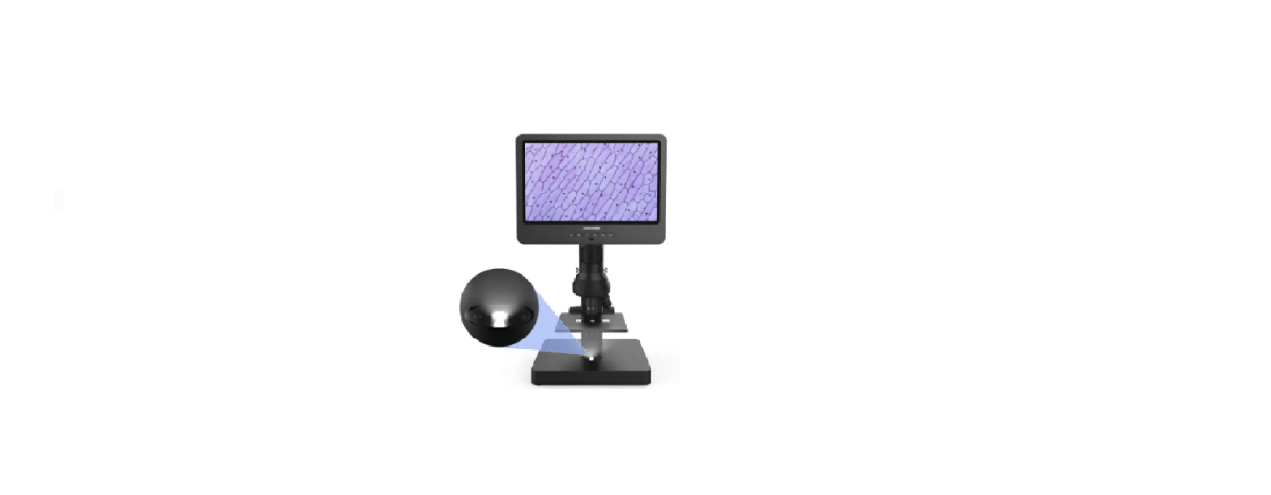

Andonstar 246S, 249S Digital Microscope

Safety Instructions
- Please read this user manual carefully before using the device.
- It may cause permanent damage to the device if the operation guide is not followed.
- This product contains tiny parts and components that are NOT edible.
- Please let children and teens use this device under proper guidance and supervision by adults.
- Disabled patients and people with allergies should not use this product.
- We do not recommend using this product outdoors.
- It is not waterproof, and can not be placed in an extreme environment: heat, high pressure, etc..
- Please keep and use it in a safe, clean, and dry environment.
- Stay away from oil, gas, water, and corrosive potions.
- Storage method refers to other electronic products, such as a computer.
- Users should follow these steps for daily cleaning as well.
- Remember to ONLY wipe the INSULATED part of the monitor.
- The screen of the monitor is very fragile; please use it with care.
- The monitor is not waterproof. Please clean it with a soft and dry material.
- Please be aware that this microscope is not for medical use.
Package include
- Microscope
- Plastic Stand
- Lens A(has been fixed)
- Lens B&C
- USB spot lights*2
- Remote
- Dimmer cable
- HDMI cable
- USB cable
- Screwdriver
- Slides kit
- Tweezers
- Backdrop board*3
- Bug box

Button And Connection
- Power on/off
- Mode/Menu
- Up/Digital Zoom in
- Down/Digital zoom out
- OK/Start recording
- Take pictures (while the device is recording)
- Remote signal receiver (where you aim the remote)
- Focusing tube
- Lens fixing screws
- Reset
- HDMI port
- USB port
- SD card slot
Bracket installation
Please see the attached installation diagram.
Bracket instructions
P3 Bracket instructions
- Arm locker
- Monitor Fixing Screws
- USB spotlights
- Stage height controller
- Mechanical stage
- Clips
- Loophole
- Bottom light
- light socket
Quick Start
- Connect the device to the power supply as shown in pic 4 to power on the microscope.
- Press and hold the Power button (pic 2 #① ) until the monitor lights up. (The device may switch on
automatically when you power it on, and it is normal.) - Troubleshooting When the monitor image stops or freezes, please press the Reset hole (pic 2 #⑩) to reset the device first, then power on the device again. (The reset hole is very tiny, located at the back of the monitor.
- You may need to use the help of other tools with this process. All settings of the microscope will be back to factory settings after this, but it won’t delete any files saved in the memory card.

How to choose a lens
Lens A:
Focus range:12mm-320mm, Magnification:60-240x(with 33 times digital zoom, output to 28-inch HDMI monitor) Applications: observe whole size or part of coins, stones/stamps collect, circuit board observe, etc.
Pic 5 Use lens A to see a coin
Steps: In pic 5, it marked out which parts of the microscope are involved in each step.
- Install and fix lens A to the bottom of the focusing tube.
- Place the black or white backdrop board in the loophole on the stage, then place the coin on the
stage. - Bend the two goose-neck spotlights, and make sure the light shines on the coin.
- Lose the arm socket, locate the whole monitor part to the desired height, meanwhile adjust the height of the mechanical stage, and make sure the final object distance is within 12mm to 320 mm. The shorter the object distance is, the bigger the magnification is.
- Turn the focusing tube to get a clear image. Turn it clockwise to zoom in and the other way to zoom out.
- To observe part of the coin, please lower the arm height to shorten the object distance, then
turn the focusing tube to get a clear image. - The steps above can also be applied to observe plants, stones, etc.
Lens B&C
Lens B: Focus range: 7mm-8mm, Magnification: 1560-2040x (with 3 times digital zoom, output to 28-inch HDMI monitor)
Lens C: Focus range: 3mm-4mm, Magnification: 2760-4080x with 33 times digital zoom, output to 28-inch HDMI monitor. Applications: Microscope slides, etc.
Pic 6 Go with Lens B&C.
Steps: In pic 6, it marked out which parts of the microscope are involved in each step.
- Install and fix the nosepiece set with Lens B&C to the bottom of the focusing tube.
- Place the translucent backdrop board on the loophole on the stage, and place slides on it.
- Remove the two USB spotlights.
- Lose the arms locker, locate the whole monitor part to the desired height, meanwhile adjust the height
of the mechanical stage, and make sure the final object distance is within 7-8mm(lens B). The shorter the
object distance is, the bigger the magnification is. Or if you want to zoom in even more, revolve the
nosepiece to lens C and make the object distance within 3-4mm. The shorter the object distance is, the bigger the magnification is.
Digital zoom
Press the “up” button on the monitor (pic 2 ) to apply digital zoom in, and the “down” button to zoom out( pic 2)
Save files to a micro SD card.
To save images and videos to a memory card, please insert a card into the TF slot at the back of the monitor before powering on the device. Attention:
- TD cards are not included in the standard package. Please purchase it from quality suppliers. We
recommend a 10-grade high-speed TF card. - The metal strip side of the card faces outward.
- Push the card deeply into the card slot until you hear a click sound. Otherwise, it would bounce back.
- When the monitor shows “card error” or “card is full”, please format the card first before taking pics.
- Format steps are: Press and hold the button “M” until it shows a menu → Press the “M” button again to get into the Settings menu→Press the up or down button to select→choose” Format” and confirm
- Do not insert a card while the microscope is working.
- If you do, the microscope will switch off automatically. And you will have to turn it on again.
Record videos
- Freeze: Stop the image on the display, work in video mode, photo mode, and while recording.
- Illumination+ & -: exposure compensation from +2.0 to -2.0.
- Sharpness up and down: three levels of sharpness: Soft/Normal/Strong. Those two buttons are both used
to switch the levels, but in different orders. - Contrast-up-down: the same principle as Sharpness
Pic 7 Remote
- Upside down: refer to pic as follows Normal

- Upside down

- Inverse: refer to pic as follows Normal

- Inverse

- Black&white: refer to the pic below Normal

- Black&white

Settings
In any mode, press and hold the M button until it shows the video/photo/playback menu, press M again, and get iSettingssting menu. For example. In video mode, press and hold the M button, and it will show the video menu as shown below: Then, press M again to get into the settings menu, as right below.w

Gridline Settings (remote needed)
Use “Up” and “Down” to choose among “Cross Line”, “Line”, “Direction”, “Location”, “Color”, and “Wide”. Use “Left” and “Right”(marked as a brightness +&- in pic 8) to change settings. The microscope can’t do this mission alone. The remote is needed. A cross line, as its name says, it’s a pair of vertical and horizontal lines located in the very middle of the
image.
When you turn on the function“Line”, there will be 8 lines showing up automatically(named 1 to 8). For each one, you could change its direction (“HOR” or“VER”, which stands for “horizontal” and “vertical”), position, color, and width. To delete unnecessary lines from the view, change its color to “TRANSPARENT”, see the following pic.

Output to external devices
HDMI output
- Firstly, make sure the external device is an actual, real FHD 1080P HDMI monitor; otherwise, the display resolution can not reach 1080P.
- Power on the microscope, and connect it to the HDMI monitor. The microscope has no built-in battery, so please make sure the microscope stays powered on the whole time.
- Switch on the microscope, place the specimen on the base or the slide holder, and adjust the object distance and focus distance.
- When the microscope is connected to external devices, image data is transferred to the external device, so the microscope monitor displays no image.
- HDMI output supports photo capture, but not video recording.
USB Output
Software installation
Where to download the software: https://bit.ly/3xCRDPL. Currently software“Microscope Measure” only supports the Windows system. System requirements: Windows XP SP3、 Windows 7、 Windows 8 、 Windows 10. Runtime:Microsoft.Net Framework 4.0, Microsoft Visual C++ 2010. If there aren’t any of the runtimes mentioned above in your computer system, it will report during the installation process. If you can’t open the download link above, contact our customer service. After downloading, open the zip file and run it.
Icons definitions
Interface Definitions and Functions
- Main menu: Where users to open different devices or import pictures to observe or edit, do video settings or save settings, choose which windows to show or hide, etc.
- Toolbar: Where tools are shown that are used to measure and perform image analysis.
- The definition and function of different tools have been given in the chapter“Icons definitions”. Users can choose to hide or show this toolbar window following the path: ‘View→Toolbars and Docking Windows→Standard’.
- Pictures browser: Where users review all the pictures they’ve captured. Users can also edit the picture by right-clicking the picture and opening it in the main operating window. Choose ‘View→Toolbars and Docking Windows→Picture browser’ to show or hide this window.
- Secondary operating window: This window is for zooming in on the area around the cursor. With the help of this window, the result of measuring can be much more precise.
- Main operating window: window shows the full view from the microscIt’sAnIts also the place where users do measuring and image analysis.
- Calibration Management and Measuring Results: These two windows are located in the same place, and users can switch between them by clicking.

Operating Steps
- Material: A computer (Windows system, with software ‘Microscope Measure’); USB microscope (device name: ‘USB CAMERA’), A ruler.
- Connect the Andonstar 246S digital microscope to the computer via the USB cable included. After the microscope monitor
Displays a few options, choose “USB camera” by pressing the buttons “down”&” OK” or using the remote. - Open the software“Microscope Measure”.
- Click “File”→ “Open”→ “Open Device”→ “USB MODE” → “USB CAMERA”.

Functions
- Put the ruler under the digital microscope, and adjust the focusing tube and the height of the
stand to get the best clearance and desired magnification. (After it’s done, keep the object
distance for the rest steps) - In the ‘Calibration management’ set the name and unit length of the new calibration(refer r
the picture on the right). Then, click ‘Calibration’; meanwhile, the ‘ ‘ in the toolbar should
have been chosen automatically. If not, please choose it yourselves. - Move the cursor to the main operation window, and draw a unit-length line with the help of the
ruler(it doesn’t matter if the length result shows differently). After these, click the ‘Finish’
button at the bottom of the ‘Calibration Management’ window. - Check. The length of Andonstar 246S digital microscope, the line you draw in step 3 should now appear as the unit length. The
name of the new calibration should be shown in the list of calibrations.
- Choose the tool you need to measure in the toolbar.
- Click dots or draw Andonstar 246S digital microscope lines that you need to measure in the main operating window.
- Place the results of measuring in a proper place around the target.
- Special Effect
Click “ ”, finish the other settings, and start to record.
Once it starts to record, it will show a timer in the upper left corner.
Check and change the save path: “File→Save Setting→Path”.
Specifications
FAQ
- Why does it say ‘ missing files’ during installation or the initialization procedure?
Please confirm that in the system, there is Microsoft. Net Framework 4.0 and Microsoft Visual C++ 2010 runtime. - The software works fine, but the software can not recognize the microscope.
Firstly, please make sure that you have connected the microscope to the PC properly and have chosen a ‘USB camera’ on the Andonstar 246S digital microscope monitor. Secondly, if there is still no image, please check the ‘Device Manager’ of your PC, delete the previous USB camera from “image devices”, then rescan the device changes. Let the system identify again. After it’s done, in the ‘Imaging devices’ there should have shown, the current USB camera device name, which is “USB Camera”. Then reboot the software. - Why is there a measurement error?
In order to get a more precise measurement result, you would need a more precise calibration. When you apply a calibrator to measure a length, you need to keep the magnification still, which means you need to keep the object distance still when you set the calibration. - Why can’t the microscope be switched on?
Please connect the microscope properly, as in pic 4, and make sure it has a stable and strong 5V 2A power supply. If it doesn’t work, pin the reset holeont the back side of the monitor.
