

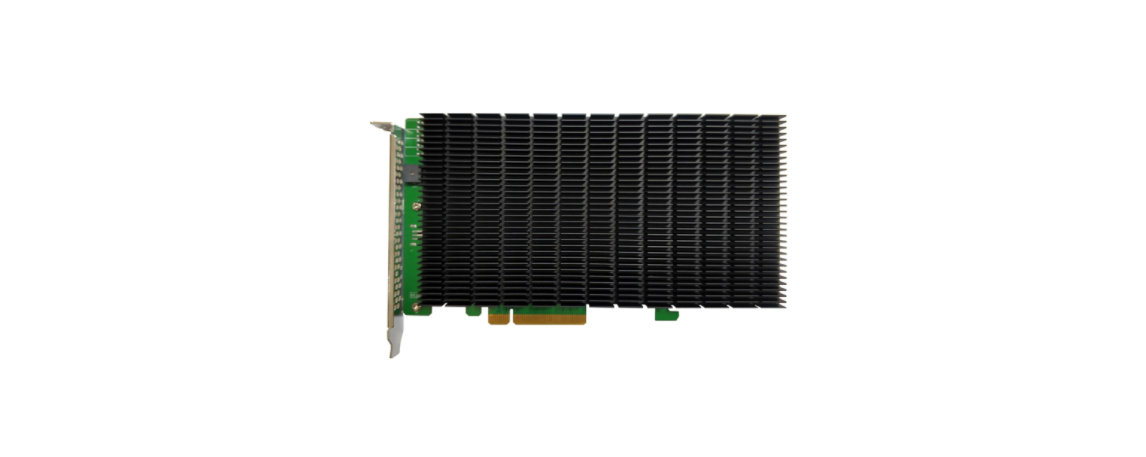

HIGHPOINT SSD7104/SSD7204 RAID Controller

Introduction
This guide includes hardware descriptions of the SSD7104 and SSD7204 NVMe RAID controllers, explains how to safely install NVMe SSDs into each HIGHPOINT SSD7104/SSD7204 RAID Controller card, and provides a series of Resource links for additional installation guides, compatibility lists, and software updates.
Kit Content
- SSD7104 Controller Card
- Quick Installation Guide
- SSD7204 Controller Card
- Quick Installation Guide
Data RAID Prerequisites
- You must have at least one NVMe SSD installed in the SSD7104/SSD7204 controller.
- The SSD7104 must be installed into a PCIe 3.0 and 4.0 x16 lanes.
- The SSD7204 must be installed into a PCIe 3.0 and 4.0 x8 or x16 lanes.
- Operating system
- Windows 10 / Windows 2016 / Windows 2019
- A Linux Distribution with Kernel 3.10 and later
- macOS 10.13 and later
- A motherboard that can support UEFI modes. Please check the SSD7104 Compatibility List and SSD7204 Compatibility List for recommended motherboards.
- SSD7104 Hardware
Front View
- SSD7204 Hardware
Front View
Installation
- On the rear of the SSD7204, remove the six screws that secure the unit’s heat sink to the PCB. After removing the screws, carefully remove the heat sink from the SSD7204.

- These 4 screws are used to install the NVMe SSDs. The SSD7204 can support any M.2 form factor (2242, 2260, 2280, and 22110).

- Please remove the screws on the right side of SSD7204

- Gently insert the SSD into the slot.

- Refasten the screw to secure the SSD. Repeat Steps 3 to 5 to install the remaining SSD.

The following example shows four SSD 970 EVO Plus installed into Ports 1 and .;
- Replace the heat sink after installing all SSDs
- On the rear of the SSD7204, refasten the six screws that were removed in step 1.

-
-
Resources
Various manuals, guides, and FAQs are available for the SSD7749M2NVMe RAID AIC. In addition, we recommend visiting the Software Downloads webpage for the latest drivers and RAID Management software.
- For Software Downloads, Documentation, and more product information
- Visit: https://www.highpoint-tech.com/nvme-individual/ssd7749m2
- FAQ & Troubleshooting
- Visit: http://helpjuice.com
-
Other Reference Information
SSD7104 User Guide – How To Set Up & Monitor RAID Array
SSD7204 User Guide – How To Set Up & Monitor RAID Array
FAQ & Troubleshooting
Customer Support
If you encounter any problems while utilizing the SSD7749M2 or have questions about this or any other HighPoint Technologies, Inc. product, feel free to contact our Customer Support Department.
- Web Support: https://www.highpoint-tech.com/support-and-services HighPoint Technologies, Inc.
- websites: https://www.highpoint-tech.com
FAQs
Q: What type of PCIe slot is required for these controllers?
Ans: Depending on the model, insert the controller into a Gen3 or Gen4 PCIe x16 slot. Steer clear of chipset-connected slots to guarantee maximum bandwidth.
Q: What kind of SSDs are supported?
Ans: Both controllers support M.2 NVMe SSDs (M-key, 2280 length). There is no support for SATA M.2 drives.
Q: Is RAID configuration hardware-based or software-based?
Ans: Using the built-in tools in HighPoint, you may construct and manage arrays that are RAID 0, 1, 5, 10, or JBOD.
Q: Can I use these controllers in HBA (non-RAID) mode?
Ans: Indeed. Both variants can function in pass-through mode, which exposes every SSD to the OS directly.
Q: Are these controllers hot-swappable?
Ans: It is not possible to hot-swap M.2 NVMe discs.
Q: Do these controllers require additional cooling?
Ans: Indeed. Both types have a significant heat-generating capacity while under load. To avoid thermal throttling, make sure there is active airflow across the GPU and SSDs.