

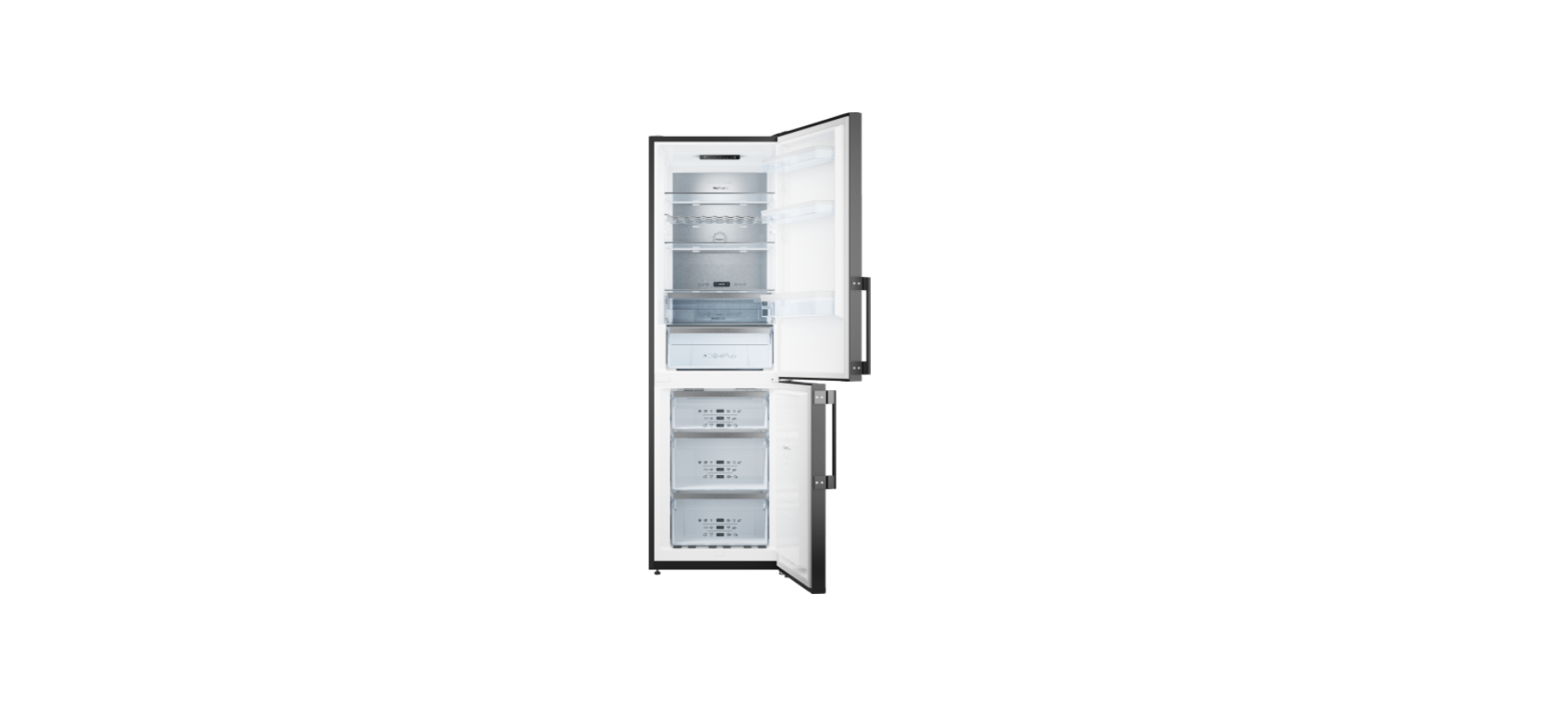

ASKO FN23841 Refrigerator With Freezer
Safety Instructions
- Never let children play with this device.
- Keep the cable away from hot surfaces.
- Never open the casing of the appliance.
- Never cover the ventilation openings.
- Do not use steam cleaners or high-pressure cleaners to clean the appliance, as this may result in an electric shock.
- In preparing meals containing alcohol, high temperatures may cause the alcohol to evaporate.
- The vapour can catch fire if it comes into contact with hot parts.
- Do not use the appliance for storing flammable materials or materials that warp easily.
- Do not use any abrasive cleaners or metal scrapers to clean the glass door.
- This will scratch the surface, which may cause the glass to break.
- Moisture/condensation or dirt can get between the windows through these openings.
- Use oven gloves or a pot-holder to remove dishes and accessories from the appliance.
- Only use the temperature probe recommended for this oven (for appliances having a facility to use a temperature-sensing probe).
- Remove all excess spillage and utensils before cleaning with the self-cleaning function.
- The lamp in this household appliance is only suitable for the illumination of this appliance.
- The lamp is not suitable for household room illumination.
- Before activating the automatic cleaning process, remove the grid, the spit roasting kit, glass baking trays, meat probe, and any other cookware that is not a part of the oven equipment.
- During the automatic cleaning process, the oven gets very hot on the outside.
- Do not allow children to clean or maintain the appliance unless supervised.
- Do not store anything of interest to children in cabinets above or behind the appliance.
Installation and connection
Selecting the location
- Place the appliance in a dry and wwell-ventilatedroom room.
- Do not place the appliance near a source of heat, such as a gas cooker, radiator, or boiler, etc., and do not expose it to direct sunlight.

- A kitchen cupboard above the refrigerator must have a gap of at least 5 cm between the back of the cupboard and the wall.
- The plug of the installed appliance must remain accessible!
- The appliance’s air outlet is at the top. Blocking the outlet can result in damage to the appliance.
- The appliance must stand level or tilted slightly to the back. It should be stable and have a solid base.
- The rear side of, casters allows for easier installation of the appliance (only with some models).

- After you have levelled the appliance using the adjustable feet, adjust the additional foot for extra stability of the appliance.
- To reach the rated/minimum power consumption, always provide 50 mm of clearance between the wall and the back of the appliance, and above the appliance. Also, allow adequate air circulation on either side of the appliance and above it.
- In case of such placement, the appliance will operate flawlessly; however, power consumption could increase. Observe the minimum clearance above and behind the appliance, as indicated in the figure.

Connecting the appliance
- Connect the appliance to the power supply with a plug.
- The appliance can withstand small variations in the mains voltage to a maximum of plus or minus 6%.
Side-by-Side kit
- There is a possibility of placing two appliances side-by-side.
- Using the dedicated side-by-side kit will ensure exact alignment, stabilization, and eliminate the possibility of excessive condensate accumulation between adjacent appliances.

Use
- Do not connect the appliance to the mains until you have carefully read the instructions for the correct and safe use of the appliance.
- As these instructions are for various types and models, the instructions ASKO FN23841 Refrigerator With Freezer for use may refer to settings or parts that are not available on your appliance.
- We recommend that you keep these instructions for future use. If you sell the appliance, enclose it with the appliance. Inspect the appliance for damage and/or irregularities.
- Allow the appliance to stand upright for at least 4 hours before you connect the appliance to the mains.
- This reduces the risk of malfunctions resulting from transport effects on the refrigerant unit.
- Wipe the cleaned parts with a cloth with clean water and then dry them thoroughly. If you use the appliance for the first time, do not put food into the appliance until the temperature has decreased to the set temperature.
Energy-saving advice
- Install the appliance as stated in the instructions for use.
- Do not open the door more than necessary.
- Never cover or obstruct the ventilation openings.
- Store food in well-sealed containers or suitable packaging.
- Allow food to cool to room temperature before you put it in the appliance.
- Defrost food in the refrigerator compartment.
- Defrost a conventional freezer once a layer of about 2 to 3 millimetres of frost or ice has formed on the inside.
- Space the shelves evenly in the refrigerator compartment.
- Place the food so that the air can circulate freely in the appliance.
- The lower the set temperature, the higher the power consumption.
Reversing the door opening direction
- Disconnect the appliance from the power mains before reversing the door opening direction.
Tools required
- Socket wrench No. 8,

- Cross-point screwdriver

- Flat screwdriver

- Spanner No. 8

- Torx T25

- Remove the top hinge cap (1).

- Undo the screws (2) and remove the hinge (3). Hold the door while doing this to prevent it from falling.

- Remove the door from the bottom hinge by carefully lifting the door straight up.


- Remove the cap (6) from the left side of the door. Then, remove the cap (7) from the right side of the door.

- Undo the screw (8) and remove the door retainer (10) and the door stop (9).

- Tilt the appliance backwards and remove the adjustable foot (11).
- Unscrew the pin (13) from the bottom hinge and screw it onto the opposite side of the hinge, complete with the extra foot (12).

- First, tighten screw 1, followed by screws 2. Then, screw on the adjustable feet (11).

- Place the door on the bottom hinge and use the screws (2) to attach the top hinge (3).


- Replace the upper hinge cap (1).

- Open the door and replace the door racks/shelves. Close the door again. Replace the handle.

Description
- Control panel
- LED lighting of freezer interior
- NoFrost freezer unit (cooling unit, fan …)
- Freezing and storage compartment
- Foot

NoFrost
- With the NoFrost system, you no longer need to defrost the freezer.
AdaptTech
- Innovative sensor technology allows adjusting appliance operation to the user’s habits or behaviour.
- An adaptive intelligent system monitors, analyzes, and records on a daily and weekly basis the use of the appliance and adapts the appliance operation to the perceived patterns.
- The appliance will also anticipate adding larger amounts of food into the refrigerator or freezer and adapt by cooling or freezing more intensively.
Operating the appliance
- A. Appliance on/off key
- B. Temperature and extra functions settings key
- C. Set temperature display.
- D. Intensive freezing (fast freeze) function indicator.
- E. Eco function indicator.

To set the appliance temperature or activate the Eco function, press the B key successively. The indicator cycles through the settings circularly, from right to left. To activate or deactivate intensive freezing (freezer boost), press the B key and hold it for a few seconds.
Switching on the appliance
- Press the A key.
- Press the A key again and hold it for 2 seconds. The appliance will be switched off, but it will remain powered.

Adjusting the temperature in the appliance
The factory default setting is the recommended temperature of -18 °C. After the appliance is switched on, it may take several hours for the set temperature to be reached. Do not place any food into the refrigerator before the temperature drops to the selected setting.
- Set the desired temperature using the B key.
- Set the desired temperature by successively pressing the B key.
- The indicator cycles through the settings circularly, from right to left.

- The numbers -16, -18, -19, -20, -22, and -24 indicate the temperature in degrees Celsius (°C) in the appliance.

- We recommend setting the temperature to -18 °C, as this will preserve food quality and freshness longer.
- If the temperature of the room where the appliance ASKO FN23841 Refrigerator With Freezer is installed is below 16 °C, we recommend setting a temperature lower than -18°C.
Intensive freezing (super freeze) function
Use this setting after switching on the appliance for the first time, before cleaning, or 24 hours before adding a large amount of food
Switching on
- To activate intensive freezing, press the B key and hold it until the light D lights up.

Switching off
- Press and hold the B key again until the light D goes off. If the intensive freezing function is not deactivated manually, it will be automatically switched off (after approximately two days), and the temperature will return to the most recently set value.
- If there is a power outage while the intensive freezing function is active, the function will be restarted once the power supply is restored.
Eco function
Switching on
- To activate the Eco function, press the B key multiple times until the light E lights up. When this function is activated, the appliance operates under optimum settings.
Switching off
- To switch off the Eco function, use the B key to select the desired temperature.
High temperature alarm
- If the temperature inside the appliance is too high, the acoustic alarm will be activated (intermittent tone) and the signal light below the set ASKO FN23841 Refrigerator With Freezer temperature (°C) will flash.
- Every time you switch on the appliance using ASKO FN23841 Refrigerator With Freezer the A key, a 24-hour delay in alarm operation is activated. If the appliance fails to reach a sufficiently low temperature after this period, the alarm will be activated.
Switching off the alarm
- To acknowledge and switch off the acoustic alarm, press the B key. If the alarm is not switched off, it will be activated every hour for approximately 15 minutes.
- When you press the B key again, it will already work as a settings adjustment key.
- The light below the set temperature C will flash until the appliance reaches a sufficiently low temperature.
Open door alarm
- If the appliance door is open for more than 2 minutes, an acoustic alarm (repetitive beep) will be activated. If the alarm is not switched off manually, it will sound for 10 minutes.
To switch off the alarm
-
- To switch off the alarm, close the appliance door.
- If you switch off the alarm by pressing the B key, it will be activated again after 4 minutes if the door is still open.
- If you leave the door open for more than 10 minutes, then the alarm will stop, and the indicator light above the “–16°” indicator will start flashing. Appliance operation will switch to safe mode to provide sufficient cooling and prevent food spoilage despite the open door.
Storing and freezing food
Recommended distribution
- The best location for freezing fresh food is marked.

- Do not store lettuce, eggs, apples, pears, grapes, peaches, yoghurt, buttermilk, sour cream, or mayonnaise in the freezer.
Avoid contamination of food.
- Opening the door for long periods can cause ASKO FN23841 Refrigerator With Freezer a significant increase in the temperature in the compartments of the appliance.
- If the refrigerating appliance is left empty for long periods, switch off, defrost, clean, dry, and leave the door open to prevent mould developing within the appliance.
Freezing and storing food in the freezer
- Use only good-quality fresh food that is suitable for freezing.
- Allow hot food to cool to room temperature.
- Food needs to be frozen quickly. It is recommended that you use small packs.
- Use air and watertight packaging to prevent the food from drying out and losing its vitamins.
- Note the type and quantity of the food on the packaging, together with the date on which it was frozen.
- Do not allow fresh food to come into contact with frozen food.
- You can remove all the drawers to make use of the total volume of the freezer compartment. Put the food directly on a shelf and the base of the freezer.
Freezing large quantities of fresh food
- Activate the intensive freezing function 24 hours before you plan to freeze the food. To make sure the food freezes as quickly as possible, lay out the packages as described below:
- Divide fresh food into smaller packages (1 kg). Place two packages against the back wall along the left and right edges of the upper drawer, one package in the middle in front of them (also in the upper drawer), and one package in the middle drawer, against the middle of the back wall.
Important recommendations for storing frozen food
- Follow the manufacturer’s instructions for the storage and use of frozen food. Take note of the recommended storage temperature and use-by date stated on the packaging.
- Use only food in undamaged packaging that has been stored at a temperature of -18 °C or lower.
- Do not buy food covered in frost. This indicates that the food has thawed or partially thawed several times and, as a result, is of inferior quality.
- Make sure that the food does not thaw ASKO FN23841 Refrigerator With Freezer during transport. An increase in its temperature will shorten the storage life and harm the quality of the food. Recommended storage times of frozen food in the freezer.

Thawing frozen food
- Thawing is an important step in storing food preserved by freezing.
- Food must be thawed in the correct way.
- Some frozen products can be prepared without needing to thaw them first.
- The manufacturer will state this on the packaging.
- The food needs to be packed in small portions. In this way, the food thaws faster.
- Use partially or completely thawed food as quickly as possible.
- The bacteria in thawed food are reactivated, and the food will spoil rapidly.
- This applies in particular to fruit, vegetables, and ready-made food.
- Do not refreeze partially or completely thawed food.
Maintenance
Defrosting
The NoFrost freezer defrosts automatically. Any frost deposits will then disappear.
- A layer of frost could build up on the appliance walls despite the NoFrost feature.
- This is usually a result of abnormal use of the appliance, such as too frequent door opening, leaving the door open for too long, poor door seal, etc.
- Simultaneously press the A and B keys and hold them (10 seconds.

Cleaning the appliance
- Switch off the appliance and remove the plug from the socket before you start cleaning it.
- Do not use abrasive cleaning agents, as they can damage the surface.
- Do not use abrasive cleaning agents, as they can damage the surface.
- Regularly clean the interior of the appliance with lukewarm water.
- If so required, add a neutral cleaning agent or special refrigerator cleaner to the water.
- Clean all surfaces with a soft cloth. Wipe the cleaned parts with a cloth with clean water and then dry them thoroughly.
- Do not put parts of the appliance in a dishwasher: this could damage them.
- Empty, defrost, and clean the appliance, and leave the door ajar.
Troubleshooting


Disposal
Ask your local authorities for more information about how to do this. A separate collection of household appliances helps to prevent any potential negative impact on the environment and human health caused by improper disposal.
- cardboard;
- polyethylene film (PE);
- CFC-free polystyrene (PS rigid foam).
Customer Service
- Address: ASKO Appliances Pty Ltd – 35 Sunmore Close – MOORABBIN VIC 3189
- Phone: 1300 00 2756
- Fax: 03 8551 2220
- Email: sales@asko.com.au – https://au.asko.com