

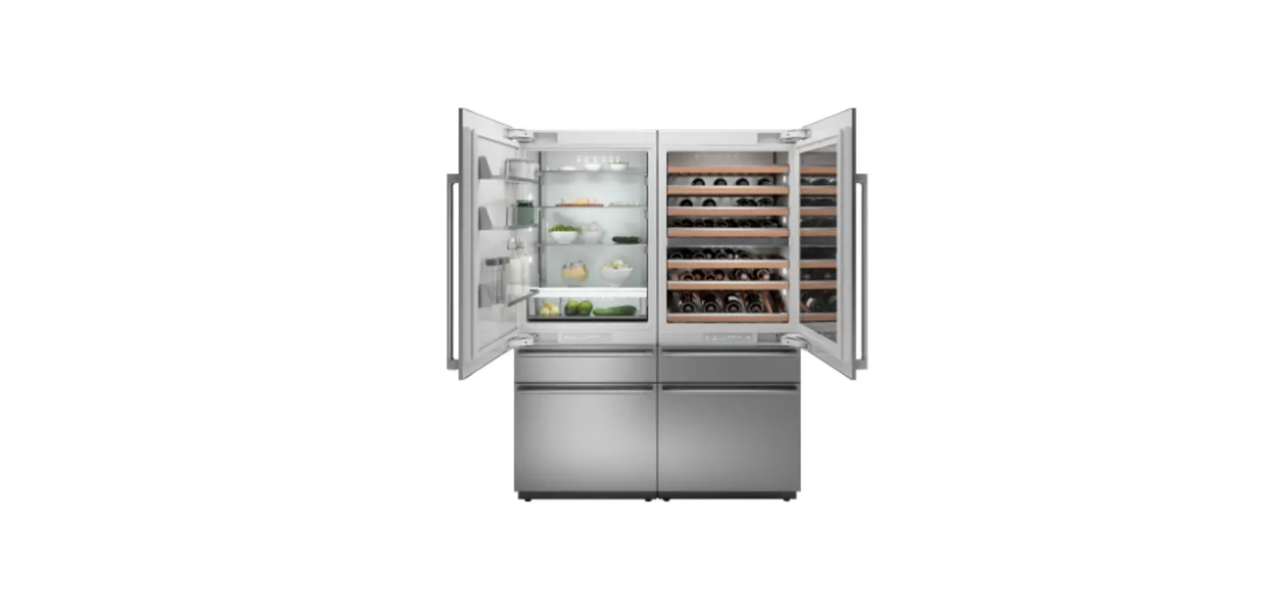

ASKO R23841 Refrigerator With Freezer
Introduction
Before connecting the appliance to the power mains, please read carefully the instructions for use, which describe the appliance and its correct and safe use. Check for any damage or irregularities on your appliance.
Safety Instructions
- Do not locate multiple portable socket-outlets or portable power supplies at the rear of the appliance.
- Before cleaning the appliance, unplug it from the power mains (unplug the power cord from the wall outlet).
- To avoid freeze burn, never put frozen food in your mouth, and do not touch frozen food.
- Children shall not play with the appliance.
- staff kitchen areas in shops, offices, and other working environments;
- farm houses and by clients in hotels, motels, and other residential-type environments;
- bed and breakfast type environments;
- catering and similar non-retail applications.
Technical information on the appliance
It indicates data on voltage, gross and net volume, type and amount of refrigerant, and information on the climate classes. If the language on the rating plate is not the language of your choice or the language of your country, replace it with the one supplied.
Installation and Connection
Selecting the location
- Place the appliance in a dry and well-ventilated room. Do not place the appliance near a source of heat, such as a gas cooker, radiator, or boiler, etc., and do not expose it to direct sunlight.

- A kitchen cupboard above the refrigerator must have a gap of at least 5 cm between the back of the cupboard and the wall.
- The plug of the installed appliance must remain accessible!
- The appliance’s air outlet is at the top. Blocking the outlet can result in damage to the appliance.

- The appliance must stand level or tilted slightly to the back. It should be stable and have a solid base.
- On the rear side, casters allow for easier installation of the appliance (only with some models).
- After you have levelled the appliance using the adjustable feet, adjust the additional foot for
extra stability of the appliance. - To reach the rated/minimum power consumption, always provide 50 mm of clearance between the wall and the back of the appliance, and above the appliance.
- Also, allow adequate air circulation on either side of the appliance and above it.
- In case of such placement, the appliance will operate flawlessly; however, power consumption could increase.
- Observe the minimum clearance above and behind the appliance, as indicated in the figure.

- depending on the model
- model with integrated handle
- model with external/protruding handle
Connecting the appliance
- Connect the appliance to the power supply with a plug.
- The appliance can withstand small variations in the mains voltage to a maximum of plus or minus 6%.
Side-by-Side kit
There is a possibility of placing two appliances side-by-side. To ensure the proper fitting and long-lasting operation of two appliances installed side-by-side, the dedicated kit should be used. Using the dedicated side-by-side kit will ensure exact alignment, stabilization, and eliminate the possibility of excessive condensate accumulation between adjacent appliances.
Use
Do not connect the appliance to the mains until you have carefully read the instructions for the correct and safe use of the appliance. As these instructions are for various types and models, the instructions for use may refer to settings or parts that are not available on your appliance. We recommend that you keep these instructions for future use.
If you sell the appliance, enclose it with the appliance. Inspect the appliance for damage and/or irregularities. If the appliance is damaged, contact the store that sold you the appliance. Allow the appliance to stand upright for at least 4 hours before you connect the appliance to the mains.
This reduces the risk of malfunctions resulting from transport effects on the refrigerant unit. Wipe the cleaned parts with a cloth with clean water and then dry them thoroughly. If you use the appliance for the first time, do not put food into the appliance until the temperature has decreased to the set temperature.
Energy-saving advice
- Install the appliance as stated in the instructions for use.
- Do not open the door more than necessary.
- Never cover or obstruct the ventilation openings.
- Replace a door seal that is damaged or no longer seals properly as quickly as possible.
- Store food in well-sealed containers or suitable packaging.
- Allow food to cool to room temperature before you put it in the appliance.
- Defrost food in the refrigerator compartment.
- Defrost a conventional freezer once a layer of about 2 to 3 millimetres of frost or ice has formed on the inside.
- Space the shelves evenly in the refrigerator compartment. Place the food so that the air can circulate freely in the appliance (follow the recommendations for the location of foods enclosed in the instructions).
- The lower the set temperature, the higher the power consumption.
- When the appliance is equipped with a fan then make sure that the ventilation openings are kept clear.
Reversing the door opening direction
The direction in which the appliance door opens can be reversed.
Tools required
- Socket wrench No. 8,
- Cross-point screwdriver
- Flat screwdriver
- Spanner No. 8
- Torx T25
Installation
- Place the appliance in an upright position. Open the door and remove the door racks (to prevent damaging them during the procedure). Then, close the door.

- Remove the top hinge cap (1).

- Undo the screws (2) and remove the hinge (3). Hold the door while doing this to prevent it from falling.

- Remove the door from the bottom hinge by carefully lifting the door straight up. Lay the door onto a smooth surface.

- Take the (right) cap/cover (4) from the bag and place it on the spot from which the top hinge was removed.

- Remove the cap (6) from the left side of the door. Then, remove the cap (7) from the right side of the door.

- Undo the screw (8) and remove the door retainer (10) and the door stop (9).

- Tilt the appliance backwards and remove the adjustable foot (11).

- Undo the three screws on the bottom hinge (14) and remove it.

- Attach the hinge (14) onto the opposite side using the screws.

- Place the door on the bottom hinge and use the screws (2) to attach the top hinge (3).

- Replace the upper hinge cap (1).

- Open the door and replace the door racks/shelves. Close the door again.

- Remove the top hinge cap (1).
Description of the appliance
This product contains a light source of energy efficiency class G.
- Control panel
- LED lighting
- CoolFlow*
- Bottle rack
- Glass shelves
- Slider for converting the MultiZone drawer into a fruit and vegetables bin *
- Drawer MultiZone *
- Fruit and vegetable drawer with humidity control *
- Fruit and vegetables drawer
- Door compartments
- Foot
CoolFlow
- This system creates optimal air circulation to keep the temperature constant throughout the entire refrigerator compartment. The openings around the fan may never be covered or obstructed.
Shelf
You can lay out the empty shelves to your liking across the guides in the refrigerator interior without having to remove them from the refrigerator. To move the shelf or take it out of the refrigerator, slightly lift it at the back, pull it towards you, and then either move it or take it out of the appliance. Store quickly perishable food at the back of the shelf where the temperature is the lowest.
Bottle rack
- Some models also feature a wire bottle rack. It is protected against being inadvertently pulled out. It can only be pulled out when it is empty. To pull it out, lift it slightly at the back and pull it towards you. Place the bottle rack so that the length of the bottles does not hinder the proper closing of the door. The holder can take a maximum load of nine 0.75-litre bottles or 13 kilograms of total weight – see label on the right side in the appliance interior.
- Cans may also be placed on the bottle rack (lengthwise or crosswise).
Fruit and vegetable drawer with humidity control
- The drawer at the bottom of the refrigerator is intended for storing fruit and vegetables. It provides humidity and prevents the food from drying out.
- The humidity in the drawer is regulated automatically, depending on the type and amount of food inserted.
- Pulling out the bin: To remove a drawer, pull out the drawer as far as it will go (1). Then, lift the front part (2) and pull it out completely.
MultiZone drawer
The MultiZone compartment allows storing a wide variety of fresh food for up to three times longer than in a conventional refrigerator. The food stays fresh longer, retaining the flavour and nutrients.
The temperature in this drawer depends on the temperature settings in the refrigerator compartment, the environmental temperature, the frequency of door opening, and the amount of food placed in it.
For a temperature around 0 °C in the MultiZone drawer, we recommend setting the refrigerator compartment temperature to 4 °C or lower. Temperature in the ZeroZone drawer may fall below 0 °C. Therefore, place the temperature-sensitive food in the upper parts of the refrigerator.
For optimum performance
- When buying food, make sure it is fresh, as this will determine the quality of the food, as well as how long it will keep in the fridge.
- Store the food in closed containers or appropriate packaging to prevent it from emitting or receiving odours and humidity.
- Take the food from the drawer 30 to 60 minutes before use to allow the aroma and flavour to develop at room temperature.
- Food sensitive to low temperature and not appropriate for storage in the MultiZone drawer include the following: pineapple, avocado, bananas, olives, potatoes, eggplant, cucumbers, beans, peppers (capsicum), melons, watermelons, pumpkins, squash, zucchini, etc.
- To remove the drawer. Pull out the drawer until it is blocked. Lift it at the front and pull it out completely

Turning the MultiZone drawer into a fruit and vegetables drawer
- If you find you need extra space for your fruit and vegetables, you can turn your MultiZone drawer into a fruit and vegetables drawer.
- To do this, use the slider as follows. To use the drawer as a MultiZone: push the slider to the right. To use the drawer as a fruit and vegetables drawer: move the slider to the left.

Door racks
The interior side of the refrigerator door is fitted with shelves intended for storing cheese, butter, eggs, yoghurt, and other smaller packages, tubes, cans, etc.
You may lay out the racks as desired by lifting them slightly from the grooves that hold them in place and moving them to the desired spot, making sure to fit them in the grooves there. The bottom rack is intended for storing bottles. The maximum load on each door shelf is 5 kg.
CoolFlow
The advanced CoolFlow fan system evenly distributes the temperature throughout the entire refrigerator. Air mimics the natural microclimate that keeps the food fresh for longer. This system also allows placing any type of food on any shelf in the fridge, as there are no temperature differences between them.
AdaptTech
Innovative sensor technology allows adjusting appliance operation to the user’s habits or behaviour. An adaptive intelligent system monitors, analyzes, and records on a daily and weekly basis the use of the appliance and adapts the appliance’s operation to the perceived patterns.
If the appliance is able to anticipate an increased frequency of door opening, the appliance will automatically lower the temperature before such time to prevent the increase of food temperature as the door is opened more often. The appliance will also anticipate adding larger amounts of food into the refrigerator or freezer and adapt by cooling or freezing more intensively.
Operating the appliance
- Appliance on/off key
- Temperature and extra functions settings key
- Set temperature display. The signal light below the set temperature display is lit
- Intensive cooling (super cool) function indicator. If intensive cooling (super cool function) is activated, the light D will be lit.
- Eco function indicator: If the Eco function is activated, the signal light above the E symbol will be lit.
To set the appliance temperature or activate the Eco function, press the B key successively. The indicator cycles through the settings circularly, from right to left. Three seconds after the key is released, the setting will be stored automatically. To activate or deactivate intensive cooling, press the B key and hold it for a few seconds.
Switching the appliance on/off
- Switching on the appliance: press the A key.
- Switching off the appliance: Press the A key again and hold it for 2 seconds. The appliance will be switched off, but it will remain powered.
Adjusting the temperature in the appliance
The factory default setting is the recommended temperature of 4 °C. After the appliance is switched on, it may take several hours for the set temperature to be reached. Do not place any food into the refrigerator before the temperature drops to the selected setting.
- Set the desired temperature using the B key.
- Set the desired temperature by successively pressing the B key.
- The indicator cycles through the settings circularly, from right to left.
The numbers 2, 3, 4, 5, 6, and 8 indicate the temperature in degrees Celsius (°C) in the appliance.
- The recommended temperature setting is 4 °C. At this temperature, food quality and freshness are preserved longer.
- If the temperature of the room where the appliance is installed is below 16 °C, we recommend setting a temperature lower than 4 °C.
Intensive cooling
Use this setting after switching on the appliance for the first time, before cleaning, or 24 hours before inserting a large amount of food.
- Switching on: To activate intensive cooling, press the B key and hold it until the light D lights up.
- Switching off: press and hold the B key again until the light D goes off.
Eco function
- Switching on: To activate the Eco function, press the B key multiple times until the ASKO R23841 Refrigerator With Freezer light E lights up.
- Switching off: To switch off the Eco function, use the B key to select the desired temperature.
High temperature alarm
Every time you switch on the appliance using the A key, a 24-hour delay in alarm operation is activated. If the appliance fails to reach a sufficiently low temperature after this period, the alarm will be activated.
Switching off the alarm
- To acknowledge and switch off the acoustic alarm, press the B key.
- When you press the B key again, it will already work as a settings adjustment key.
- The light below the set temperature C will flash until the appliance reaches ASKO R23841 Refrigerator With Freezer a sufficiently low temperature.
Open door alarm
If the appliance door is open for more than 2 minutes, an acoustic alarm ASKO R23841 Refrigerator With Freezer (repetitive beep) will be activated. If the alarm is not switched off manually, it will sound for 10 minutes.
- To switch off the alarm: to switch off the alarm, close the appliance door.
Storing food
Sections of the refrigeration compartment
- Upper section: canned food, bread, wine, and pastas, etc.
- Middle section: dairy products, ready-to-cook meals, desserts, soft drinks, beer, and cooked food etc.
- Lower section: meat, meat products, and delicatessen.
Sections of the door
- Top/middle door compartment: eggs, butter, cheese, and sauces, etc.
- Bottom door compartment: drinks, cans, and bottles, etc.
Avoid contamination of food
To avoid contamination of food, please respect the following instructions:
- Opening the door for long periods can cause a significant increase in the temperature in the compartments of the appliance.
- Regularly clean surfaces that can come in contact with food and ASKO R23841 Refrigerator With Freezer accessible drainage systems.
- Store raw meat and fish in suitable containers in the refrigerator, so that it is not in contact with or drip onto other food.
Storing fresh food in the refrigerator
Important recommendations for storing fresh food
- To ensure the quality of fresh food, it is important that. The appliance is at the correct temperature. The appliance is clean.
- Take good note of the use-by date stated on the food packaging.
- Put food in the refrigerator in sealed containers or suitable packaging. This will prevent the food from picking up or spreading odours and will keep it dry.
- Do not store flammable, unstable, or explosive materials in the refrigerator.
- Some organic solutions, such as essential oils in the skin of lemons and oranges, and butyric acid, that come into long-term contact with plastics, can eat into the material and cause premature ageing.
- A disagreeable odour is an indication that the appliance is not clean or that it contains food that has spoiled (see the chapter ‘Maintenance’).
- Take perishable foods out of the refrigerator when you ASKO R23841 Refrigerator With Freezer will be away from home for a longer time.
Maintenance
Defrosting the appliance
- Switch off the appliance and remove the plug from the socket before you start cleaning it.
- Do not use abrasive cleaning agents, as they can damage the surface.
- Regularly clean the interior of the appliance with lukewarm water.
- If so required, add a neutral cleaning agent or special refrigerator cleaner to the water.
- Clean all surfaces with a soft cloth. Wipe the cleaned parts with a cloth with clean water and then dry them thoroughly.
- Do not put parts of the appliance in a dishwasher: this could damage them.
- Occasionally, clean it using a soft non-metal brush or a vacuum cleaner.
Faults table
Problem
- The cooling system operates continuously for a long period.
- Excessive build-up of ice on the back wall of the refrigerator interior can be a result of the following.
- LED lighting does not work.
- The light below the set temperature display is flashing.
- The signal light below the D or E indicator is flashing.
- The light below the “3°” indicator is flashing.
- The light below the “4°” indicator is flashing.
Cause/Solution
- The door opened too frequently or too long. Food or containers in contact with the back interior wall of the refrigerator. Poor door sealing. If the seal is dirty or damaged, clean or replace it.
- If LED lighting does not work, call a service technician. Do not attempt a repair of the LED lighting yourself, as there is a danger of contact with high voltage!
- The door opened too frequently or too long. Door not closed correctly (possible impurities on the seal, misaligned door, damaged seal, etc.). An extended power failure.
- Sensor keys are not responding. Call a service centre for repair. The appliance will automatically maintain the most suitable temperature.
- Temperature sensor error or fault. Call a service centre for repair. The appliance will automatically maintain the most suitable temperature.
- Compartment fan failure. Call a service centre for repair. The appliance cannot operate normally. Transfer the food to a cool place and switch off the appliance.
- Condenser compartment fan failure. Call a service centre for repair. The appliance cannot operate normally. Transfer the food to a cool place and switch off the appliance.
Disposal of packaging and appliances
Contact the local authorities for information about the method.
-
- Cardboard.
- Polyethylene foil (PE).
- CFC-free polystyrene (hard PS foam).
Collecting and disposing of domestic appliances separately avoids detrimental consequences for humans and the environment.
Declaration of conformity
We hereby declare that our products conform to the applicable European Directives, Regulations, and requirements, as well as all requirements in the standards to which reference is made.
FAQs
Q: What type of appliance is the ASKO R23841?
Ans: With multi-zone cooling, sophisticated temperature management, and energy-efficient operation, the ASKO R23841 is a freestanding refrigerator with a bottom-mounted freezer that is ideal for effective food preservation.
Q: Is the ASKO R23841 frost-free?
Ans: Indeed. Both the freezer and the refrigerator have NoFrost technology, which keeps frost from accumulating and does away with the need for regular defrosting.
Q: Can I reverse the door swing?
Ans: Indeed. Switching the door hinge from right to left (or vice versa) is possible with the ASKO R23841’s reversible door installation feature.
Q: How long does it take to reach optimal cooling after installation?
Ans: After turning on, wait six to eight hours for the freezer and refrigerator to achieve their proper temperatures before adding food. During setup, turn on the SuperCool and SuperFreeze features for quicker cooling.
Q: Can I install the ASKO R23841 in a garage or unheated space?
Ans: With a climate class SN-T rating, this appliance performs best in temperatures between +10°C and +43°C. Avoid putting it in uninsulated outdoor kitchens or unheated garages.
Q: How often should I clean the condenser or ventilation grille?
Ans: Vacuum the back ventilation grille every six to twelve months to keep it operating efficiently and avoid dust accumulation. Before cleaning, always unplug the appliance.
Q: Can I use an extension cord or adapter?
Ans: Avoid using multi-plug adapters, power strips, and extension cords.